




 CC-BY 4.0
1. Introduction
Reconstructing paleoclimate and paleo-salinity remains a key challenge in Earth sciences, providing crucial insights into past environmental conditions and their role in shaping the evolution and distribution of life (Chraiki et al., 2023; Liu et al., 2025; Sun et al., 2022; Wei and Algeo, 2020; Ye, Yang, Fang, Zhang, et al., 2020). Although paleosalinity proxies are well established in younger systems (Chen et al., 2025; Gilleaudeau et al., 2021; Sun et al., 2022; Ye, Yang, Fang, Zhang, et al., 2020), reconstructing salinity in ancient settings such as the Proterozoic is far more challenging because original geochemical signals may be overprinted by late diagenesis and because secular variations in trace-element concentrations and clay-mineral assemblages can obscure the primary salinity imprint (Liu et al., 2025). The 2.1 Ga Francevillian Paleoproterozoic Series of Gabon (Ikouanga, Reisberg, et al., 2024) is particularly significant in this regard, as it hosts some of the oldest macroscopic fossils (El Albani, Bengtson, Canfield, Bekker, et al., 2010) interpreted as one of the first evidences for early multicellular life on Earth (Chi Fru, Aubineau, et al., 2024; El Albani, Bengtson, Canfield, Riboulleau, et al., 2014; El Albani, Mangano, et al., 2019; El Albani, Konhauser, et al., 2023; El Khoury, Somogyi, et al., 2025; El Khoury, Saleh, et al., 2025; F. Ossa Ossa et al., 2023). Understanding the depositional environment of these successions is therefore crucial for accurately placing the biogenic record into its proper paleoenvironmental context. This will allow new insights into how life emerged and evolved on Earth.
Within the Francevillian basin, the FB2 unit has attracted sustained attention because it preserves fossil-bearing black shales. The lower part, the Poubara sandstones (FB2a) (Weber, 1968), has been variably interpreted as offshore bars (Azziley Azzibrouck, 1986), a shoreface system (Pambo et al., 2006), deltaic deposits (Dubois et al., 2017; Gauthier-Lafaye, 1986; F.-G. Ossa Ossa, 2010), or high-density turbidites deposited below storm-wave base (Parize et al., 2013). Sequence stratigraphic studies and redox studies suggest that these sandstones record regressive conditions, with interbedded shales deposited in the same general setting (Canfield et al., 2013; Reynaud et al., 2018).
The overlying FB2b black shales, which contain the macrofossil assemblages, have given rise to equally diverse interpretations. They have been described as recording an anoxic lagoon (Azziley Azzibrouck, 1986), a prodelta environment (Gauthier-Lafaye, 1986; F.-G. Ossa Ossa, 2010), a storm-dominated shelf (Pambo et al., 2006), or deep-water turbidites (Parize et al., 2013). More recently, the discovery of load casts, liquefaction features and microbial mat textures has supported an alternative view: rapid fluid–mud deposition in shallow-water conditions (<80–100 m), consistent with euphotic setting (Aubineau, El Albani, Chi Fru, Gingras, et al., 2018; Reynaud et al., 2018), but all with a priori marine environment.
Taken together, these contrasting models highlight the complexity of reconstructing the depositional history of the FB2 unit. While facies analysis and sequence stratigraphy have been central to this debate, one environmental parameter has remained largely overlooked: paleosalinity. Salinity reflects basin-scale hydrological conditions and freshwater–marine mixing dynamics. Although it exerts only limited direct control on sedimentary processes (Mulder et al., 2003), it remains a key parameter for constraining depositional environments and water–mass connectivity. In this work, we examine paleosalinity across several sections of the Francevillian Series, with a particular focus on the fossiliferous FB2b interval. By applying geochemical proxies, including S/TOC, B/Ga, Sr/Ba and Y/Ho, we aim to refine interpretations of depositional environments and to better constrain the paleoenvironmental conditions under which the Francevillian macrobiota were preserved.
2. Geological setting
The Francevillian basin belongs to a well-known Paleoproterozoic lithostratigraphic succession that outcrops across 35 000 km2 in southeastern Gabon. It is only slightly deformed and show no evidence of metamorphic transformation (Bankole, El Albani, Meunier and Gauthier-Lafaye, 2015; Gauthier-Lafaye, Holliger, et al., 1996; Ikouanga, Fontaine, et al., 2023; Ngombi-Pemba et al., 2014). It consists of several lithostratigraphic formations, designated as Francevillian (F) FA to FE (Figure 1) (Weber, 1968).
Synthetic lithostratigraphic column of Francevillian Series (modified form Aubineau, 2019; Ngwal’ghoubou Ikouanga, 2022). The fossil symbol indicates the fossiliferous subunit.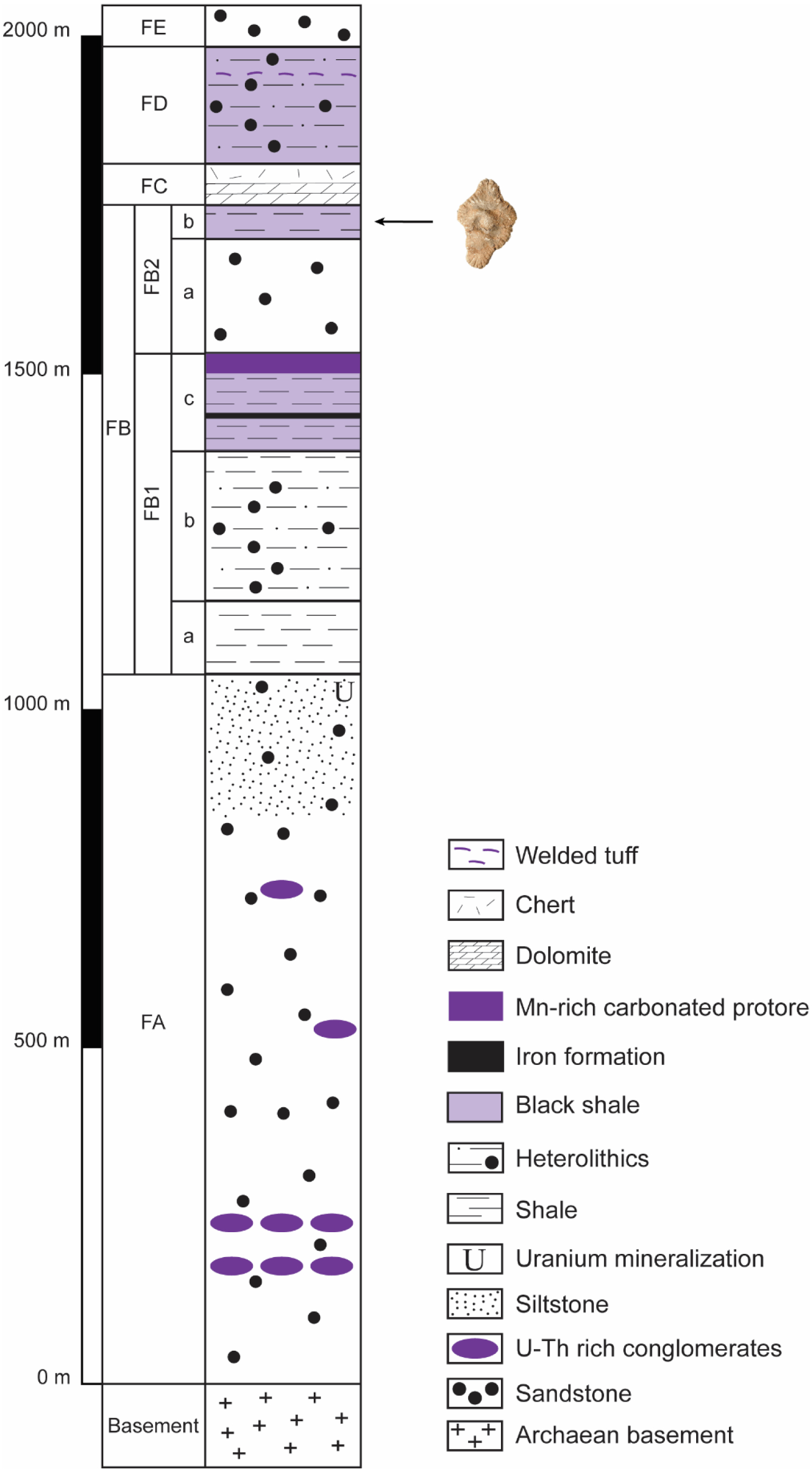
The FA Formation primarily comprises fluvial and deltaic coarse-grained sandstones but also contains red radioactive U–Th rich conglomerates and some interlayered siltstones indicating a progressive marine invasion (Bankole, El Albani, Meunier, Poujol, et al., 2020; Bankole, El Albani, Meunier and Gauthier-Lafaye, 2015). Its thickness ranges from 100 to >1000 m, from the proximal to the distal part of the basin. This Formation rests unconformably on Archean basement rocks (Weber, 1968). At the top, it contains uranium enrichments associated with bitumen and the notable Oklo natural nuclear reactors (Gauthier-Lafaye and Weber, 1989).
The FB Formation is composed mainly of marine sediments deposited below the storm wave base that are discordantly overlyfluvial to deltaic FA Formation. Its thickness ranges from 400 to 1000 m (ibid.) and contains up to 15 wt% organic intervals (Canfield et al., 2013). This Formation is further subdivided lithologically into FB1 and FB2 members with the FB1 Member divided into the FB1a–c units and the FB2 Member into FB2a–b units (Azziley Azzibrouck, 1986). In this scheme, the FB1a–b units consist of interlayered shales, sandstones, and conglomerates that transition into predominantly shales at the top while the FB1c unit consists primarily of shales, with a thin iron formation overlain by black shales and a manganese-rich interval, formed by the weathering of Mn-rich carbonate layers known as protore (Azziley Azzibrouck, 1986; Reynaud et al., 2018; Weber, 1968). The FB2a unit includes dominantly “Poubara” coarse-grained sandstone beds deposited during sea level fall (Reynaud et al., 2018). This unit is sharply overlain by the FB2b unit, characterized by finely laminated black shales interbedded with thin siltstone layers deposited by waning storm surges (Weber, 1968). It contains remarkable specimens that are partially to completely pyritized and non-pyritized macrofossils found abundantly in the black shales (El Albani, Bengtson, Canfield, Bekker, et al., 2010; El Albani, Bengtson, Canfield, Riboulleau, et al., 2014; El Albani, Mangano, et al., 2019). Fossil abundance decreases towards the top of the section, where silty and sandy beds are more common. In the fossiliferous quarry, the FB2b black shales are 5 m thick and were deposited in a quiet, low-energy marine environment from a fully oxygenated water column (Canfield et al., 2013). While macrofossils are only found in the FB2b unit, microbial mat structures can be found in all the FB2 Member (Aubineau, El Albani, Chi Fru, Gingras, et al., 2018; Dubois et al., 2017).
The FC Formation is dominated by massive dolomites, indicative of shallow-water evaporitic depositional conditions (Préat et al., 2011; Weber, 1968). It also contains stromatolitic cherts with interlayered black shales at its base (Bertrand-Sarfati and Potin, 1994) hosting Gunflint-type assemblage of microfossils (Lekele Baghekema et al., 2017). This Formation varies between 5 and 40 m in thickness and is perceived as a lithostratigraphic marker since it is ubiquitous in the Franceville basin (Thiéblemont et al., 2014).
The FD Formation corresponds to black shales deposits interbedded with volcanic tuffs and fine- to medium-grained sandstones (ibid.). It does not really differ from the FB Formation, however, the occurrence of silica-rich FC rocks (i.e., cherts) allows distinguishing between the FB and the FD Formations. These sediments were settled in a near-continental margin, during a transgressive phase (Canfield et al., 2013; Chi Fru, Somogyi, et al., 2019). They are highly enriched in organic content (up to 10 wt%) and very depleted in 13C, suggesting the incorporation of methanotroph-derived organic matter (Weber and Gauthier-Lafaye, 2013).
The FE Formation has been predominantly eroded across the basin. However, it can be identified in some restricted geographical extensions and consists of medium-grained arkose with interlayered shales (Gauthier-Lafaye and Weber, 1989; Thiéblemont et al., 2014). It is considered a localized filling of depressions through weathering of the Ogooué orogenic belt (Thiéblemont et al., 2014).
3. Materials and methods
Samples were collected from the Moulende quarry, as well as several core drills in the Francevillian Basin. Selected 218 samples (39 FB1b, 78 FB1c, 21 FB1a, 47 FB2b, 20 FC and 13 FD) were powdered in agate mortar, and analyzed for whole-rock major, minor and trace element compositions including CaO, B, Ga, Sr, Ba, Y and Ho at the Service d’Analyse des Roches et des Minéraux (SARM; CRPG-CNRS, Nancy, France). Detection limits were 0.03% for CaO, 2 ppm for B, 0.2 ppm for Ga, 1.5 ppm for Sr, 8 ppm for Ba, 0.1 ppm for Y and 0.003 ppm for Ho as reported by SARM analytical standards. The whole-rock powder of ∼100 mg of each sample was fused with a lithium metaborate (LiBO2) and dissolved in nitric acid for elemental analysis. Major and trace element data were obtained using inductively coupled plasma atomic emission spectrometry (ICP-AES) and inductively coupled plasma mass spectrometry (ICP-MS), respectively, following the techniques described in Carignan et al. (2001). Total sulfur (S) and organic carbon (TOC) content were measured by infrared absorption with carbon–sulfur EMIA 320-V2 (HORIBA) at SARM-CRPG. Detection limits were approximately 0.02 wt% and 0.01 wt% respectively.
4. Results and discussion
Reconstructing paleosalinity in deep time systems requires a multiproxy strategy because no single geochemical ratio provides a fully reliable signature, especially in Proterozoic settings where post-depositional alteration and secular changes in seawater chemistry can complicate interpretations. Elemental proxies such as B/Ga, Sr/Ba, S/TOC and Y/Ho have been used effectively in previous work (Cao et al., 2023; Lawrence, Greig, et al., 2006; Liu et al., 2025; Remírez, Algeo, et al., 2024; Remírez and Algeo, 2020; Wei and Algeo, 2020), but each responds to different environmental and diagenetic processes. For example, Algeo et al. (2025) demonstrated that clay–mineral assemblages can influence B uptake, potentially biasing B/Ga ratios in some sedimentary contexts. Liu et al. (2025) showed that in Proterozoic shales, Sr/Ba tends to underestimate salinity relative to B/Ga, likely due to reduced Sr concentrations in ancient seawater. By combining four complementary proxies in this study, it becomes possible to cross-validate salinity estimates, reduce ambiguity, and produce a more robust reconstruction than that with fewer indicators.
4.1. S/TOC proxy
A first proxy would be the S/TOC ratios (Liu et al., 2025; Wei and Algeo, 2020). The S/TOC ratio in the FB1b and FB1c subunits yield values between 0.009 and 0.5 (average 0.11) and 0.007 and 0.48 (average 0.23) respectively (Figure 2a; Supplementary data). In the FB2a samples, the values are between 0.08 and 1.08 (average 0.55) while in the FB2b subunit, some TOC contents are below detection limits, with S/TOC ratio that can go up to 2.34 (average 0.18). Values are more variable in the FC unit, ranging from 0.01 to 15.14 (average 4.09). Finally, S/TOC values range from 0.03 to 0.48 (average 0.36) in the FD unit. Overall, the dataset reveals substantial stratigraphic variability; FB2 interval shows intermediate values with a clear distinction between FB2a and the fossil-bearing FB2b subunit while higher and more heterogeneous values occur in FC. Relatively low and stable values characterize FD.
Paleosalinity proxies including (a) S/TOC, (b) B/Ga, (c) Sr/Ba and (d) Y/Ho (according to Lawrence and Kamber, 2006; Wei and Algeo, 2020). The vertical axis represents a normalized composite stratigraphic depth, reflecting the relative stratigraphic position of each sample and not the exact depth.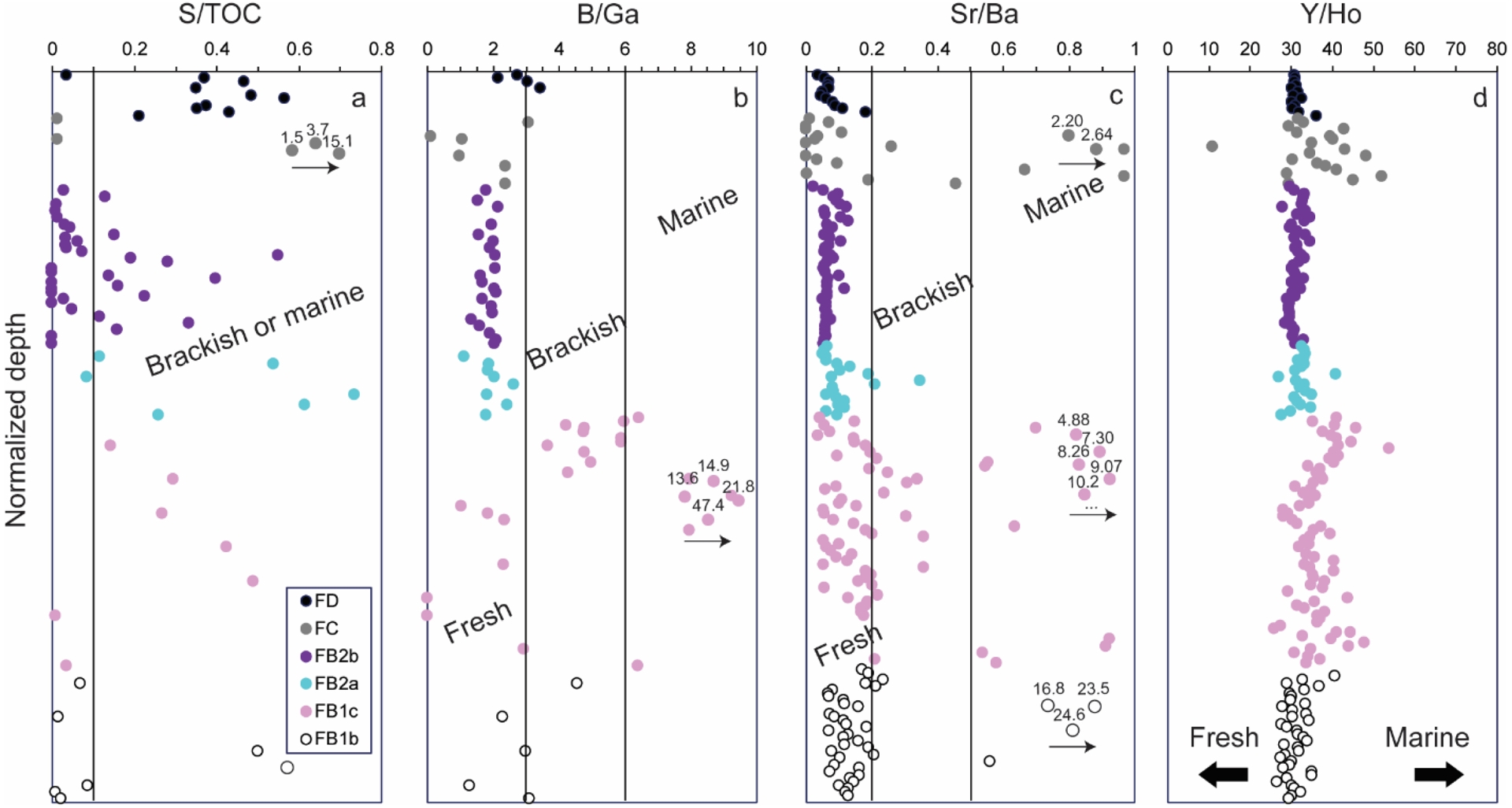
Applied to the Francevillian succession, these thresholds suggest a progressive shift in salinity conditions through the sequence. At the base, the FB1b subunit yields S/TOC values close to the freshwater threshold (<0.1 (Wei and Algeo, 2020)), indicating limited sulfate availability. Upsection, FB1c displays more variable but generally higher values, consistent with brackish to marine influence. The overlying FB2a subunit shows a further increase (average 0.55), reflecting more sustained brackish–marine conditions. In contrast, the fossiliferous FB2b interval is marked by a pronounced decrease in S/TOC (average 0.18, with several samples below detection), pointing to reduced sulfate availability and enhanced freshwater input (Chen et al., 2025). Above this interval, the FC unit exhibits the highest and most heterogeneous values (average 4.09, with several samples >1), indicating strong marine influence and efficient sulfur incorporation during early diagenesis. The succession culminates with the FD unit, where moderately low and stable S/TOC values (average 0.36) again reflect brackish to marine depositional conditions.
When considered collectively, the S/TOC proxy suggests significant heterogeneity in salinity across the Francevillian succession (Figure 2a). Importantly, the fossil-bearing FB2b interval records amongst the lowest average ratios, implying that macro-biota developed and were preserved under conditions of reduced salinity relative to the other units. This provides a first-order constraint on the depositional environment of FB2b, suggesting a setting influenced by freshwater input, such as a shallow restricted lagoon or estuarine system.
4.2. B/Ga proxy
The second considered proxy is the Boron/Gallium (B/Ga) ratio (Liu et al., 2025; Wang et al., 2021; Wei and Algeo, 2020). At the base of the succession, FB1b exhibits moderate B/Ga values ranging from 1.29 to 4.54 (average 2.83) (Figure 2b; Supplementary data). Upsection, FB1c displays markedly higher variability, with values ranging from below detection to 47.43 (average 7.51). The overlying FB2a subunit shows a narrower range of values (1.12–2.43; average 1.94), followed by the fossiliferous FB2b interval, where ratios remain similarly restricted (1.34–2.13; average 1.85). Above these units, the FC interval yields values between 0.10 and 3.06 (average 1.65), while the uppermost FD unit records ratios ranging from 2.13 to 3.43 (average 2.83). Overall, the FB2 interval is characterized by consistently low B/Ga ratios relative to other parts of the succession, with particularly restricted values in the fossil-bearing FB2b.
Boron uptake in sediments is enhanced under marine conditions due to the more alkaline chemistry of seawater, whereas gallium concentrations remain relatively low owing to strong particulate scavenging (Orians and Bruland, 1988). Consequently, B/Ga is a widely used paleosalinity proxy, with thresholds of <3 for freshwater, 3–6 for brackish, and >6 for marine facies (Wei and Algeo, 2020). Applied to the Francevillian Series, most FB2 samples plot within the freshwater domain, with mean values between 1.1 and 2.6. The FB2b subunit (average 1.85) thus indicates a strong freshwater influence, consistent with its low S/TOC ratios. Similarly, FB2a (average 1.94) also lies in the freshwater field, though with slightly higher values. The FD unit averages 2.83, straddling the upper limit of freshwater, while the FC unit averages 1.65, again within the freshwater domain despite occasional higher values. By contrast, FB1c shows highly variable values, including some >6 that fall within the marine range, while FB1b mostly remains below the brackish threshold.
Taken together, the B/Ga proxy suggests that the fossiliferous FB2b interval was deposited under very low-salinity conditions, in contrast to marine incursions recorded in FB1c (Figure 2b). This reinforces the view that the depositional setting of FB2b was restricted and strongly influenced by continental runoff, a scenario compatible with shallow-water or estuarine environments.
Moreover, B shows a close geochemical association with potassium (K) (Retallack, 2020). In the fossiliferous sediments of FB2b, boron is primarily hosted in clay minerals such as illite, given the absence of K-feldspar (Ngombi-Pemba et al., 2014). The lack of tourmaline, a boron-rich heavy mineral, further excludes significant detrital contributions of boron that could bias salinity reconstructions (Ye, Yang, Fang, Zhang, et al., 2020), leaving only minor inputs from detrital clays (e.g., chlorite) and micas. If inherited boron from these phases were accounted for, the corrected boron content (B∗), as proposed by Ye, Yang, Fang and Zhang (2016), defined as the difference between measured and inherited boron, would yield even lower effective values. Boron can also be expelled from clay structures during advanced diagenesis (200–300 °C) or metamorphism (Retallack, 2020). However, the FB2b sediments are exceptionally well preserved and show minimal signs of alteration or thermal overprint (Bankole, El Albani, Meunier and Gauthier-Lafaye, 2015; El Khoury, Somogyi, et al., 2025; El Khoury, Saleh, et al., 2025; Gauthier-Lafaye, 1986; Ikouanga, Fontaine, et al., 2023; Ngombi-Pemba et al., 2014).
4.3. Sr/Ba proxy
Another proxy for salinity is the Sr/Ba ratio (Liu et al., 2025; Remírez, Algeo, et al., 2024; Wei and Algeo, 2020). This proxy requires careful consideration of carbonate content because Sr concentrations can be artificially elevated in carbonate-rich sediments. In the studied dataset, no significant correlation is observed between Sr, Ba, and CaO, (Figure 3). In the FB1b subunit, Sr/Ba values range from 0.06 to 24.62 (average 1.80) (Figure 2c; Supplementary data), while FB1c exhibits similarly broad variability, with ratios between 0.04 and 10.25 (average 0.87). Upsection, the FB2a interval shows markedly lower and more restricted values, ranging from 0.05 to 0.34 (average 0.10), and the fossiliferous FB2b subunit displays an even broader range but similarly low average values (0.02–6.13; average 0.07). Above these units, the FC interval yields values from concentrations below detection to 2.64 (average 0.43). The FD samples (excluding the carbonate-rich sediments) displays values from 0.03 to 0.11 (average 0.06). Overall, the FC unit shows the highest average values within the FB–FC interval, whereas the fossiliferous FB2b and FB2a subunits display consistently low averages.
CaO versus Sr/Ba correlations for the different units and subunits of the Francevillian Series.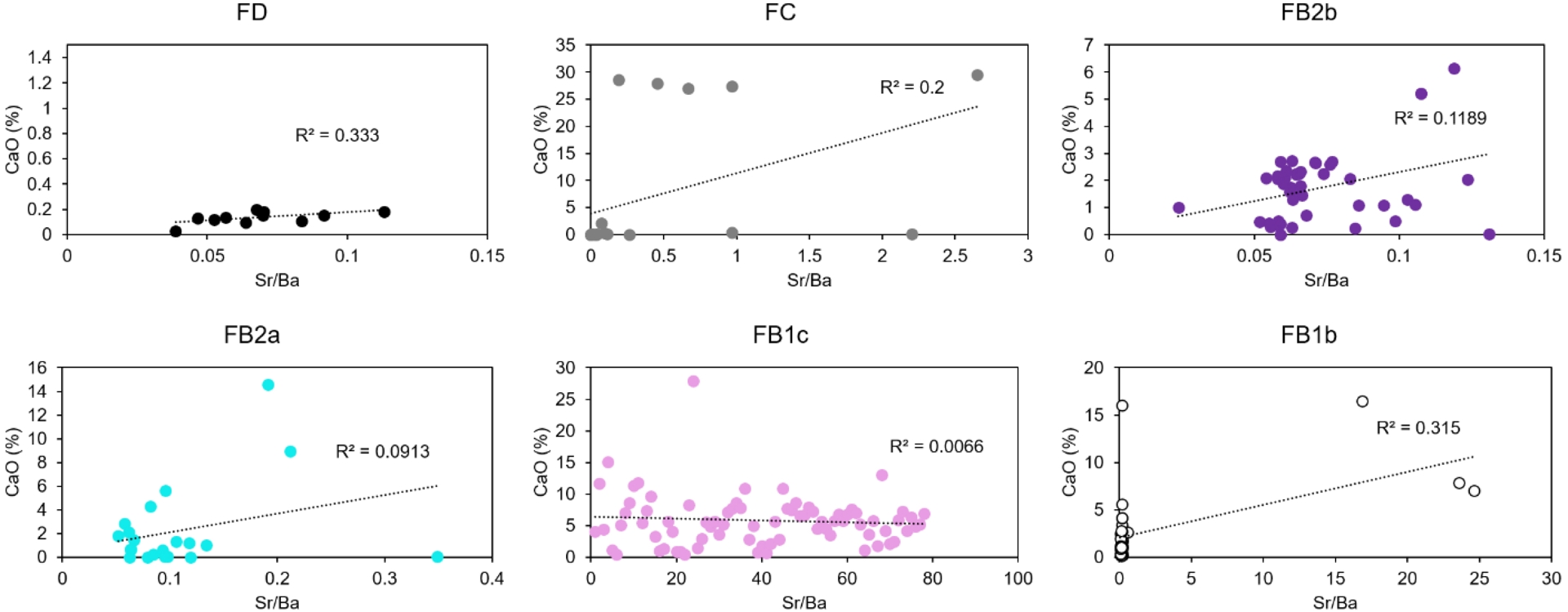
Strontium is relatively enriched in seawater, with concentrations showing little variation with depth, whereas barium is scarce due to its low solubility, especially when bound in carbonate, sulfate, or phosphate minerals. For this reason, Sr/Ba is widely applied as a paleosalinity proxy, with thresholds of <0.2 indicating freshwater, 0.2–0.5 brackish, and >0.5 marine conditions (Omar et al., 2023; Wei and Algeo, 2020). Applied to the Francevillian succession, Sr/Ba ratios in FB2b (average 0.07) and FB2a (average 0.10) fall within the freshwater domain, consistent with results from the B/Ga and S/TOC proxies. By contrast, the FC unit, with an average of 0.43, plots within the brackish range, suggesting a more sustained marine influence. FB1c and FB1b show highly variable values, with averages in the brackish to marine domains but individual samples reaching very high marine-like ratios (>10), likely reflecting localized carbonate or diagenetic effects (Onanga, 2016).
In sum, Sr/Ba results reinforce the view that the fossiliferous FB2b interval was deposited under low-salinity, freshwater-influenced conditions, in contrast to the more marine character of FC (Figure 2c). These findings align with the independent evidence from S/TOC and B/Ga, pointing to significant paleosalinity heterogeneity across the Francevillian basin (Figure 2).
4.4. Y/Ho proxy
Y/Ho ratios were also evaluated as a paleosalinity proxy (Bolhar et al., 2004; Lawrence and Kamber, 2006). In the FB1b subunit, Y/Ho values range from 26.49 to 40.54 (average 30.97) (Figure 2d; Supplementary data), whereas FB1c exhibits a broader range, from 28.01 to 47.60 (average 36.35). Upsection, the FB2a interval yields values between 26.88 and 40.78 (average 32.28), followed by the fossiliferous FB2b subunit, where values range from 28.49 to 34.45 (average 31.05). Above these units, the FC interval spans from 10.83 to 51.84 (average 35.96), and the FD unit displays values between 30.07 and 35.9 (average 31.25).
The Y/Ho ratio is a robust indicator of seawater influence, as yttrium is preferentially stabilized by complexation with anionic salts, resulting in elevated Y/Ho values in saline waters (Bolhar et al., 2004; Lawrence, Greig, et al., 2006; Lawrence and Kamber, 2006). Average shale compositions typically yield ratios of ∼27, whereas modern seawater is characterized by higher, superchondritic values (>44). All average values for the Francevillian succession fall between 30 and 36, which are consistently above the Post-Archean Average Shale (PAAS) normalized value of 27, placing them within the marine range. The fossiliferous FB2b subunit (average 31.05) lies within the lower end of this range, consistent with some freshwater influence that moderated the seawater signature. In contrast, the FC unit (average 35.96) and FB1c (average 36.35) display the highest averages, pointing to more pronounced marine conditions.
Taken together, the Y/Ho proxy suggests that although all intervals record a significant seawater component, relative differences exist across the succession. The lower values of FB2b align with other proxies (S/TOC, B/Ga, Sr/Ba), reinforcing the interpretation of reduced salinity in the fossil-bearing interval, while FC and FB1c reflect stronger marine influence (Figure 2).
Although the Francevillian basin experienced early diagenesis and localized late-stage fluid circulation (Bankole, El Albani, Meunier and Gauthier-Lafaye, 2015; Gauthier-Lafaye and Weber, 2003), it has been subject to only minimal tectonic deformation and show no evidence of metamorphic alteration (Bankole, El Albani, Meunier and Gauthier-Lafaye, 2015; Gauthier-Lafaye, Holliger, et al., 1996; Ikouanga, Fontaine, et al., 2023; Ngombi-Pemba et al., 2014). In addition, several lines of evidence indicate that the geochemical ratios used here retain a largely primary environmental signal. S and total organic carbon (TOC) can be altered during early diagenesis; however, employing their ratio (S/TOC) rather than absolute concentrations reduces much of the associated variability. Moreover, previous work has shown that diagenetic reworking of organic matter in the FB2 unit is limited (Aubineau, El Albani, Chi Fru, Kipp, et al., 2021). B/Ga, Sr/Ba, and Y/Ho are comparatively more resistant to low-temperature diagenetic overprinting. Boron remains bound within clay mineral lattices unless exposed to temperatures >200–300 °C (Retallack, 2020), far exceeding conditions documented in the Francevillian Basin. Sr/Ba ratios display limited mobility under early diagenesis once carbonate influence is accounted for, and rare earth element ratios such as Y/Ho are among the most stable geochemical indicators and generally preserve their primary marine-continental signatures (Lawrence, Greig, et al., 2006). Taken together, these considerations confirm that diagenesis may contribute minorly to the mobility of the used elements but does not obscure the broader paleosalinity trends identified in this study.
4.5. Implications
The paleosalinity patterns identified in the Francevillian succession show strong coherence with previously established paleoenvironmental frameworks. Low-salinity conditions in the FB2b fossiliferous interval are consistent with reconstructions of sea-level fluctuations and oxygenation events in the basin (Canfield et al., 2013). The variability in salinity across the succession also agrees with facies models that distinguish between shallow- and deeper-water depositional environments (Reynaud et al., 2018). In this context, the low-salinity signature of FB2b is compatible with rapid accumulation in shallow settings (<80 m), and the presence of bacterial mats (Aubineau, El Albani, Chi Fru, Gingras, et al., 2018), whereas more marine-like values in the FC and FB1c units reflect open-water deposition. The marine incursions indicated by Sr/Ba and Y/Ho ratios in FB1c are further consistent with the hydrothermal influence described for this interval (Chi Fru, Aubineau, et al., 2024). A similar correspondence is observed in the FC unit, where relatively marine geochemical signatures match independent evidence of hydrothermal inputs (El Khoury, Somogyi, et al., 2025). These associations suggest that both hydrothermal activity and episodic marine inflows played an important role in shaping basin hydrology (Table 1).
Summary of paleosalinity proxies and inferred depositional environments for each stratigraphic unit of the Francevillian FB–FD succession
| Stratigraphic level | S/TOC (avg) | B/Ga (avg) | Sr/Ba (avg) | Y/Ho (avg) | Inferred environment |
|---|---|---|---|---|---|
| FB1b | 0.10 | 2.83 | 1.80 | 30.97 | Brackish to slightly marine, fluctuating salinity, moderate terrestrial influence |
| FB1c | 0.23 | 7.51 | 0.87 | 36.35 | Highly variable, episodic freshwater–marine mixing, hydrothermal contribution |
| FB2a | 0.55 | 1.94 | 0.10 | 32.28 | Brackish, transitional conditions, partial freshwater influence |
| FB2b | 0.18 | 1.85 | 0.07 | 31.05 | Freshwater-influenced, low-salinity |
| FC | 4.09 | 1.65 | 0.43 | 35.96 | Marine influenced, hydrothermal contribution |
| FD | 0.36 | 2.83 | 0.06∗ | 31.25 | Brackish to marine, low variability |
∗Refers to the value excluding carbonate rich samples.
Overall, the integration of paleosalinity proxies with existing stratigraphic and geochemical data indicates that the Francevillian Basin was marked by pronounced spatial and temporal heterogeneity in water chemistry. Within this framework, the FB2b subunit stands out as a freshwater-influenced environment, providing critical paleoenvironmental conditions for not only the development but also the preservation of some of the earliest known macroscopic life forms. In fact, freshwater environment commonly enhances the delivery of fine-grained sediments and promotes rapid burial of organic remains, a key factor for soft-tissue preservation (Kidwell and Holland, 2002). Moreover, a low salinity environment can decrease the degradation rate of proteins (Corthésy et al., 2025) and suppress bioturbators, minimizing sediment mixing and allowing delicate biological fabrics to persist (Przeslawski et al., 2009; Zipperle and Reise, 2005).
5. Conclusion
Geochemical proxies including S/TOC, B/Ga, Sr/Ba, and Y/Ho provide new constraints on the paleosalinity of the Francevillian Basin. The results reveal systematic differences among the studied units, with the fossiliferous FB2b interval characterized by consistently low salinity, in contrast to more marine-influenced signatures in the FC and FB1c subunits. These variations demonstrate that the basin experienced alternating phases of freshwater dominance and marine incursions, shaped in part by sea-level fluctuations and localized hydrothermal activity.
The freshwater influence on FB2b is particularly significant, as it defines the paleoenvironmental context in which some of the earliest macroscopic organisms evolved and were preserved. The paleosalinity framework established here thus refines the understanding of depositional environments in the Paleoproterozoic and provides a critical foundation for interpreting the ecological and taphonomic conditions associated with early complex life. Although these patterns are fundamentally local, they contribute to a broader understanding of environmental heterogeneity in the early Paleoproterozoic ocean, a period following the Great Oxidation Event, when surface environments were becoming increasingly diversified.
Acknowledgements
We thank La Région Nouvelle Aquitaine (Project Darwin, grant E458CR25), the French government program “Investissements d’Avenir” (EUR INTREE, reference ANR-18-EURE-0010) and the Synchrotron SOLEIL, ANR-BIOGEN, grant, 22-CE49-0010-02) for their financial support. We also thank the CENAREST Gabonais, the COMILOG and SOCOBA Companies, the French Embassy in Libreville and the Institut Français du Gabon, for their support. We appreciate the technical and logistical help of C. Lebailly, A. Ngomanda, C. Laforest and R. Oslisly.
Declaration of interests
The authors do not work for, advise, own shares in, or receive funds from any organization that could benefit from this article, and have declared no affiliations other than their research organizations.