


 CC-BY 4.0
This thematic issue of the reports of the French Academy of Sciences, Geosciences series is dedicated to the CNRS’s Human-Environment Observatories, (Observatoires Hommes-Milieux, OHM) and their organisation. The included contributions present illustrations of research results produced by these observatories, which have been in existence, except for the one that has just been created (MIDELT), for between 7 and 18 years. The purpose of this foreword is to explain what these observatories are and how they operate, so that readers can understand their role and the content and characteristics of the research they carry out.
The Human-Environment Observatories and the Interdisciplinary Research Facility on Human-Environment Interactions (Labex DRIIHM1 ), which is inextricably linked to it, were designed and built to study the complexity of highly anthropised social-ecological system (SES) hit by a crisis2 . There can be no DRIIHM without an OHM, and no OHM operating at full capacity without the DRIIHM.
The two groups make up a CNRS-Ecology & Environment system designed to encourage and support the development of interdisciplinarity in human and environmental sciences3 , the combination of which is necessary to understand the highly complex nature of the SES affected by the crises caused mainly by globalisation and global change. This system has been designed to facilitate the emergence and use of this necessary interdisciplinarity by avoiding or eliminating the difficulties usually encountered in its implementation.
The OHMs were conceived by the author as part of the CNRS’s “EDD”4 department in 2006, then developed as part of InEE’s5 . The first OHM, Bassin Minier de Provence, was created in 2007. They have been strengthened as a system by the DRIIHM Labex (2012–2026), which brings them all together and has led to a major functional and conceptual development of the overall system. There are now 14 OHMs in mainland France, the French overseas territories and abroad6 .
1. The OHM-DRIIHM system
1.1. OHM
1.1.1. Definition and organisation: characteristics
An OHM therefore studies (in time and space) an SES that has been, is, or will be affected by a major crisis likely to profoundly change its functioning and dynamics. This could be, for example, a mining operation and the closure of the mine. These socio-ecosystemic crises, which call into question the entire functioning of the SES into consideration, make sense for all SDEs. They also necessarily correspond to the questions and expectations of the society affected, which must also be taken into account in the design and development of research projects. In this way, the results of the research can not only provide answers to the scientific questions posed by the researchers, but can also help the Social Players (economic, administrative, political, associative, ordinary inhabitants of the area concerned) to devise their own responses to the issues they face, in order to provide the best possible guidance for their actions in the areas in which they are working towards Development. The OHMs are thus a mechanism for fundamental and applied research and for taking account of society’s needs. It has been designed to encourage/support/promote the interdisciplinarity needed to understand the complexity of socio-ecosystems7 .
Another fundamental characteristic is that OHMs have been designed to make SDE interdisciplinarity easy to achieve by avoiding, circumventing or even eliminating the obstacles usually encountered in seeking it out.
1.1.2. Basic principles
OHMs are characterised by a constitutive, original and identity-building heuristic framework, generally referred to as the Ternary, which is characterised by three concepts: the Social-ecological Framework, the Disruptive Event and the Focal Object (see below).
They are organised according to a series of characteristic functions, the most important of which are:
- When an OHM is set up, a pre-configuration year is factored in, during which its definition is clarified and a pre-problematisation is co-constructed so that the ways in which it will be tackled can be specified;
- The annual opening8 of calls for research projects (CRP), doctoral or post-doctoral contracts;
- The formulation on these occasions of projects which can be, freely, disciplinary or interdisciplinary;
- The organisation of a number of seminars (one a year for each OHM, for the DRIIHM, and others on specific themes), which represent fundamental opportunities and times for meetings and exchanges, and are the very basis of the life of the system;
- A general co-operative approach, which may concern all those involved in research (from students to senior staff, lecturers, researchers, engineers or technicians), or, depending on the circumstances, may also be extended to Social Players.
- Particular and crucial attention will be paid to the duration of the research, in order to free up time for discussion and reflection in this diversity and to encourage active interaction and emergence on the one hand, but also to take into account the specific and different timeframes for each of the SDE and the people dedicated to them.
Other functionalities are also important, but those identified here are at the very basis of the creation and development of the “culture broth” (cf. below and Chenorkian, 2020, p. 297–298) thanks to which the OHM-DRIIHM system can develop and make it possible to create the interdisciplinarity necessary for an understanding of SES. These elements form the conceptual and functional frameworks and their interactions, which underpin the whole system.
1.2. The DRIIHM, role and actions
The role of the DRIIHM is to bring together and coordinate all the OHMs into a functional structure.
- It allocates and monitors the funding awarded to the OHMs, in particular during the various CRPs that it co-finances. It also ensures and organises relations between the OHMs9 .
- It fosters cross-disciplinary links (organised relations between the OHMs via the staff who participate in them), enabling the development of common tools: databases (GéoDRIIHM: geocatalogue of metadata, PhotoDRIIHM: OHM photo library, DRIIHM-HAL: HAL collection of scientific productions, Canal-U DRIIHM: video resources (films, seminars, scientific mediation), ORRSO: Open Science Resource Search Tool), etc.
- It has enabled the emergence and implementation of permanent working groups: EEDD (Education for the Environment and Sustainable Development), DataDRIIHM (Working and Discussion Group on Data Produced by OHMs, its Valorisation, Visualisation and FAIRisation)10 .
- It enables the development of bottom-up cross-disciplinary research projects: SASI-OHM (Food systems under influence), ENERGON (Energy transition), HYDECO (Connection, disconnection, reconnection in socio-hydrosystems), mainly through the allocation of funding both for the research concerned and for the organisation of discussion and follow-up events.
It is essential to the ability to bring about and sustain the development of interdisciplinarity, and it also plays a fundamental and functional role of a reactor (in the biological sense of the term), enabling the emergence and expansion of the “culture broth” that fundamentally ensures that the OHM-DRIIHM system functions properly (diversity, indisciplinarity11 , transgressions, emergences, innovations (serendipity), interdisciplinarity, cf. below and Morin (1991, p. 39–49); Chenorkian (2020, p. 297–298)).
1.3. Complexity
The notion of complexity used here must be understood in the sense of E. Morin and J.-L. Le Moigne (Morin, 1990; Le Moigne, 1990). All SES, and particularly the highly anthropised ones that concern us here, are highly complex, i.e. no single discipline can account for them and explain how they work. There is therefore a structural need for interdisciplinarity between all the SDEs12 that is required to address the complexity of the SESs covered by the OHM-DRIIHM project. In a nutshell, we could say “interdisciplinarity, because of complexity”. For us, there is no other reason13 . This fact is absolutely fundamental, because it conditions the entire organisation, functioning and interdisciplinary capacities of the entire system, particularly in its simplicity.
2. Features and functions
2.1. Human environment Observatory
An SES cannot be analysed because it is complex. To analyse it would be to simplify it and thus destroy the links of interaction between all the systems that make it up. “We evaluate a complex system by observing its behaviour” (Le Moigne, 1990). This is why the meaning of the term observatory in OHM is not as simple as it might seem. “Observatory” in this context has two meanings. It has the common meaning of a device generally placed in a specific location, usually bringing together various measuring devices whose recordings are monitored over time, in accordance with strictly defined standards. The results, which will be stored in a database, will be used to support research into a specific theme of great importance to the subject under consideration.
This meaning also exists in the case of OHMs, but “Observatory” is above all a way of understanding the complexity of SES. Observation will make it possible to build a systemic model14 . Observation is the primary act of research into SES. This research is built up through an iterative sequence which includes observation/experimentation–comparison/systemic modelling. In terms of iteration, this trans-scalar approach, for a given question, leads to proposing the most probable interpretation among the attested or conceived possibilities of the systems studied.
2.2. The Ternary
In principle, any OHM concerns a highly anthropised SES, marked by a crisis that is also anthropogenic and that has profoundly disrupted it. The challenge is to understand what has happened and what is happening to this SES as a result of such upheaval and any resulting actions by society.
The OHM’s SES object can be read and understood according to a system of three converging axes making up what is known as “the Ternary”. It consists of:
- The Social-ecological framework (Fait Structurant), which corresponds to the state of the SES concerned, most often marked in this case by a socio-economic activity with a high environmental impact, but also by an ecological framework which weighs heavily on humanity and human society. In all cases, the structuring factor predominantly organises the initial functioning of the SES under consideration.
- The Disrupting Event (Événement Fondateur), the crisis that has hit, is hitting or will hit the SES, causing upheaval and establishing the conditions for setting up a new way of working that is the subject of the studies conducted by the OHM, its very heart.
- The Focal Object (Objet Focal), determined by the convergence of the first two, it defines the territory which, concerned by the Social-ecological framework and the Disrupting Event, will be the object of study for all the SDEs.
Each of the elements of the Ternary is necessarily anthropogenic. Each interacts closely with the other two. This system forms the basis of any OHM and conditions all the research activities that take place within it. It facilitates and promotes interactions between the SDEs. It is the very basis on which all interdisciplinarity is built in OHMs.
Thus, for the first OHM to be built, Bassin Minier de Provence (BMP, Provence coalfield), the Social-ecological framework is the mining of the lignite deposit in this area, which has been going on for more than two centuries, with all the socio-ecological consequences for the organisation of this territory and the society that has developed there; the Disrupting Event was the closure of the mine in 2003, which put an end to this socio-ecologically decisive activity and disrupted the entire existing SES and its dynamics. The Focal Object is defined as the entire area affected by the operation of the mine and marked by its social, economic and ecological consequences, and by the sudden closure of the mine and its consequences (closure of the operation, of the employment area, changes in ecological, economic and social living conditions).
Although an OHM is a single place (possibly made up of several sites15 ), it will always be protean depending on the points of view considered (the docker’s coastline will not be the same as that of the sailor, the tourist, the town planner, etc.). All of them will necessarily have wide overlaps, due in particular to the nature of the object itself, but also to the reading grid put in place by the ternary and to its consequences on the design of the research.
Particularities of the Disrupting Event.
- It is a major event for the SES under consideration, and more often than not contradict sit head-on16 .
- It is an open door to the SES, relevant to the Social-ecological Framework under consideration.
- When it appears, the Disrupting Event causes most of the dynamics (sub-systems) of the SES and their trajectories to change at roughly the same time. It thus determines a Time Zero (T0) and brings together all the SDEs, which thus have the same temporal relationship with it. It gives them the same starting point for studying the evolution of the SES affected by this crisis. It is a major tool for assessing the changes that have occurred, their significance and the evolution of their trajectories. This is an exceptional situation for comparing the results obtained by all the research, whatever the disciplines (or interdisciplines) involved (see Figure 1).
- T0 is used to establish a before and an after. It also allows us to determine a state zero (see Figure 1), that of the SES at the time of the Disrupting Event. This moment, which is not very large in terms of time, makes it possible to establish an inventory, framed by the ternary, which will provide an invaluable basis for understanding and assessing the impact of the crisis and its consequences. Any OHM must give priority to establishing this baseline situation, which will be the reference point for understanding all the new dynamics and assessing changes in the old ones17 .
- T0 also makes it possible to establish a before and an after (see Figure 1). It therefore forms the basis of the retrospective observation that will enable us to understand the dynamics at work in the context of the Social-ecological framework and their trajectories, and thus provide a high level of understanding of the causes and dynamics of the zero state, an essential circumstance for understanding the conditions of the post-Disrupting Event future.
Consequences of the Disrupting Event on the SES studied by OHM.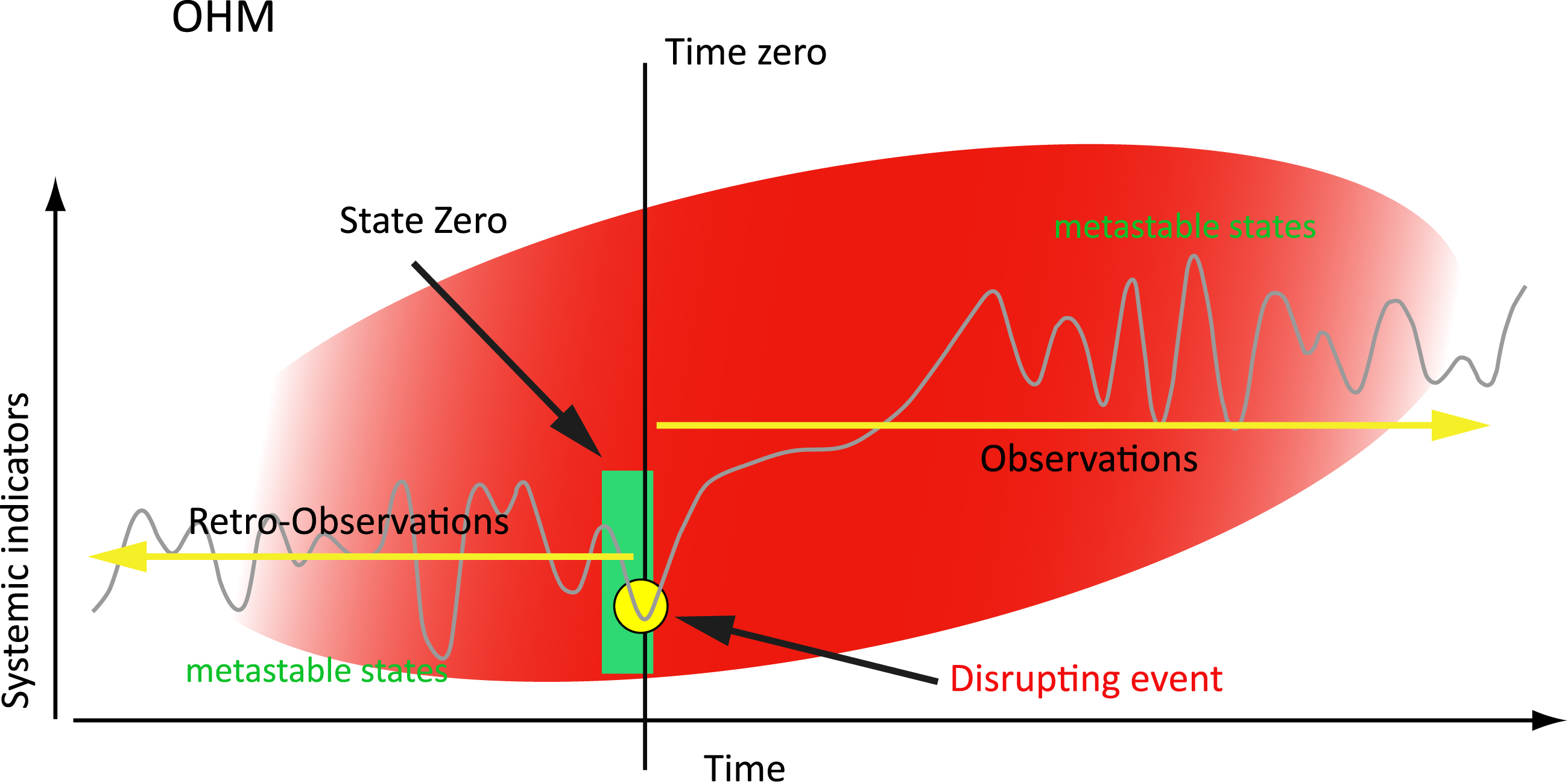
The Disrupting Event
- is a major factor in simplifying not the SES under consideration, which is impossible because of its complexity, but its approach (the only way to make this complex system easier to understand).
- necessarily has a temporal dimension, unlike a natural event (earthquake, tsunami, for example18 ). It is necessarily built up over time (see, for example, the reasons for the closure of the Provence coal mines or the Fessenheim power station).
- poses questions of profound changes to the SES, reconversion and rehabilitation, which necessarily concern all SDEs. This is one of the major factors facilitating the emergence of interdisciplinarity.
- These issues will very often be socially and ecologically sensitive. The ternary approach and the Disrupting Event bring scientists and society very close together. It makes it easy to take account of the social context and queries when formulating research questions. This is one of the hallmarks of OHM research, and a guarantee of its relevance to society.
- Presents a uniqueness. The Disrupting Event is unique in its role, space and time. It is a door that opens onto the SES at a given point at a given moment and in major contradiction/modification of the Social-ecological Framework. Although it is necessarily the result of different components that have converged to make its appearance possible, this in no way alters its uniqueness.
- Is fundamentally stable. This event is characterised. It has no future in itself19 . It is the dynamics that are put in place from the moment it occurs that evolve, and the study of these dynamics is the very raison d’être of the OHM.
2.3. Interdisciplinarity
There are many definitions of this term20 . In the context of the OHM, “interdisciplinarity” is the tool which, by bringing together the various SDE disciplines and their contributions, makes it possible to understand the complexity of the SES under consideration and to answer the scientific questions raised by its understanding. Each person’s contributions, in terms of operations and results, provide enrichment for all, leading to the emergence of an “enlightened disciplinarity”, which is the first level of our interdisciplinarity (cf. Chenorkian, 2020, pp. 301–302).
2.3.1. The creation of interdisciplinarity: the “culture broth”
The interdisciplinary approach, as defined above, is not likely to emerge naturally within the framework of traditional research and higher education systems, because nothing is provided within them to encourage it as such. It is therefore necessarily transgressive, because it clashes with the organisations, concepts, workings and traditions of most of these systems. The emergence of interdisciplinarity therefore necessarily presupposes a resolution of these elements that would oppose its development and, in particular, an open-mindedness (indisciplinarity, see note 11) that allows the contributions all disciplines to be echoed by the players in each of them.
The challenge, therefore, within the OHM-DRIIHM framework and the SES under consideration, is to remove these obstacles by promoting the convergence of the various SDEs concerned. The entire OHM-DRIIHM system has been designed with this aim in mind.
Design
Morin (1991, p. 38–49) characterised and theorised the question of the liberation of thought, its insubordination to norms, its ability to transgress dogmas and to identify the “conditions that allow its autonomy, and correlatively, the conditions of objectivity, innovation and evolution of knowledge” [p. 39]. This is exactly the challenge we face when it comes to the emergence of interdisciplinarity in OHMs.
To achieve the objective set here, the conditions are created for the emergence of a virtuous circle that sets up a “culture broth” that Morin describes this as the existence of a dialogical exchange activity, in which antagonisms and opposites complement each other [p. 42], developing “cultural heat”, “caloric activation” [p. 49], “lively debates, exchanges, … antagonisms”. Admittedly, this activation leads to a lot of wasted energy and a lot of uncertainty, but it also provides many opportunities for the development of ideas and knowledge [p. 49]. This culture broth increases and frees up the possibility of expressing deviances that can lead to hybridisation or, better still, a creative synthesis of opposing ideas [p. 41].
The OHM-DRIIHM mechanism for creating interdisciplinarity was built on these conditions and principles, described here with quotes from E. Morin21 .
Putting it into practice
Every OHM is an object that is co-constructed and co-problematised at the time of its creation by all the SDEs involved. It is therefore fully intelligible and accessible to all the SDEs and their representatives from the outset. The crises affecting all the SESs considered by the OHM ipso facto concern the fields of interest and research of all the SDEs concerned. The subject is therefore necessarily relevant to all of them. Working on it makes sense and is of interest to all of them.
The OHM is therefore, by design, a functional place for all disciplines to share ideas and research results, which form the breeding ground from which interdisciplinarity develops. The OHM-DRIIHM system provides all levels with the tools and dynamics to ensure natural, frequent and productive outcomes. All these elements are necessary for the SDEs to come on board. The framework thus created is the very basis of the “spontaneous” emergence of interdisciplinarity that we know from this system and which is its strength.
Basics of operation and efficiency
The principle is to proscribe anything that over-disciplines or blocks exchanges and debates, and prohibits the emergence of new avenues. Yet these are the most common practices in the way research works. This is a typical example of the construction of a “culture broth”22 . The main thing is to avoid:
- not expertise, which is fundamental and beneficial to all, but the posture of the expert, which gives a word of authority to one and prohibits the interventions of others and exchanges between all.
- excellence as the ultimate goal for each individual, which it then closes in on itself and its skills. Excellence should only be sought for the interdisciplinary system and its explanatory performance and results.
- the search for consensus in dialogue, which is unfortunately terribly widespread but which neutralises, even undermines, any capacity to transgress, a transgression which is nonetheless the very breeding ground for interdisciplinarity and innovation.
On the contrary it seeks to:
- encourage anything that opens up, decompartmentalises and provokes open debate: diversity of scientific cultures, diversity of disciplines, populations, functions, levels, to allow/encourage interactions, disciplinary transgressions and innovations, in a word, diversity;
- simultaneously install the presence of hierarchy, panarchy and an-archy (cf. Chenorkian, 2014; Chenorkian, 2020) in combinations and relationships that are as far as necessary multi-scalar, trans-scalar and a-scalar.
- set up, plan and build meeting places and times to talk and listen, to exchange ideas both formally and informally;
- create opportunities for iterations (i.e. create the dynamics for these iterations to take place) wherever necessary.
All the seminars, which are open to both academic and non-academic participants in the scheme, are ideal places for developing these behaviours and dynamics.
2.4. The construction of research in OHM-DRIIHM: calls for research, Post Doctoral and Doctoral projects
These are essential elements of OHM research. Calls for proposals are normally issued annually23 . They enable research to steer with great efficiency while leaving it a great deal of freedom. There are only two constraints on applicants: (i) their projects must fit into the Ternaire, whatever the SDE concerned, and (ii) they must in principle be in line with the (pre-)problematisation established by each OHM and thus adapted to the wishes of all SDEs24 , whatever they may be, who will thus be able to find meaning and interest in their results25 .
The winning research projects have two years to be completed. This ensures, among other things, that the OHM maintains an active research dynamic. What’s more, it is still possible to submit follow-up projects which, like all the others, will be subject to evaluation and acceptance by each OHM during each campaign.
These projects can be both disciplinary and interdisciplinary. This is a key factor in the emergence and success of interdisciplinarity in the OHM-DRIIHM scheme, as it removes many of the major obstacles otherwise encountered. The possibility of developing cross-disciplinary projects makes it possible to:
- naturally remove any suspicions about the quality of the work, since it can be published in the best disciplinary journals and therefore evaluated accordingly;
- remove the problems of personal commitment, since working within the framework and rules of the disciplines enabling everyone, young or established researchers, to access understanding and consideration by their community for their research without encountering specific difficulties …;
- remove all the difficulties associated with a priori interdisciplinarity26 , which is always very difficult, uncertain and time-consuming to establish, sometimes to no avail.
The benefit of the proposed research for all disciplines and its relevance and capacity to make sense for the community as a whole are ensured by the co-construction of all the SDEs during the year of pre-configuration and by the periodic re-profiling which follows and redefines the relevance of the research choices as the OHMs evolve and their research progresses.
These research projects are one of the essential elements of the “culture broth” in terms of sharing and exchange between the SDEs. The projects are presented upon their selection and their results are reported during the annual restitution seminars and highlighted during the annual DRIIHM seminars This ensures that all the SDEs within the OHM and at DRIIHM level are kept informed of research activities, both in terms of the issues and questions raised and the results obtained. In addition, once each project has been completed, a short summary text (4 pages) must be produced27 . This will be archived and will always be available on the OHM and DRIIHM websites. This will enable everyone to find out about the research carried out and its results, and to use them as food for thought in constructing research questions, benefiting from the progress already made, even if it is old.
Finally, the OHM framework guarantees that everyone, whatever their discipline, works on the same object (Focal Object), thus opening up a great capacity for everyone to interact, across a very broad disciplinary spectrum, and enabling the easy and fertile emergence of inter-disciplinary interactions.
2.5. The question of assessments
Disciplinary research projects can also be published rapidly, as soon as their own results have been obtained, and potentially in the best journals accessible in their discipline. In the case of the OHM-DRIIHM system, this means that the evaluation of research work can be “subsidiarised” by expert disciplinary bodies recognised by all, thereby removing any suspicion of quality from the outset. This will also immediately raise the profile of the research components emerging from the OHMs, which will then be able to open the way to the interdisciplinary results to which they will necessarily contribute when the time comes.
As far as the evaluation of interdisciplinarity is concerned, the question is more delicate and difficult to answer. There is no comprehensible evaluation of interdisciplinarity that is accessible to all disciplinary bodies. For us, peer assessment, which is the basis of all disciplinary assessments, cannot work because, by definition, there can be no interdisciplinary “peer”. Interdisciplinarity cannot be qualitatively fixed because its composition and, above all, the reality of the interactions that actually take place within it are fundamentally variable according to circumstances28 .
The most well-developed interdisciplinary evaluation systems tend to assess the conformity of the work with an interdisciplinary “ideal”29 , which says nothing about the efficiency of the research undertaken (i.e. its ability to achieve its scientific goals). As far as we are concerned, in our setting, an interdisciplinary project is assessed on the basis of its ability to resolve the question for which it was designed using the systemic modelling process, i.e. its ability to propose a system that best explains how the SES operates in relation to this question. This ability to convince is assessed by its ability to take into account and integrate into the model as many of the observations made as possible, whatever the original disciplinary or interdisciplinary field, and their characteristics in the description of this functioning.
The OHM-DRIIHM system produces interdisciplinarity through its overall organisation and operation. These enable a permanent dynamic to be established, fuelled by both disciplinary and interdisciplinary CRPs, seminars, and activites which are both cross-disciplinary and enlightening—all of which form part of the culture broth and the dynamic that enables it to emerge and become effective. This is how interdisciplinarity emerges “spontaneously”, as a result of all the schemes. In the OHMs, interdisciplinarity can be built and operated anywhere and at any time. They were designed precisely for that purpose.
3. Summary and conclusion
Interdisciplinarity in the OHM-DRIIHM system is successfully and easily achieved thanks to:
- Very few constraints (Ternary, participation in operations, 4 p.);
- A choice of disciplinary or interdisciplinary research;
- Avoiding obstacles linked to interdisciplinarity (disciplinary relevance, recognised assessments);
- The sharing of study objects by all disciplines (Focal Object, Ternary as a whole) with relevance for all (co-construction of the OHM and its issues); native inter-disciplinary convergence of research objectives (OHM framework);
- The overall organisation, which allows the creation of times and places (temporalities, durations, meetings on occasions and in configurations not otherwise foreseen) favourable to exchanges between disciplines, or even communities, which allow intra- and inter-disciplinary thinking to mature, as well as the development of indisciplinarity;
- The presentation of results and the ensuing discussions (“enlightened disciplinarity”) have provided insights into each other’s work;
We achieve
- A “spontaneous” interdisciplinarity that is naturally interwoven thanks to the layout of the entire OHM-DRIIHM system and the resulting dynamics;
- Systemic modelling to build an understanding of complexity and assess the validity of proposals;
- Results that are stored so that they can be identified and, if necessary, reactivated as and when required;
- The establishment of a permanent capacity for transgression, creation and openness (seminars, cross-disciplinary initiatives, DRIIHM events);
- Continuing to create and adapt the system according to the principle implemented from the outset: no concept without application, no recurring behaviour without theorising.
The way OHMs work and their effectiveness are constantly being demonstrated. All the contributions given In this special issue OHM bear witness to this.
1 “Laboratoire d’Excellence”, an initiative of the french government’s “Grand Emprunt” to promote research in France (Labex ANR-11-LABX-0010). Created in 2012, renewed in 2020 and extended until 2026, it is currently awaiting possible longer-term renewal.
2 Thus often labelled as “in crisis”, which is a linguistic stretch because the meaning of this qualification applied to an SES is far from relevant.
3 Or SDE, which covers Earth, Life and Human and Social sciences, insofar as they are dedicated to this field.
4 I.e. environment and sustainable development.
5 CNRS’s institute of ecology and environment which is called now CNRS-Ecology & Environment.
6 They are Bassin minier de Provence (2007), Oyapock (Guyane, 2008), Pyrénées – Haut-Vicdessos (2009), Tessékéré (Ferlo, Sénégal, 2009), Estarreja (Portugal, 2010), Vallée du Rhône (2011), Littoral méditerranéen (2012), Nunavik (2012), Pima County (Arizona, États-Unis, 2014), Pays de Bitche (2015), Patagonia-Bahia Exploradores (Chili, 2015), Littoral caraïbe (Guadeloupe, 2016), Fessenheim (2018), MIDELT (Maroc, 2025).
7 This is the definition given when it was first presented in Strasbourg on 6 March 2007, at a SIC - INSU (CNRS) foresight symposium.
8 See below.
9 See https://www.driihm.fr/.
10 FAIRisation: principle of data organisation, the aim of which is to make digital resources easy to Find, Accessible, Interoperable and Reusable (FAIR acronym).
11 Sensu Loty, 2005; Catellin and Loty, 2013. Cf. Chenorkian (2020, p. 297).
12 Known as the Global Ecology approach.
13 No moral or ethical reason. Cf. among others Lemay, 2017, Critique de la raison disciplinaire: une révolution tranquille? TrajEthos, On interdisciplinarity, 6(1), 11–28, slide 18 Interdisciplinarity: “research democracy”.
14 “The Complex is made intelligible by modelling” (Le Moigne, 1990, p. 10).
15 Cf. OHM French Mediterranean coastal zone. 4 sites on the coast of Marseille, the Gulf of Aigues-Mortes, in Corsica in Balagne and on the Biguglia lagoon.
16 It is then said to be antagonistic. Sometimes, however, it may simply have a strong influence on the SES without directly contradicting the Social-ecological framework (as in the case of the Oyapock or Tessékéré OHMs, for example). This Disrupting Event is then described as anagonic (cf. Chenorkian, 2020).
17 Depending on the purpose of the baseline study, an analytical approach may legitimately be used, as long as the aim is to determine the components (study of a given taxon, for example) and not the dynamics, at which point the complexity (interactions, etc.) becomes apparent and therefore need to be approached in the right way.
18 We are talking here about the impact of these two events on the SES, and not about the events themselves, which obviously have their own history, most often independent of the SES they will impact, which is in no way linked to their occurrence. This is why such a natural event (earthquake, tsunami) cannot be a Disrupting Event and and provide a basis for the creation of an OHM.
19 E.g. the closure of Houillères de Provence. This fact per se will not change. It is marked in its form at a given moment, the moment of closure.
20 Cf. Chenorkian (2020); in the Anglo-Saxon context, and particularly in the United States, interdisciplinarity actually corresponds to a process of disciplinarisation, the construction of a new discipline: “What is considered interdisciplinary today might be considered disciplinary tomorrow.”, US National Science Foundation (2025), https://new.nsf.gov/funding/learn/research-types/learn-about-interdisciplinary-research.
21 The two mirror-graphs in Chenorkian (2020, p. 298, Figure 3), illustrate these functions and their implementation.
22 For a more detailed presentation, see Chenorkian (ibid., p. 297–299).
23 Since 2020, the calls have been biennial for funding and management reasons, but in terms of content, for research and development, annual frequency is still considered preferable.
24 Is represented on the OHM Board, whose role is to ensure that these themes are selected and that they are relevant.
25 However, there is always the possibility of innovating and proposing research that is not problematised. Such proposals will be submitted to the OHM’s evaluation committees, which may accept them if they see fit.
26 Building a common language, new concepts, etc.
27 This practice concerned one of the OHMs. Its generalisation is recent and is therefore gradually being put in place.
28 This is not necessarily accepted by everyone. See for example https://cihr-irsc.gc.ca/f/52470.html.
29 Cf. Huutoniemi and Ràfols (2016), McLeish and Strang (2016), Laursen et al. (2022); also Huutoniemi, Klein, et al. (2010).