





 CC-BY 4.0
1. Introduction
In natural marine settings, both temporal and spatial dynamics of deep-sea foraminifera (Eukaryota, Rhizaria) are controlled by three major physico-chemical parameters (see the review by A. Gooday, 2003; Zeppilli et al., 2015). Organic-matter flux toward the sea floor is the most important ecological constraint as far as it defines the benthic ecosystem’s trophic level, and the related food availability for foraminiferal communities (A. Gooday, 2003). When high, this food supply supports high-density and high-diversity foraminiferal fauna. When too excessive, the organic-matter flux is also considered an ecological limiting factor by inducing either temporary or long-term hypoxia either in the sediment or bottom water (Fontanier, Duros, et al., 2014; A. J. Gooday et al., 2000; Kurbjeweit et al., 2000; Schumacher et al., 2007). Below a certain oxygen concentration threshold (i.e., 45 μM/l), the oxygenation level of the bottom water then becomes the second ecological constraint, limiting the diversity of benthic foraminiferal fauna (Fontanier, Duros, et al., 2014; A. J. Gooday et al., 2000; Kurbjeweit et al., 2000; Schumacher et al., 2007). Often neglected or underestimated in ecological studies, hydro-sedimentary processes constitute the third set of environmental constraints in deep-sea environments. Sediment gravity flows running down mature submarine canyons can supply organic detritus and terrigenous particles to the deep ocean. Foraminiferal faunas living in these naturally disturbed habitats are characterized either by various stages of low-diversity-fauna colonization occurring after physical disturbance (e.g. turbidity flows), or by equilibrium phases (with a net increase in faunal diversity) related to the gradual burial of organic matter (e.g. eutrophication) (Duros, Fontanier, Metzger, Cesbron, et al., 2013; Duros, Fontanier, Metzger, Pusceddu, et al., 2011; Fontanier, F. J. Jorissen, Geslin, et al., 2008; Fontanier, F. J. Jorissen, Lansard, et al., 2008; Hess and F. J. Jorissen, 2009; Hess, F. J. Jorissen, et al., 2005; Koho, García, et al., 2008; Koho, Kouwenhoven, et al., 2007). Because of the abovementioned, foraminifera are a remarkable group of organisms for studying rapid disturbances in benthic environments, whether natural or anthropogenic. These unicellular organisms, characterized by their relatively short life cycle and their metabolic plasticity, make ideal candidates for the monitoring of environmental stress related to human activities (Schönfeld et al., 2012; Zeppilli et al., 2015).
Between 1967 and 2015, bauxite residues (namely red mud) were dispersed into the Cassidaigne Canyon (NW Mediterranean) by the Gardanne alumina refinery (see review by Dauvin, 2010). Bauxite red mud (a combination of liquid effluent and residual solid) was drained away by a submarine pipe and discharged at a water depth of 320 m, about 8 km offshore. This sedimentary material passed down along the axis of the Cassidaigne Canyon and its lateral flanks to great depths (>2000 m) with a total coverage estimated to be more than 900 km2 (Dauvin, 2010; Fabri, Pedel, et al., 2014; Fontanier, Mamo, et al., 2020; Fontanier, Biscara, et al., 2015; Fontanier, Fabri, et al., 2012). In January 2016, bauxite residue dispersal ceased (see https://alteo-environnement-gardanne.fr/ for further information). Since then, only residual liquid effluent has been released from the pipeline outlet into the Cassidaigne Canyon. This liquid, characterized by a density lower than the ambient sea water, is gradually diluted as it rises up through the water column.
Ecological studies have been carried out for the last five decades in order to assess the impact of red mud on deep-sea metazoan (Bourcier, 1969; Bourcier, Stora, et al., 1993; Bourcier and Zibrowius, 1973; Fabri, Pedel, et al., 2014; Vitiello and Vivier, 1974; Vivier, 1978a; Vivier, 1978b). Close to the pipe outlet, the hydro-sedimentary pollution related to the flooding of red mud (i.e., high sedimentation rate and potential submarine erosion) precluded benthic meiofauna and macrofauna settlement along the canyon axis. In the surrounding areas, normal hemipelagic deposit- and suspension-feeding benthic macrofauna could thrive, despite the presence of a thin layer of red mud. Fontanier, Fabri, et al. (2012) investigated foraminiferal faunas from two stations located at 725 m and 1528 m along the axis of the Cassidaigne Canyon (ESSROV cruise, October 2011). Both studied sites were highly contaminated by iron, titanium, vanadium and chromium compared to normal hemipelagic sedimentary environments. At the shallower station located close to the pipe outlet, the living (Rose Bengal stained) benthic foraminiferal community was characterized by very low diversity (i.e. only three species; Gyroidina umbonata (Silvestri, 1898), Bulimina marginata d’Orbigny, 1826 and Bulimina costata d’Orbigny, 1852). The physical disturbance related to red mud deposition/remobilisation was likely the major hydro-sedimentary parameter precluding the settlement of diverse fauna. Conversely, bauxite residues had no environmental impact on foraminiferal faunas living at the deeper site. In September 2012 (one year later), fourteen stations located between 288–2432 m water depth at varying proximity to the pipe outlet were sampled (Fontanier, Biscara, et al., 2015). Due to more extensive coring, Fontanier, Biscara, et al. (ibid.) evaluated the impact of red mud dispersal in the Cassidaigne Canyon, not along its axis but on its flanks and its surrounding area (adjacent canyons and the deep basin). Deposits of red mud were observed in the Cassidaigne and Planier Canyons down to ∼2000 m (coverage area ∼900 km2). The diversity, composition and standing stocks of foraminiferal faunas were predominantly constrained by overall meso-oligotrophic conditions. The reduction of sedimentary organic detritus with varying water depth and the ecological constraint determined by bottom currents generated gradual changes in foraminiferal communities, regardless of red mud presence. Compared to the canyon axis studied by Fontanier, Fabri, et al. (2012), there was no obvious environmental impact of dispersed bauxite residues on benthic biodiversity in the sampling period (September 2012). In September and October 2016, four years after the previous study, and ten months after the cessation of red mud dumping (January 2016), more extensive core collections than those performed by Fontanier, Fabri, et al. (2012), Fontanier, Biscara, et al. (2015) were gathered in the frame of an environmental survey (Fontanier, Mamo, et al., 2020). Foraminiferal communities were sampled at 16 stations located between 265–2500 m with varying proximity to the pipe outlet. Most of these sites were within the geographical zone where historical bauxite residues have been previously detected (Dauvin, 2010; Fontanier, Fabri, et al., 2012; Fontanier, Biscara, et al., 2015). At the 725 m-depth station closest to the Cassidaigne Canyon submarine pipe, Fontanier, Mamo, et al. (2020) recorded the highest abundance of species considered opportunistic (B. marginata and Gyroidina altiformis, Stewart & Stewart, 1930) and a strongly altered benthic diversity. At the other fifteen stations, foraminiferal standing stocks and simple diversity decreased by decreasing food input to the seafloor and increasing water depth. There, foraminiferal composition with a minor contribution of stress-tolerant species echoed the overall meso-oligotrophic patterns of a relatively stable and unpolluted ecosystem.
During an environmental survey performed in winter and spring 2022 (this study), living (stained) benthic foraminiferal faunas were gathered at 13 stations sampled within the Cassidaigne Canyon (NW Mediterranean Sea) and surrounding area. These stations, which are located between 265–2300 m water depth, are the same as those sampled in 2016 and studied by Fontanier, Mamo, et al. (ibid.). The only difference with the 2016 campaign is that the three stations furthest from the outlet (>60 km) were not sampled for this study. The main objective of our study is to determine the ecological patterns of benthic environments by investigating foraminiferal fauna (diversity indices and faunal composition) almost six years after the last sampling cruise and the cessation of solid waste dispersal in the Cassidaigne Canyon (ibid.). It is hypothesized that historically impacted benthic ecosystems may be resilient, unless the particular hydro-sedimentary conditions prevailing in the Cassidaigne canyon (i.e. instability of historical red mud deposits in the canyon head) limit the ecological recovery of the most vulnerable benthic environments.
2. Study area
The Cassidaigne Canyon lies in the eastern Gulf of Lions (NW Mediterranean) (Figure 1 insert). The 200 m-deep canyon head borders the Cassis Bay at only 7 km from the coast and is characterized by a narrow canyon axis (2 km in width at 1700 m depth downstream) (Figure 1) (Fabri, Bargain, et al., 2017). The Northern Current (NC), which forms the northern branch of the cyclonic Liguro-Provençal Current (LPC), follows the continental margin from the Provence coast (France) to the coast of Catalonia (Spain) (Béthoux and Prieur, 1983; Millot, 1990). The NC determines the general surface water circulation patterns. Below the surface waters (>200 m), spreads the modified Levantine Intermediate Water (LIW), which is characterized by a salinity maximum (∼38.5) and a relative temperature maximum (>13 °C). The Western Mediterranean Deep Water (WMDW) runs below the LIW with a diffusive boundary at 500–800 m (Béthoux, Durrieu de Madron, et al., 2002; Béthoux and Prieur, 1983). It is characterized by a homogeneous temperature (∼13 °C) and salinity (38.40–38.45) (Béthoux, Durrieu de Madron, et al., 2002; Béthoux and Prieur, 1983). Primary production in surface waters shows a classic seasonal variation in temperate latitudes, with a remarkable bloom in the boreal spring (March to May) (Fraysse et al., 2013). Moreover, in late winter, spring and summer, coastal upwellings are triggered by north-westerly winds (Mistral) (Fabri, Bargain, et al., 2017; Brun et al., 2023). They generate enhanced phytoplankton production in the surface water (Millot, 1990; Fraysse et al., 2013). The transitional period between autumn and winter is the least productive (Fraysse et al., 2013). The changes in the circulation of the NC over the course of a year, the variability in the nature of the winds blowing over the Bay of Cassis and the general morphology of the continental shelf and the Cassidaigne canyon generate very specific hydro-sedimentary processes of sediment remobilisation (i.e. turbidity currents) in the axis of the canyon down to its greatest depths (Brun et al., 2023).
Bathymetry of the study area and location of the 13 stations sampled during the 2022 oceanographic cruises (winter-spring 2022). “Outlet” refers to pipeline outlet that was used to disperse bauxite residues.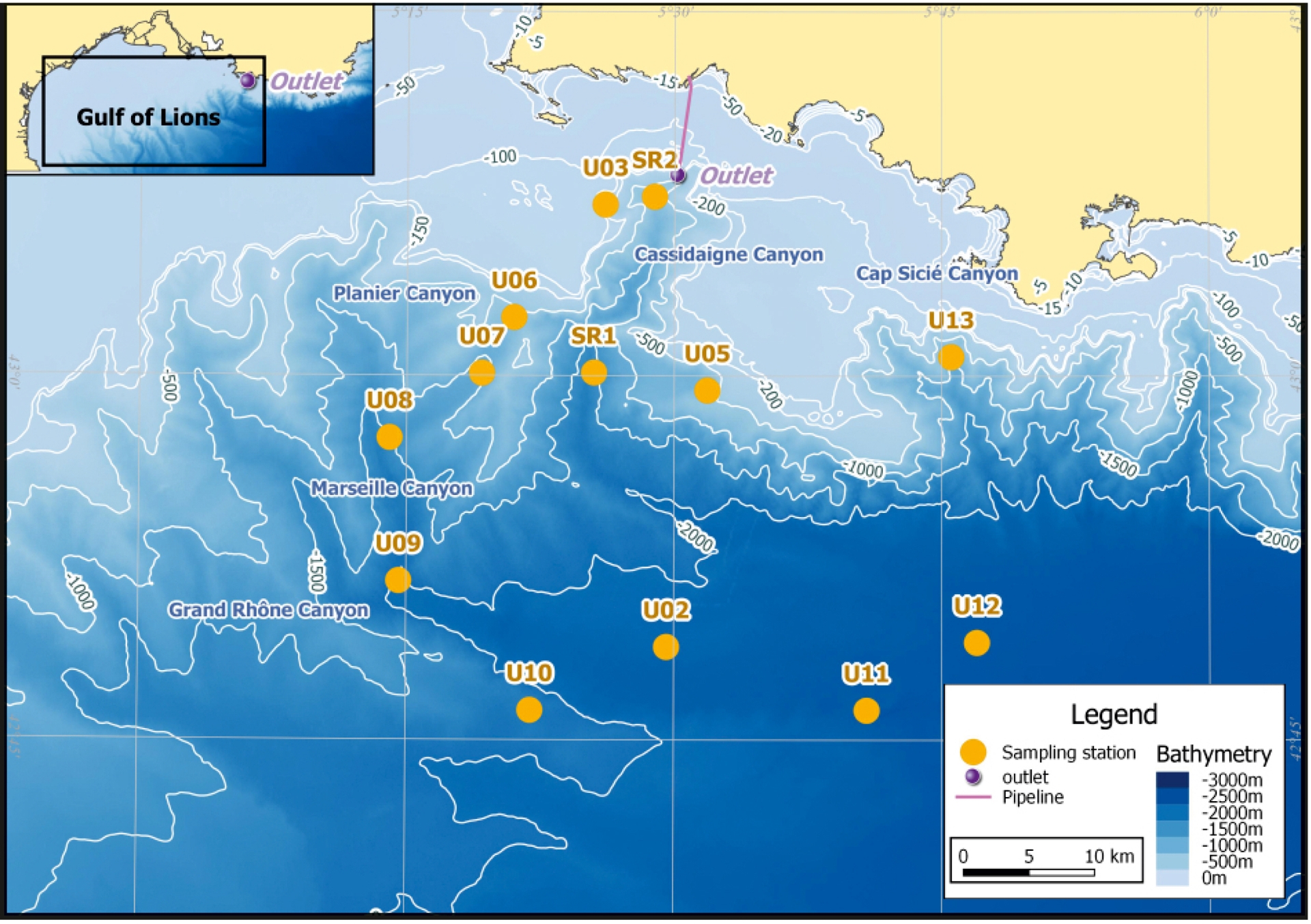
Our present study is based on sediment cores collected during a monitoring oceanographic cruise, which took place in winter and spring 2022. Thirteen stations were sampled within and around the Cassidaigne Canyon (Table 1; Figure 1). Eleven of these stations, starting with “U”, have already been studied by Fontanier, Biscara, et al. (2015), Fontanier, Mamo, et al. (2020) and the remaining two stations, SR1 and SR2, correspond approximately to sampling sites investigated in Fontanier, Fabri, et al. (2012). Both were studied by Fontanier, Mamo, et al. (2020). Stations U03 (292 m) and U05 (751 m) are located at the head and on the eastern flank of the Cassidaigne Canyon. Stations SR2 (747 m) and SR1 (1553 m) are situated along the Cassidaigne Canyon axis. Stations U06–U09 are along the Planier Canyon between ∼600–2000 m water depth. Both stations U02 and U10 are located along the deep valley where both the Marseille and Planier tributary canyons converge (>1800 m). Stations U11 and U12 (>2200 m) are under the influence of the Marseille/Planier/Cassidaigne Canyon system. Station U13 is located in the western branch of the Cap-Sicié Canyon (France), less than 7 km from the coast and around 25 km south-east of the pipe outlet.
Water depth, coordinates and physiographic settings of all stations sampled during the 2022 oceanographic cruises (winter and spring 2022)
| Station | Sampling date | Latitude | Longitude | Depth (m) | Settings | Horizontal distance from the pipeline outlet (km) | Visual detection of red mud deposits |
|---|---|---|---|---|---|---|---|
| U03 | 11/01/2022 | 43°07.05′N | 05°26.11′E | 292 | Head of the Cassidaigne Canyon | 5.9 | Reddish brown surface layer (several cm) |
| SR2 | 11/01/2022 | 43°07.38′N | 05°28.88′E | 747 | Axis of the Cassidaigne Canyon | 2.4 | Reddish brown sediment |
| U05 | 12/01/2022 | 42°59.40′N | 05°31.85′E | 751 | Eastern flank of the Cassidaigne Canyon | 17.3 | No |
| SR1 | 12/01/2022 | 43°00.13′N | 05°25.49′E | 1553 | Axis of the Cassidaigne Canyon | 16.3 | Reddish brown surface layer (several cm) |
| U13 | 27/04/2022 | 43°00.78′N | 05°45.54′E | 952 | Western Branch of the Cap-Sicié Canyon | 25 | No |
| U06 | 11/01/2022 | 43°02.34′N | 05°21.00′E | 605 | Head of the eastern branch of the Planier Canyon | 16.6 | Reddish brown surface layer (several cm) |
| U07 | 11/01/2022 | 43°00.09′N | 05°19.21′E | 1056 | Eastern branch of the Planier Canyon | 21.2 | Reddish brown surface layer (several cm) |
| U08 | 12/01/2022 | 42°57.43′N | 05°14.04′E | 1530 | Axis of the Planier Canyon | 29.7 | Reddish brown surface layer (several cm) |
| U09 | 13/01/2022 | 42°51.53′N | 05°14.58′E | 1968 | Axis of the Planier Canyon | 37.5 | Reddish brown surface layer (several cm) |
| U10 | 13/01/2022 | 42°46.22′N | 05°21.95′E | 1800 | Connection between both Marseille and Planier Canyons | 42.3 | Reddish brown patches at the sediment surface |
| U02 | 27/04/2022 | 42°48.83′N | 05°29.58′E | 2100 | Connection between both Marseille and Planier Canyons | 36 | Reddish brown patches at the sediment surface |
| U11 | 26/04/2022 | 42°46.22′N | 05°40.80′E | 2222 | Connection between Marseille/Planier and Cassidaigne Canyons | 43.3 | Reddish brown surface layer (cm) |
| U12 | 26/04/2024 | 42°49.01′N | 05°46.97′E | 2290 | Connection between Marseille/Planier and Cassidaigne Canyons | 42.3 | Reddish brown patches at the sediment surface |
In accordance with previous studies by Fontanier, Fabri, et al. (2012), Fontanier, Biscara, et al. (2015), Fontanier, Mamo, et al. (2020), reddish brown surface sediment was observed at most stations providing (with other physicochemical indicators such as the geochemical composition of sediment) qualitative evidence regarding the geographical and historical dispersal of bauxite residues (Table 1; CREOCEAN, 2018). Surface sediment (0–4 cm interval) Titanium (Ti) content, considered a geochemical proxy for red mud dispersal (Dauvin, 2010), matches relatively well with visual observations of the sediment–water interface (Fontanier, Mamo, et al., 2020). Extraordinarily high Ti values were recorded at station SR2 (∼32 000 μg⋅g−1 DW) and to a lesser degree, station SR1 (∼20 500 μg⋅g−1 DW) confirming that bauxite residues accumulated preferentially along the Cassidaigne Canyon axis (CREOCEAN, 2018). For comparison, the Ti content of the pipeline dispersed red mud before January 2016 was ∼70 000 μg⋅g−1 DW (SAFEGE, 2011). Nepheloid layers and sediment gravity flows are considered the main hydro-sedimentary processes responsible for transferring the bauxite-derived material from the pipeline outlet along the Cassidaigne Canyon axis (Dauvin, 2010; Fabri, Pedel, et al., 2014; Fontanier, Biscara, et al., 2015; Fontanier, Fabri, et al., 2012; Brun et al., 2023). Moderate to high Ti values were recorded at most of the other stations in adjacent canyons (between 3300 and 4400 μg⋅g−1 DW) even at great depths (∼5100 μg⋅g−1 DW at station U10, 1800 m). As suggested by Fontanier, Biscara, et al. (2015), the region’s episodically strong up- and downwelling currents coupled with efficient sediment transfer by both gravity and suspension flows could trigger the large spatial coverage of the natural and Ti-laden seafloor sediments. In contrast, samples from station U05 (725 m) and U13 (958 m) yielded relatively low Ti content (respectively ∼3400 and ∼3100 μg⋅g−1 DW) (Fontanier, Biscara, et al., 2015; Fontanier, Fabri, et al., 2012). As already discussed in Fontanier, Biscara, et al. (2015), both stations U05 and U13 are located in canyon areas not accessible by bauxite residue. Stations U11 (2222 m), U12 (2290 m) and U02 (2100 m) located at the deeper connections between the Marseille, Planier and Cassidaigne Canyons, also exhibit low Ti content (between 2700 and 3100 μg⋅g−1 DW).
3. Material and methods
Although our intention was to retrieve samples in boreal autumn (as had been the case in 2010, 2012 and 2016) (Fontanier, Fabri, et al., 2012; Fontanier, Biscara, et al., 2015; Fontanier, Mamo, et al., 2020), particularly unfavourable weather conditions in September and October 2021 led to the expedition’s cancellation and sampling was delayed until the boreal winter of 2022. Again, due to bad weather, only nine of the thirteen planned stations were sampled in January 2022. The four remaining stations were finally investigated in April 2022 (Table 1). For this study, all the samples from winter and spring 2022 are grouped together for comparison with those from previous campaigns (e.g., 2016). However, we are aware that the 2022 samples incorporate the spatio-temporal variability inherent in sampling over two seasons. Therefore, this paper constitutes a snapshot of ecological conditions prevailing during January and April 2022 in the Cassidaigne Canyon and surrounding area, almost six years after the last sampling cruise (Fontanier, Mamo, et al., 2020).
3.1. Sampling
Sediment samples were collected with an USNEL-type box corer (surface area of 2500 cm2). Two deployments were conducted at all sites (Figure 1). In the first box core, two sectors with equal surfaces (1250 cm2) were defined with a plastic plate. One sector was subsampled with a Plexiglas tube (internal diameter of 9.3 cm, surface area of 68 cm2). The uppermost 2 cm of this sediment core were sliced into half-centimeter intervals and dedicated to foraminiferal analyses. As explained above, because of meteorological constraints (strong swell), the box corer could not be deployed at stations U13 (952 m), U02 (2100 m), U11 (2222 m) and U12 (2290 m) in January 2022. There, sediment cores were collected in April 2022, three months later. To understand overall ecosystem variability, triplicates are recommended at each sampling site (Schönfeld et al., 2012). Despite this, most ecological papers studying deep-sea living (stained) foraminiferal communities use only one core per site. To facilitate effective comparisons between previous work of this kind, we have also only used one core per site. Nevertheless, readers should consider our observations and interpretations with care as they may be biased by potential spatial (cm- to m- scale) variability that we cannot fully account for with our datasets.
3.2. Benthic foraminiferal analysis
Whilst on board, sediment samples dedicated to foraminiferal study were transferred to 250 cm3 bottles filled with 95% ethanol containing 2 g⋅L−1 Rose Bengal stain, commonly used to identify live foraminifera (Murray and Bowser, 2000; Walton, 1952). All samples were gently shaken for several minutes to obtain a homogeneous mixture. Some weeks after the spring-2022 cruise they were sieved through a 125 μm screen and the sieve residues were stored in 95% ethanol. Well-stained foraminifera (all chambers excluding the final stained bright pink) were sorted into wet samples and stored in Plummer slides. Strict staining criteria were applied and doubtful individuals without perfectly stained tests were not included. Miliolid and non-transparent agglutinated taxa were broken for inspection of the interior of the test. Most live foraminifera were identified at the species level. All data generated or analysed during this study are included in this published article (see Supplementary Material). At each station, the total number of stained individuals found in each core (surface area of 68 cm2) was normalized to an area of 100 cm2 so that the resulting density could be compared with previous surveys and other studies conducted in other geographic areas. Diversity indices including simple diversity S (representing the number of species), Shannon index H′ (log base e), Rarefied Species Richness E(S35) and Dominance index D were calculated (Hayek and Buzas, 1997; Murray, 2006) (using PAST software by Hammer et al., 2001). These faunal descriptors were based on counts of stained specimens from the four depth horizons analysed in each core.
Although we understand the value of studying either juvenile or preadult individuals (belonging to the <125 μm size fraction) and any opportunistic foraminifera belonging to this size class, this work was carried out as part of a contractual service for a consulting firm, and the samples were processed according to a protocol established in accordance with previous foraminiferal studies conducted in the study area (Fontanier, Biscara, et al., 2015; Fontanier, Mamo, et al., 2020). As in the temporal monitoring, only the >125 μm size fraction was studied; the <125 μm size fraction residues were not preserved and cannot be studied.
4. Results
4.1. Foraminiferal standing stocks and diversity
Foraminiferal standing stocks ranged between ∼100 (U12, 2290 m) and ∼1500 (U03, 292 m) individuals per 100 cm2 (Figure 2). Values were lower (<260 individuals⋅100 cm−2) at depths greater than 1500 m compared to shallower stations. Simple diversity (S) varied between 16 (SR1, 1553 m) and 82 (U03, 265 m) taxa (Figure 3). Diversity generally decreased with increasing water depth, with S values lower than 34 species below 1600 m. The only exception is the station SR2 (747 m) located along the Cassidaigne Canyon axis, where only 26 taxa were identified. Shannon index H′ and Rarefied Species Richness E(S30) followed the same trend (Figure 3) with higher values recorded at both stations U13 (952 m) and U03 (292 m). Station SR1 presents low H′ (1.9) and E(S30) (9) values corresponding to the very low simple diversity and relatively high dominance. Dominance index D and Shannon index values were inversely related. When the above data are compared with the data from the autumn 2016 campaign, faunas gathered in winter and spring 2022 are generally denser and more diverse, particularly at the shallower stations.
Standing stocks (No. Ind. 100 cm−2) of living (stained) foraminiferal faunas at the 13 investigated stations. Stations are arranged by both physiographic setting and increasing depth. A graphical comparison is proposed between the data from this study (winter and spring 2022) and the autumn 2016 data (Fontanier, Mamo, et al., 2020). Asterisks indicate stations sampled in spring 2022 (compared to others sampled in winter 2022).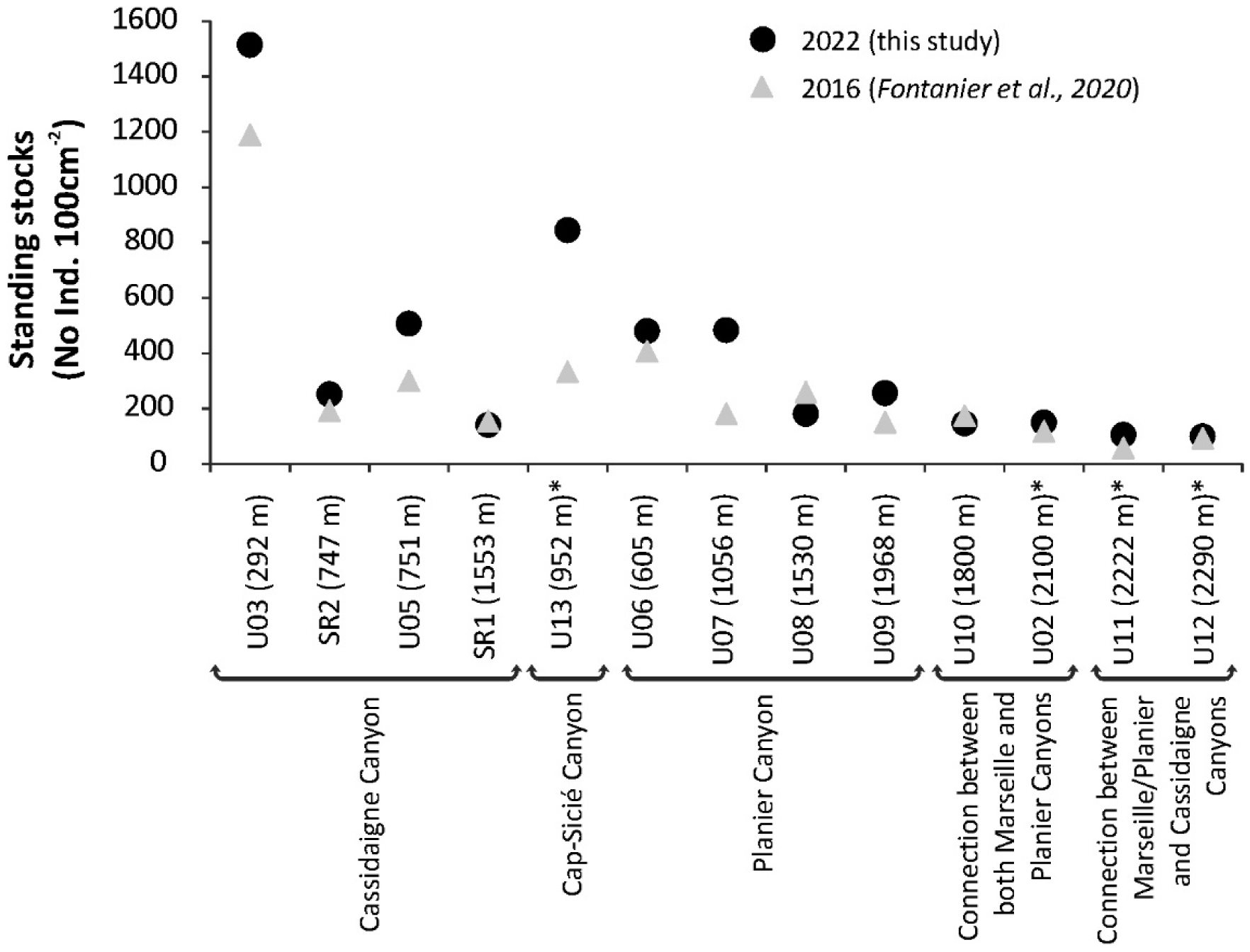
Simple diversity S, Shannon diversity index H′, Rarefied Species Richness E(S30) and Dominance index D of living (stained) foraminiferal faunas at the 13 investigated stations. Stations are arranged by both physiographic setting and increasing depth. The data from this study (winter and spring 2022) and the autumn 2016 study (Fontanier, Mamo, et al., 2020) is illustrated for effective comparison. The shaded column corresponds to station SR2, which showed a historical alteration of foraminiferal diversity during previous sampling periods (i.e., autumns 2010 and 2016, Fontanier, Fabri, et al., 2012; Fontanier, Mamo, et al., 2020). Asterisks indicate stations sampled in spring 2022 (compared to others sampled in winter 2022).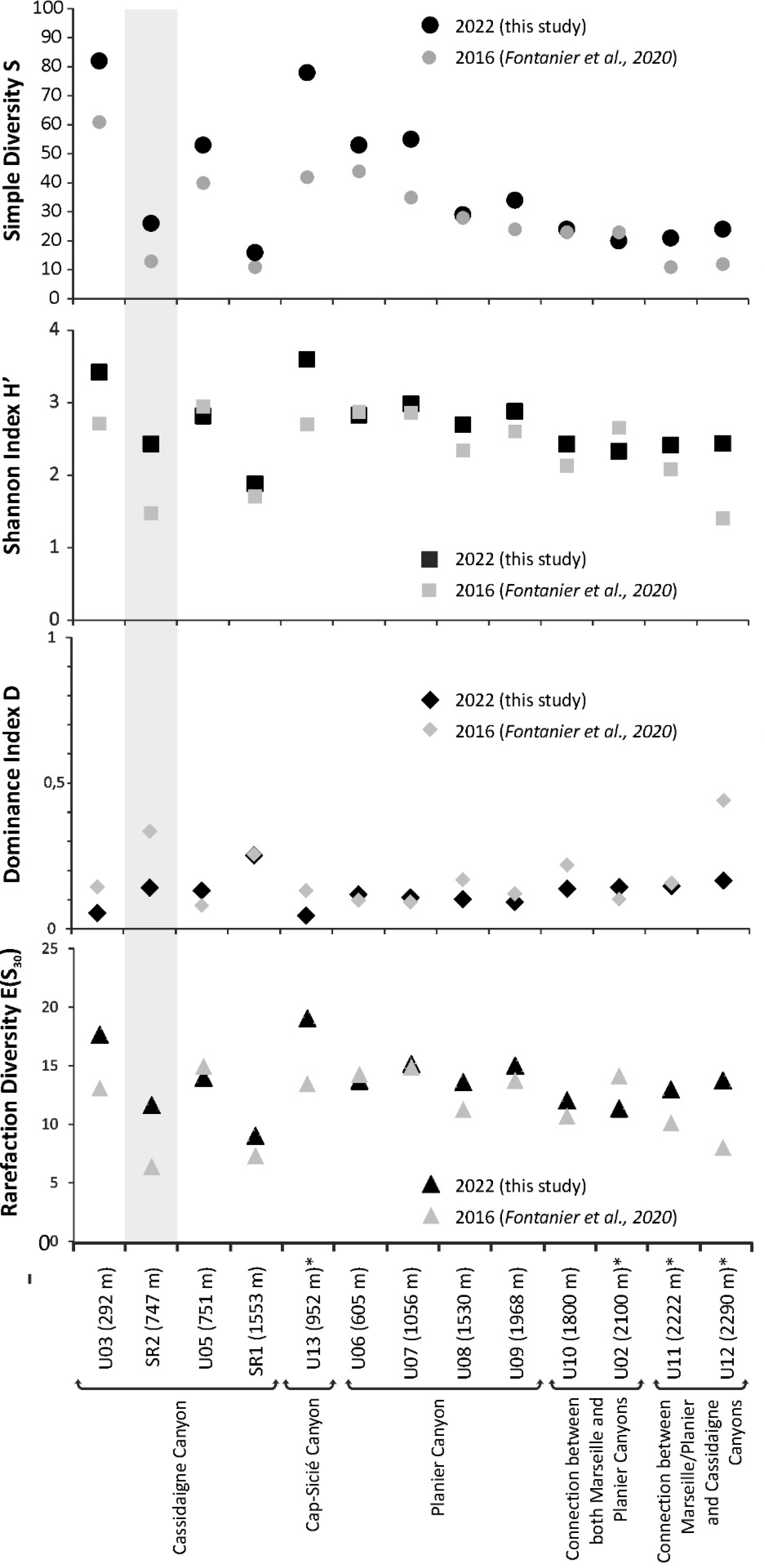
4.2. Faunal composition
At the head of the Cassidaigne Canyon (station U03, 292 m), Hoeglundina elegans (d’Orbigny, 1826) (13%), Uvigerina elongatastriata (Colom, 1952) (11%) and Melonis barleeanus (Williamson, 1858) (9.5%) dominated a relatively well-diversified living fauna (Figure 4). Along the axis of the Cassidaigne Canyon (station SR2, 747 m), Gyroidina orbicularis d’Orbigny, 1826 (29%), Bulimina marginata d’Orbigny, 1826 (16%) and Gyroidina altiformis Stewart & Stewart, 1930 (11%) were dominant. At the same depth on the eastern flank of the Cassidaigne Canyon (station U05, 751 m), Uvigerina mediterranea Hofker, 1932 (31%) dominated the living fauna. Melonis barleeanus (Williamson, 1858) (13%) and Uvigerina peregrina Cushman, 1923 (7%) were secondary taxa. At station SR1 (1553 m) located along the Cassidaigne Canyon axis, foraminiferal fauna was dominated by M. barleeanus (Williamson, 1858) (45%), U. mediterranea Hofker, 1932 (17%) and U. peregrina Cushman, 1923 (7%). In the Sicié Canyon, at station U13 (952 m) sampled in spring 2022, M. barleeanus and U. mediterranean (∼11%) were the most abundant species. Along the upper part of the Planier Canyon axis (stations U06, U07 and U08, <1530 m water depth), U. mediterranea and M. barleeanus were dominant. The relative contribution of U. mediterranea ranged between 14% and 24%, whereas the relative abundance of M. barleeanus was ∼20%. At station U06 (605 m), Bigenerina nodosaria d’Orbigny, 1826 was a substantial faunal component (∼10%). Uzbekistania charoides (Jones & Parker, 1860) (13%) and Nodellum membranaceum (Brady, 1879) (12%) were secondary taxa at station U08 (1530 m). In the deepest part of the Planier Canyon (U09, 1968 m), M. barleeanus was still an important species (14%). But N. membranaceum (22%) was the most abundant taxon. At station U09 (1800 m), Thurammina albicans Brady, 1879 (25%) dominated the living fauna. Melonis barleeanus was abundant (20%) whereas N. membranaceum (13%) was a substantial faunal component. Deeper than ∼2000 m, N. membranaceum was the dominant species with percentages between 20% (U11, 2222 m) and 36% (U12, 2290 m) (Figure 4). Melonis barleeanus was also abundant in living fauna with a relative contribution of 13% at station U12 and 30% at station U11. Lagenammina calcarea (Cushman, 1947) was a substantial taxon at both station U02 (2100 m) (19%) and station U11 (2222 m) (8%).
Composition of benthic live (stained) foraminiferal faunas at the 13 investigated stations. Only major species (at least >5% at one site) are illustrated. Stations are arranged by both physiographic setting and increasing depth. Asterisks indicate stations sampled in spring 2022 (compared to others sampled in winter 2022).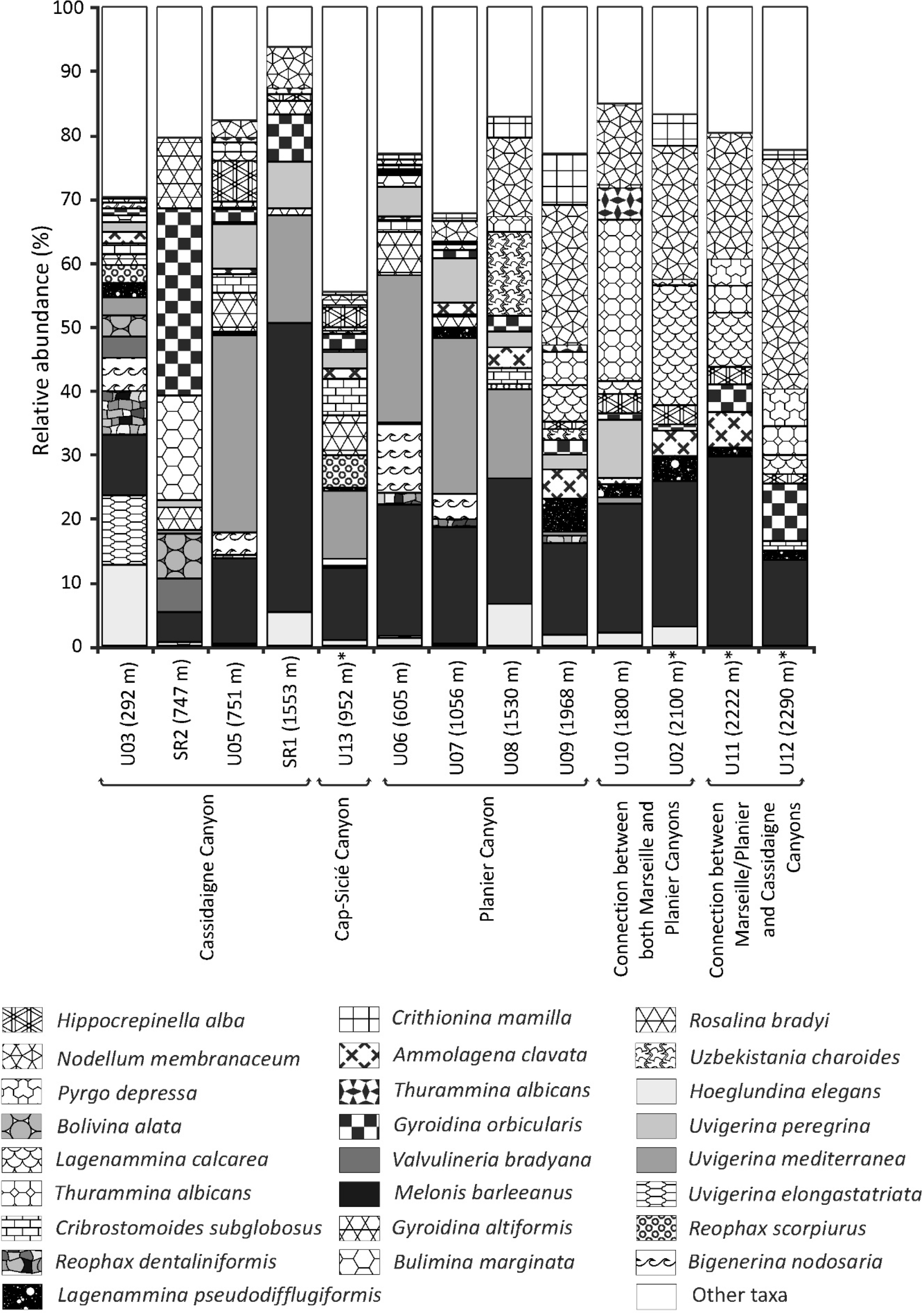
5. Discussion
There are multiple studies on living foraminifera from the Gulf of Lions and the Ligurian Sea prior to our present study (G. Bizon and J. J. Bizon, 1984; Contreras-Rosales et al., 2012; De Rijk et al., 2000; Fontanier, Biscara, et al., 2015; Fontanier, F. J. Jorissen, Geslin, et al., 2008; Fontanier, F. J. Jorissen, Lansard, et al., 2008; Goineau, Fontanier, F. Jorissen, et al., 2012; Goineau, Fontanier, F. J. Jorissen, et al., 2011; Schmiedl et al., 2000). They provide reliable information concerning what we might expect in terms of natural foraminiferal abundance and distribution in the region. Furthermore, a foraminiferal response to red mud pollution in the axis of the Cassidaigne Canyon has already been documented by Fontanier, Fabri, et al. (2012), Fontanier, Mamo, et al. (2020). Both works and other recent papers regarding foraminiferal recolonization in canyon settings (Duros, Fontanier, Metzger, Cesbron, et al., 2013; Duros, Fontanier, Metzger, Pusceddu, et al., 2011; Hess and F. J. Jorissen, 2009; Hess, F. J. Jorissen, et al., 2005) provide a reliable basis on which to assess the potential impact of red mud dispersal on foraminiferal biodiversity and its potential resilience since January 2016, when red mud dispersal ceased.
5.1. Trophic control on foraminiferal faunas in the Cassidaigne Canyon and surrounding area
Low-diversity (S < 34 taxon; H′ < 2.9) and low-density (<260 individuals⋅100 cm−2) foraminiferal faunas are observed on the distal lower slope (>1500 m) compared to more diverse and densely populated communities documented from almost all shallower stations (except station SR2) (Figures 2 and 3). This faunal distribution pattern was already documented by Fontanier, Biscara, et al. (2015), Fontanier, Mamo, et al. (2020) based on samples collected in September 2012 and in September–October 2016. It is likely related to the natural scarcity of food (i.e. sedimentary organic matter) with water depth. This deep basin food impoverishment echoes (1) the natural decrease in exported primary productivity (i.e. fresh phytodetritus) with increasing water depth and (2) the naturally diminishing lateral advection of degraded organic compounds from neritic areas to deeper stations (Fontanier, Biscara, et al., 2015; Fontanier, Mamo, et al., 2020). Compared to autumn 2016, Station U13 (952 m) is particularly diverse in spring 2022 (78 compared to 42 taxa in 2016) and presents relatively high foraminiferal standing stocks (850 compared to 330 individuals⋅100 cm−2 in 2016) (Figures 2 and 3). This interannual difference is likely a result of organic matter enhanced flux related to phytoplankton spring bloom, in April 2022. It is notable that the export of phytodetritus to the deepest stations (U02, U11 and U12; >2100 m) that were also sampled in spring 2022 had no remarkable effect on the diversity and density of foraminiferal faunas compared with the autumn 2016 samples.
A detailed analysis of the faunal composition of all the stations (with the exception of station SR2) shows that three major species dominate. Melonis barleeanus is a major taxon (>10%) at all stations (between 265–2280 m), particularly at station SR1 (45%, 1530 m). This species is abundant in mesotrophic and well-oxygenated environments (Caralp, 1989a; Caralp, 1989b; Duros, Fontanier, Metzger, Cesbron, et al., 2013; Duros, Fontanier, Metzger, Pusceddu, et al., 2011; Fontanier, F. J. Jorissen, L. Licari, et al., 2002; Fontanier, F. J. Jorissen, Chaillou, Anschutz, et al., 2005; Fontanier, F. J. Jorissen, Chaillou, David, et al., 2003; Fontanier, F. J. Jorissen, Geslin, et al., 2008; Fontanier, F. J. Jorissen, Lansard, et al., 2008; Fontanier, Biscara, et al., 2015; Koho, Kouwenhoven, et al., 2007; Kurbjeweit et al., 2000; L. N. Licari et al., 2003; Schmiedl et al., 2000). In both open slope and canyon settings, M. barleeanus thrives generally in intermediate infaunal microhabitats, some centimetres below the sediment–water interface, where it feeds on degraded organic matter. This species is generally absent in mature canyons where gravity flows trigger destruction/recolonisation of benthic foraminiferal habitats (Hess and F. J. Jorissen, 2009; Hess, F. J. Jorissen, et al., 2005). Our observations support the assumption that most of the bathyal stations are characterized by the deposition of low-quality organic compounds, either transported laterally by along-slope currents (i.e. nepheloid layer) or related to decaying phytodetritus, previously exported to the seafloor during a bloom. The dominance of U. mediterranea at most stations located at a depth of less than 1500 m (with the exception of station SR2) is in agreement with upper slope faunas described in the western Mediterranean Sea. This species is generally documented as a shallow infaunal taxon able to feed on relatively fresh organic phytodetritus in mesotrophic ecosystems (Contreras-Rosales et al., 2012; De Rijk et al., 2000; Duros, Fontanier, Metzger, Cesbron, et al., 2013; Duros, Fontanier, Metzger, Pusceddu, et al., 2011; Eberwein and Mackensen, 2006; Fontanier, F. J. Jorissen, Anschutz, et al., 2006; Fontanier, F. J. Jorissen, Chaillou, David, et al., 2003; Fontanier, F. J. Jorissen, Lansard, et al., 2008; Fontanier, F. J. Jorissen, L. Licari, et al., 2002; Koho, García, et al., 2008; Koho, Kouwenhoven, et al., 2007; Schmiedl et al., 2000). The notable presence of Rosalina bradyi (Cushman, 1915) at stations U05 (751 m), U13 (952 m) and U06 (U06) is in perfect agreement with previous observations in autumn 2016 (Fontanier, Mamo, et al., 2020). This taxon is abundant in shelf ecosystems with a preference for an epiphytic and/or epilithic life habit (Fontanier, F. J. Jorissen, Geslin, et al., 2008). Whilst attached to vegetation, individuals of this species can be transported by bottom currents into canyons (ibid.). Therefore, the occurrence of R. bradyi at our sample sites further underlines a natural source-to-sink connection in terms of organic supply and sediment transfer between upper-slope environments and deeper adjacent shelves. Below 2000 m, Nodellum membranaceum, Thurammina albicans Brady, 1879, and Lagenammina calcarea constitute substantial components of living faunas, coinciding with autumnal 2012 and autumnal 2016 faunal patterns (Fontanier, Biscara, et al., 2015; Fontanier, Mamo, et al., 2020). All above-mentioned species are typical of oligotrophic basins from the western Mediterranean Sea (G. Bizon and J. J. Bizon, 1984; De Rijk et al., 2000; Fontanier, Biscara, et al., 2015; Fontanier, Fabri, et al., 2012; Fontanier, F. J. Jorissen, Lansard, et al., 2008; Fontanier, Mamo, et al., 2020). This suggests that our deeper sample sites (>2000 m) are not affected by the high input of organic compounds.
To summarize, the ecological observations made in winter and spring 2022 show that the benthic fauna at almost all the stations (except station SR2, see below) are constrained by meso-oligotrophic conditions. The least diverse fauna, living on little degraded organic matter, occupy the deep basin, while the densest and most diverse fauna develop on the upper part of the slope, where the accumulation of fresh and degraded organic matter is higher.
5.2. Questionable ecological recovery along the axis of the Cassidaigne Canyon
In autumn 2012, a 725 m-deep sample site located very close to station SR2 (747 m) was characterised by a very low-diversity community (S = 3 and H′ = 0.76) which was dominated by Gyroidina umbonata (70%) and Bulimina marginata (25%) (Fontanier, Fabri, et al., 2012). Bulimina marginata has been documented as an opportunistic species living in outer-shelf and upper-slope environments, at both early and advanced stages of recolonization in mature canyons (e.g. Fontanier, F. J. Jorissen, Chaillou, David, et al., 2003; Hess, F. J. Jorissen, et al., 2005; Langezaal et al., 2006; Hess and F. J. Jorissen, 2009; Goineau, Fontanier, F. J. Jorissen, et al., 2011). Considered an opportunistic and pioneer taxa, G. umbonata and B. marginata were then indicative of intense hydro-sedimentary pollution due to red mud deposition and remobilisation along the axis of the Cassidaigne Canyon. In autumn 2016 (ten months after the cessation of bauxite residues dumping), station SR2 (747 m) was characterized by a slightly higher diversity (but still low) (S = 13; H′ = 1.67) suggesting an ongoing recolonization of contaminated substrate. Bulimina marginata (50%), Gyroidina altiformis (27%) and G. umbonata (3%) dominated, contributing 80% of the living community. Although G. altiformis had been documented as a very low contributor (<2%) of bathyal foraminiferal faunas in the Western Mediterranean Sea and the North-east Atlantic Ocean (e.g., Contreras-Rosales et al., 2012; Duros, Fontanier, Metzger, Pusceddu, et al., 2011; Duros, Fontanier, Metzger, Cesbron, et al., 2013; Fontanier, Biscara, et al., 2015; Fontanier, F. J. Jorissen, L. Licari, et al., 2002; Fontanier, F. J. Jorissen, Geslin, et al., 2008; Fontanier, F. J. Jorissen, Lansard, et al., 2008), its strong contribution in the axis of the Cassidaigne canyon demonstrated its ability to proliferate in a stressed community recovering from ecosystem upheaval. In winter 2022 (our present study), station SR2 (747 m) is characterized by a diversity higher (S = 26; H′ = 2.43) than previous samplings. However, diversity indices remain still lower compared to station U05 (S = 53; H′ = 2.82) located at the same depth on a flank of the Cassidaigne canyon. The two opportunistic species B. marginata and G. altiformis account for 16% and 11% respectively of living fauna, which is dominated by Gyroidina orbicularis (29%). Gyroidina orbicularis has already been described between 500 and 2000 m depth on the open slopes of the Gulf of Lions and the Bay of Biscay (Fontanier, F. J. Jorissen, L. Licari, et al., 2002; Fontanier, F. J. Jorissen, Lansard, et al., 2008). With lower contributions than in our study area (∼10% between 1000 and 1500 m in the Gulf of Lions, and 10% at 2000 m in the Bay of Biscay), it is considered an indicator species for meso-oligotrophic conditions prevailing in the middle and lower well-oxygenated slopes (Fontanier, F. J. Jorissen, L. Licari, et al., 2002; Fontanier, F. J. Jorissen, Lansard, et al., 2008). Gyroidina orbicularis is a further species of note in that it generally occupies an intermediate infaunal microhabitat, several centimetres below the water-sediment interface (e.g., Fontanier, F. J. Jorissen, L. Licari, et al., 2002; Fontanier, F. J. Jorissen, Lansard, et al., 2008). Such a living position suggests an ability to tolerate the stress (i.e. hypoxia) of living in subsurface sediments, but certainly does not suggest opportunistic behaviour such as that observed in species normally proliferating disturbed sediments. Furthermore, the faunal association observed at station SR2 in winter 2022 (association between G. orbicularis and the opportunistic species B. marginata and G. altiformis) as well as the relatively high diversity indices of the sampled fauna supports the hypothesis of an ecosystem in biotic recovery, marked episodically by benthic habitat disturbance. In Figure 5, we illustrate the proportion of opportunistic foraminiferal taxa which were documented as potential recolonizers of freshly disturbed areas (Psammosphaera spp., Saccammina spp., Technitella spp., R. scorpiurus, Quinqueloculina seminula (Linneaus, 1758), G. altiformis, G. umbonata, B. marginata) (Fontanier, Fabri, et al., 2012; Fontanier, Metzger, et al., 2013; Hess and F. J. Jorissen, 2009; Hess, F. J. Jorissen, et al., 2005; Hess and Kuhnt, 1996; Kaminski, 1985; Fontanier, Mamo, et al., 2020). At station SR2, opportunistic and pioneer taxa which constituted ∼80% of the fauna in autumn 2016, represent ∼30% of the community sampled in 2022 (six years after the cessation of red mud dumping). Yet at all stations except SR2, opportunistic recolonizers account for less than 10% of the living faunas (Figure 5) where benthic foraminifera thrive in relatively stable ecosystems and natural trophic conditions control diversity, density and composition.
Relative abundance (%) of opportunistic and stress-tolerant foraminiferal taxa that are considered potential recolonizers of freshly disturbed areas (Psammosphaera spp., Saccammina spp., Technitella spp., Quinqueloculina seminula, Gyroidina umbonata, Gyroidina altiformis, Bulimina marginata). To facilitate effective comparison, the data from this study (winter and spring 2022) and the autumn 2016 study (Fontanier, Mamo, et al., 2020) are both illustrated. Asterisks indicate stations sampled in spring 2022 (compared to others sampled in winter 2022).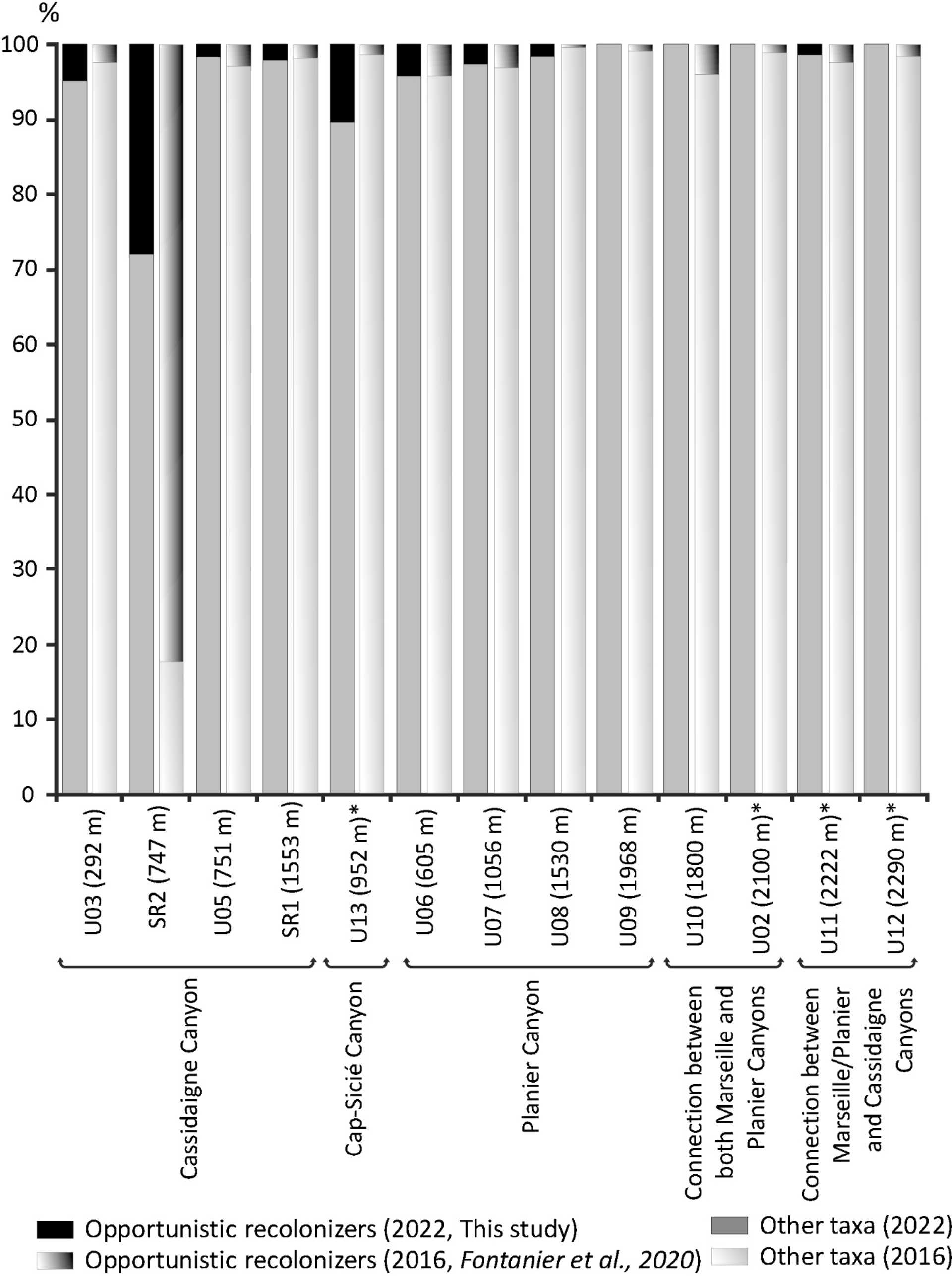
Before drawing any hasty conclusions from our observations concerning station SR2, whose benthic fauna has historically been impacted by red mud (Fontanier, Fabri, et al., 2012; Fontanier, Mamo, et al., 2020), it is important to remember that the samples taken in winter 2022 (our study) do not correspond to the previous sampling periods (autumns 2012 and 2016; Fontanier, Fabri, et al., 2012; Fontanier, Mamo, et al., 2020). Autumn is generally a period of very low primary production in surface waters in our study area (Fraysse et al., 2013), whereas upwellings in winter (spring and summer) can occasionally increase the productivity of surface waters. With this in mind, it should therefore be considered that the increase in diversity in the Cassidaigne Canyon axis in winter 2022 could simply be linked to a higher density of fauna in relation to greater inputs of organic matter compared with autumnal periods. To better assess the possible recovery of the Cassidaigne Canyon ecosystems, it would be important to collect new samples in the autumn to compare with historical faunas (Fontanier, Fabri, et al., 2012; Fontanier, Mamo, et al., 2020).
6. Conclusions
During an environmental survey performed in winter and spring 2022, living (stained) benthic foraminiferal faunas were investigated at 13 stations sampled within the Cassidaigne Canyon (NW Mediterranean Sea) and surrounding area. These stations are located between 265–2300 m water depth. For many decades, industrial bauxite residues of red mud have been dumped into the canyon via a submarine pipe, causing physical disturbance and chemical contamination. In January 2016, underwater solid waste dispersal ceased and was replaced with the dumping of a low-density liquid effluent. Six years after the cessation of red mud dispersal, our observations at the 725-m-depth station closest to the Cassidaigne Canyon submarine outlet show a better ecological quality compared to the 2012 (during the red mud dumping) and 2016 (ten months after the cessation of dumping) samplings, suggesting a putative biotic recovery at the seafloor. However, this 725-m-depth station still presents the highest abundance of opportunistic species (e.g. Bulimina marginata), and a noticeably altered benthic diversity (compared to other stations at a similar depth but not the canyon axis). At the other twelve stations, foraminiferal standing stocks and simple diversity decrease by decreasing food input to the seafloor and increasing water depth. There, foraminiferal composition with a minor contribution of opportunistic and stress-tolerant species echoes (1) the overall meso-oligotrophic patterns of a relatively stable ecosystem and (2) the putative trophic effect of phytodetritus exportation for samples gathered in spring 2022.
Acknowledgements
We thank the crew members of R/V “JANUS II” and all scientific participants on the 2022 oceanographic cruises. CF (first author of this paper) performed foraminiferal analyses in the framework of an industrial contract linking financially the FORAM Research Group and CREOCEAN (www.creocean.fr) to ALTEO. ALTEO allowed authors to use foraminiferal data for this publication. The Titanium dataset generated during the current study is not publicly available due contractual constraints linking CREOCEAN to ALTEO ALUMINA but is available from the corresponding author and the co-authors working in CREOCEAN on a reasonable request. Finally, we want to thank an anonymous reviewer for his/her comments on the first manuscript.
Declaration of interests
The authors do not work for, advise, own shares in, or receive funds from any organization that could benefit from this article, and have declared no affiliations other than their research organizations.
Supplementary materials
Supporting information for this article is available on the journal’s website under https://doi.org/10.5802/crgeos.341 or from the author.