




Plan

Opinion / Perspective
The value of “One Health” modelling in zoonotic diseases epidemiology and public health
[L’intérêt de la modélisation « Une Seule Santé » en santé publique et épidémiologie des maladies zoonotiques]
Comptes Rendus. Biologies, Volume 349 (2026), pp. 223-229

Résumés

Assessing the impact of control and prevention strategies on zoonotic diseases in human populations requires the use of formal modelling frameworks, integrating animal, environmental and human data. However, such quantitative “One Health” approaches to guide public health interventions are, to date, overlooked. Their implementation could be facilitated by improved access to epidemiological, demographic, and contact data on different hosts, by improved training of epidemiologists and modellers through relevant multidisciplinary research career paths, and finally by improving institutional support for better visibility.

Évaluer l’impact des mesures de contrôle et de prévention des zoonoses en population humaine nécessite l’utilisation d’approches de modélisation quantitatives, intégrant des données sur les animaux, l’environnement et l’humain. Cependant, ces approches quantitatives « Une Seule Santé » visant à guider les interventions en santé publique sont à ce jour peu développées. Leur mise en œuvre serait facilitée par un meilleur accès aux données épidémiologiques, démographiques, et de contact entre les différents hôtes impliqués, par une meilleure orientation des jeunes chercheurs en épidémiologie et modélisation vers une trajectoire de recherche multidisciplinaire adaptée, et enfin par un soutien institutionnel améliorant la visibilité de ces approches.

Métadonnées
Reçu le :
Révisé le :
Accepté le :
Publié le :
DOI : 10.5802/crbiol.204
Keywords: Zoonoses, Public health, One Health modelling, Epidemiology of infectious diseases
Mots-clés : Zoonoses, Santé publique, Modélisation « Une Seule Santé », Épidémiologie des maladies infectieuses

Raphaëlle Métras  1

1 Sorbonne Université, INSERM, Sorbonne Public Health Institute (SPH), F75012 Paris, France
Licence : CC-BY 4.0
Droits d'auteur : Les auteurs conservent leurs droits
Raphaëlle Métras. The value of “One Health” modelling in zoonotic diseases epidemiology and public health. Comptes Rendus. Biologies, Volume 349 (2026), pp. 223-229. doi: 10.5802/crbiol.204
@article{CRBIOL_2026__349_G1_223_0,
     author = {Rapha\"elle M\'etras},
     title = {The value of {{\textquotedblleft}One} {Health{\textquotedblright}} modelling in zoonotic diseases epidemiology and public health},
     journal = {Comptes Rendus. Biologies},
     pages = {223--229},
     year = {2026},
     publisher = {Acad\'emie des sciences, Paris},
     volume = {349},
     doi = {10.5802/crbiol.204},
     language = {en},
}
TY  - JOUR
AU  - Raphaëlle Métras
TI  - The value of “One Health” modelling in zoonotic diseases epidemiology and public health
JO  - Comptes Rendus. Biologies
PY  - 2026
SP  - 223
EP  - 229
VL  - 349
PB  - Académie des sciences, Paris
DO  - 10.5802/crbiol.204
LA  - en
ID  - CRBIOL_2026__349_G1_223_0
ER  - 
%0 Journal Article
%A Raphaëlle Métras
%T The value of “One Health” modelling in zoonotic diseases epidemiology and public health
%J Comptes Rendus. Biologies
%D 2026
%P 223-229
%V 349
%I Académie des sciences, Paris
%R 10.5802/crbiol.204
%G en
%F CRBIOL_2026__349_G1_223_0

Version originale du texte intégral (Proposez une traduction )

Le texte intégral ci-dessous peut contenir quelques erreurs de conversion par rapport à la version officielle de l'article publié.

Zoonotic diseases are infectious diseases that can be transmitted from animals to humans, and vice versa. They represent about 60% of infectious diseases and 70% of emerging ones (Jones et al., 2008; Taylor et al., 2001; Woolhouse, 2002). Zoonotic pathogens are maintained within animal populations (or at the interface between animals and the environment) and can be transmitted to humans upon circumstances favouring contact between animals and humans, such as handling infectious animals or during outdoors activities.

Current global challenges, such as climate change, urbanisation, human population growth and mobility, agricultural practices or deforestation (IPBES, 2019), contribute to increasing opportunities of contacts between animals and humans, and, therefore, of zoonotic pathogen transmission. In this context, approaches that integrate animals, humans and the environment are needed to better prevent, limit and control the impact of future (re)emergences. This is one of the visions that is being promoted by “One Health” initiatives, which have been under the spotlight and redefined in recent years by the quadripartite One Health High-Level Expert Panel (OHHLEP), including the Food and Agriculture Organization of the United Nations (FAO), the United Nations Environment Programme (UNEP), the World Health Organization (WHO) and the World Organisation for Animal Health (WOAH) (WHO, 2026) and highlighted further at the international “One Health” summit in Lyon in April 2026 (French Ministry of Higher Education and Research, 2026).

To combat zoonoses in human populations, it is important to distinguish two types of zoonotic pathogens based on their between-human transmission potential (Figure 1, Text Box 1): (i) zoonotic pathogens for which between-human transmission is the predominant transmission route, such as Ebola, Dengue, SARS-COV-2 (defined as “case 1” in Figure 1A and Text Box 1), and (ii) zoonotic pathogens with none or limited between-human transmission, such as West Nile fever, Borrelia burgdorferi, rabies (defined as “case 2” in Figure 1C and Text Box 1) (Baum, 2008). In “case 1”, most human infections result from between-human transmission events, whilst in “case 2” the large majority of human infections will result from several zoonotic transmission events. For details on definitions, see Text Box 1.

Text Box 1. Two types of zoonotic pathogens based on their between-human transmission potential and implications in public health, and diversity of zoonotic transmission pathways

Case 1. Zoonotic pathogens with predominant between-human transmission (Figure 1A,B). For such pathogens, the majority of human infections result from between-human transmission events (via a vector or not). Exemplar pathogens are Ebola, Dengue, SARS-COV-2, etc. Factors such as human mobility, contact patterns, and entomological factors, when relevant, are major components to study pathogen transmission (Cheng et al., 2025; Harish et al., 2024; Taube et al., 2025). Combating such epidemics focuses mainly on implementing control strategies for the human host, and the value of modelling in this context has now been established, especially following the SARS-CoV-2 pandemic (Colosi et al., 2022; de Meijere et al., 2023; Kucharski et al., 2020; van Kleef et al., 2025). For “case 1” zoonotic pathogens, the “One Health” vision may be used to trace back the animal origin of the pathogen, for example by combining genomics approaches and outbreak investigations (Catalano et al., 2024; Kawasaki et al., 2025; Pekar et al., 2022). It may then be useful to stress that reducing human encroachment in wild habitats and the trade of wild animal products may limit risks of novel emergence in the long term (Morand et al., 2014).

Case 2. Zoonotic pathogens with none or limited between-human transmission (Figure 1C,D). For such pathogens, an infected human is unable or has limited ability to multiply and transmit the zoonotic pathogen to another human, and most human cases will result from a multitude of animal-to-human (via a vector or not) spillover transmission events. They represent the large majority of zoonotic pathogens (Woolhouse and Gowtage-Sequeria, 2005). Exemplar ones are Crimean-Congo Haemorragic fever virus (CCHFV), Borrelia burgdorferi s.l., West Nile virus (WNV), Rift Valley fever virus (RVFV), High pathogenicity Avian Influenza virus (H5-HPAI), rabies virus, Leptospirosis bacterium, Lassa fever virus, Nipah virus, etc. These zoonotic infections translate into fewer human cases or outbreaks of smaller size than those illustrated in “case 1”. Yet, they are of considerable concern for public health. Beyond severe human disease or fatalities they may cause (Belhadi et al., 2022), they represent a threat because of their potential for spread into ecosystems (in hosts or in the environment), and their potential for increased incidence, especially in the context of climate change. Also, their possible genomic evolution may lead to increased virulence in some species or widened host range (Gandon and Lion, 2022; Miranda et al., 2021; Woolhouse and Gowtage-Sequeria, 2005; Woolhouse, Haydon, et al., 2005).

Zoonotic transmission pathways. For “case 1”, but mostly for “case 2” pathogens, estimating zoonotic transmission routes is paramount to estimate the burden of zoonotic disease in human populations. Pathogen transmission from animals can be indirect (e.g. through arthropod vectors, oral through the environment, or fomites), or direct (e.g. contact with infectious tissues or materials, by inhalation), or a combination of these (Cossaboom et al., 2026). The variety of zoonotic transmission routes are listed below (Center for Food Security and Public Health, 2026; WHO, 2024):

  • Inhalation: infectious respiratory particles from an infected animal infect humans through breathing
  • Direct contact: pathogens in the environment or in infected animals, infect humans through wound, mucous membrane or skin
  • Vector-borne: pathogens in the vector, infect humans through infectious arthropod bite
  • Oral: pathogens in water or food infect humans following ingestion
  • Fomite: pathogens on inanimate object carried from animals to humans.

Figure 1.

Zoonotic pathogens transmission pathways and implications in disease control and prevention options for (A,B) pathogens with predominant between-human transmission; (C,D) pathogens with none or limited between-human transmission. Examples of prevention and control strategies in the human, animal/environment compartment, and at the interface between the two (red crosses); solid green arrows represent zoonotic transmission, solid black lines represent between-human transmission, examples of options for disease control and prevention are illustrated in red.
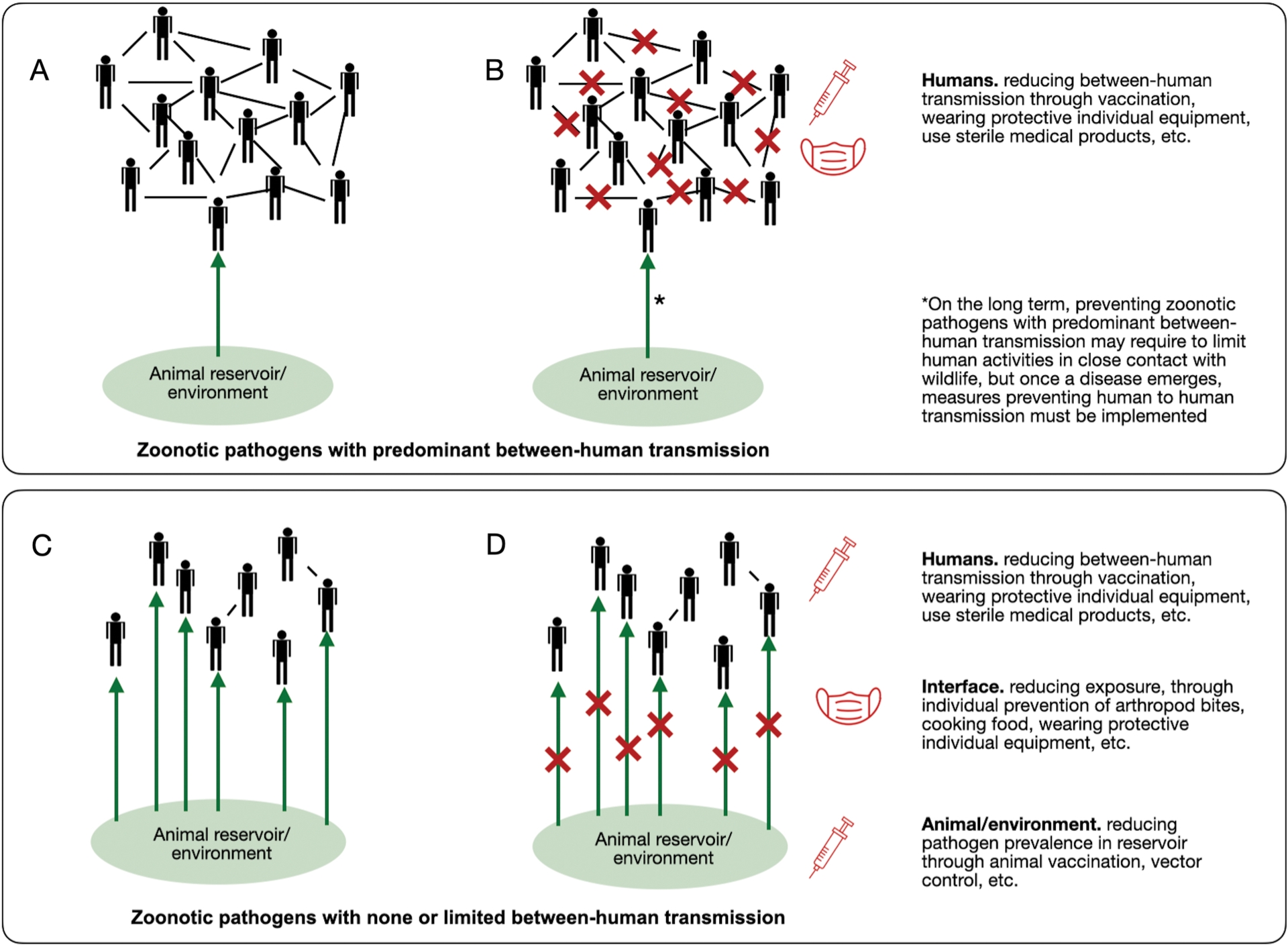
This difference in between-human transmission has major public health implications. Indeed, combating epidemics of “case 1” zoonotic pathogens (case 1, Figure 1A) will focus mainly on interventions targeting the human host (Figure 1B, e.g. vaccination, or non-pharmaceuticaI interventions such as reducing between-human contacts). In such a setting, the use of modelling to assess the impact of interventions is now widely recognised (Sofonea et al., 2022). However, reducing the public health burden of zoonotic pathogens with none or limited between-human transmission (case 2, Figure 1C) can be addressed by implementing control and prevention measures at different levels: within animal populations, within human populations, and/or at the interface between the two (Figure 1D). In this context, “One Health modelling”, which is the use of data-driven model frameworks developed at the animal–environment–human interface, appears highly valuable to estimate various zoonotic transmission routes (Text Box 1, zoonotic transmission routes) and to formally assess control options and guide public health decisions. For example, modelling the Rift Valley fever (RVF) epidemic in Mayotte at the interface between cattle, humans, and the environment in combination with surveillance data was useful (i) to estimate that emergences in animals and in humans were synchronised; (ii) to estimate that zoonotic transmission by mosquito bites and by direct contact resulted in an almost similar proportion of infections during the 2018–2019 epidemics, therefore stressing the importance of targeting prevention campaigns to both the general population and amongst farmers; and (iii) to compare vaccination strategies in an epidemic context (Métras, Edmunds, et al., 2020). Similarly, “One Health” Crimean-Congo Haemorrhagic fever (CCHF) modelling was also useful to assess that in high-endemic areas, vaccinating at-risk human populations was more effective than vaccinating livestock in the long run (Vesga et al., 2022). Regarding Lyme borreliosis, a “One Health” quantitative framework was valuable to identify that tick bites were a major risk factor in the spatial distribution of the disease, therefore stressing the importance of limiting human exposure (Fu et al., 2023).

The importance and relevance of modelling to study zoonotic diseases and address “One Health” questions has been highlighted over the past decade (Heerden et al., 2023; Scoones et al., 2017). Recent reviews conducted on modelling zoonotic diseases have underlined efforts made towards modelling transmission between hosts, but highlighted that their use and implementation in public health remain, to date, limited (de Wit et al., 2024; Doohan et al., 2024; Laidlow et al., 2025; Layan et al., 2021; Rees et al., 2021). In this context, and from our experience, we identify three key challenges to the implementation of “One Health” modelling to guide public health decisions and suggest directions for improvement. Data needs. The scarcity of available epidemiological and demographic data on the different incrimimated hosts in the same ecosystems under study, and the lack of quantitative between-species contact data, specifically at the animal–human interface, limits the possibilities for model calibration or validation (de Wit et al., 2024; EFSA (European Food Safety Authority) et al., 2024; Rees et al., 2021). We stress here the importance of implementing multi-hosts synchronised data collection, which should be designed jointly by veterinary epidemiologists, human epidemiologists and animal population ecologists (Bordier et al., 2020; Halliday et al., 2012; One Health High-Level Expert Panel (OHHLEP) et al., 2023). We advocate to support, build upon or learn from existing multi-host long-term data collection, as implemented for West Nile surveillance in Italy (Bellini et al., 2014; Gobbo et al., 2025) or for Rift Valley fever in Mayotte, where an entomological component may be useful to add (Kim et al., 2021; Lernout et al., 2013; Métras, Edmunds, et al., 2020; Métras, Cavalerie, et al., 2016); and when implementing new protocols, we advocate for building them with a long-term vision. Finally, we encourage quantifying animal–human contacts to improve model parametrisation, a subject which is tackled in the research funded by the Fondation Simone and Cino Del Duca award we received in 2024 (“Estimating contacts at the animal–human interface”). Modelling needs. The expertise to carry out such “One Health” modelling approaches needs multidisciplinary leadership that integrates public health, animal health, ecology, epidemiology, and modelling expertise, but also peer recognition in those fields, which is long and complex to acquire; putting in place multidisciplinary university research degrees is not enough for this. We underline here the importance and the need to promote the next generation of “One Health” modellers, by guiding research degree students and young researchers early in their career path. In practice, this can be done by mentoring young researchers through multidisciplinary career pathways once they have established their initial training in a modelling discipline, or, conversely, by mentoring young researchers in quantitative disciplines once they are trained in the field of application they wish to target. Institutional support. Whilst “One Health” questions have undoubtedly gained institutional visibility nationally and internationally (Académie Vétérinaire de France, 2026; French Ministry of Higher Education and Research, 2026), “One Health” modelling to guide public health decisions is still overlooked, and lacks visibility and institutional support. To gain visibility, we advocate borrowing strength from established scientific communities or research groups in infectious disease dynamics from a public health perspective. Several exemplar national and international initiatives can be cited, such as the French Research Action on Modelling Epidemics (FRAME) network (ANRS-MIE, 2026), or the Global Society for Infectious Disease Dynamics (GSIDD, 2025). Finally, being hosted within human health institutions is essential to allow the acculturation of the research to public health questions, whilst acculturating human health institutions to “One Health” visions. This path has proved successful, as illustrated by Sorbonne University Modeling Outbreaks Center (SUMOC), within Sorbonne Public Health Institute, which has made “One Health” modelling one of their structural pillars.

Acknowledgements

We thank Sorbonne University Modeling Outbreaks Center (SUMOC), supported by INSERM, Sorbonne Université, and ANRS-MIE, for integrating “One Health” modelling into their forthcoming priorities. This perspective is nourished from almost 20 years of research in the fields of zoonotic epidemiology, modelling and public health, mainly funded by a Sir Henry Wellcome postdoctoral fellowship (101581/Z/13/Z, 2014–2017), an ANR JCJC (MoZArt project, ANR-22-CE35-0003, 2023–2027), a young researcher grant Fondation Simone et Cino Del Duca - Institut de France (2024–2027), and ARCHE project (PEPR PREZODE, ANR-23-PEPZ-0003, 2024–2029). We wish to thank Thierry Boulinier for complementary discussions on the importance of “One health” in ecology and biodiversity and for comments on the paper; and Vittoria Colizza, SUMOC Director, for support in leveraging “One Health” modelling at the institutional level, and for valuable remarks in shaping the final version of the manuscript.

Declaration of interests

The author does not work for, advise, own shares in, or receive funds from any organization that could benefit from this article, and has declared no affiliations other than their research organization.


Bibliographie

[Académie Vétérinaire de France, 2026] Académie Vétérinaire de France AVIS 2026-1 Détection précoce et surveillance des infections virales émergentes chez l’animal : Prévenir la prochaine pandémie zoonotique – Enjeux Nord et Sud (2026) https://academie-veterinaire.fr/... (Accessed 2026-08-10) (Avis et Rapports, Prises de position de l’AVF)

[ANRS-MIE, 2026] ANRS-MIE Action coordonnée Modélisation des maladies infectieuses (FRAME) – ANRS MIE [WWW Document] ANRS Maladies infectieuses émergentes (ANRS-MIE) (2026) https://anrs.fr/... (Accessed 2026-01-21)

[Baum, 2008] S. G. Baum Zoonoses-with friends like this, who needs enemies?, Trans. Am. Clin. Climatol. Assoc., Volume 119 (2008), pp. 39-51 (discussion 51)

[Belhadi et al., 2022] D. Belhadi; M. El Baied; G. Mulier; D. Malvy; F. Mentré; C. Laouénan The number of cases, mortality and treatments of viral hemorrhagic fevers: a systematic review, PLoS Negl. Trop. Dis., Volume 16 (2022), e0010889 | DOI

[Bellini et al., 2014] R. Bellini; M. Calzolari; A. Mattivi; M. Tamba; P. Angelini; P. Bonilauri; A. Albieri; R. Cagarelli; M. Carrieri; M. Dottori; A. C. Finarelli; P. Gaibani; M. P. Landini; S. Natalini; N. Pascarelli; G. Rossini; C. Velati; C. Vocale; E. Bedeschi The experience of West Nile virus integrated surveillance system in the Emilia-Romagna region: five years of implementation, Italy, 2009 to 2013, Euro Surveill., Volume 19 (2014) no. 44, 20953 | DOI

[Bordier et al., 2020] M. Bordier; T. Uea-Anuwong; A. Binot; P. Hendrikx; F. L. Goutard Characteristics of One Health surveillance systems: a systematic literature review, Prev. Vet. Med., Volume 181 (2020), 104560 | DOI

[Catalano et al., 2024] S. Catalano; F. Battelli; Z. I. Traore; J. Raghwani; C. L. Faust; C. J. Standley Pathogen genomics and One Health: a scoping review of current practices in zoonotic disease research, IJID One Health, Volume 4 (2024), 100031 | DOI

[Center for Food Security and Public Health, 2026] Center for Food Security and Public Health Disease Exposure Routes - CFSPH [WWW Document], The Center for Food Security & Public Health, Iowas State University, College of Veterinary Medicine (2026) https://www.cfsph.iastate.edu/... (Accessed 2026-07-09)

[Cheng et al., 2025] Z. Cheng; N. W. Ruktanonchai; A. Wesolowski; S. Pei; J. Wang; S. Cockings; A. J. Tatem; S. Lai Social, mobility and contact networks in shaping health behaviours and infectious disease dynamics: a scoping review, Infect. Dis. Poverty, Volume 14 (2025), 123 | DOI

[Colosi et al., 2022] E. Colosi; G. Bassignana; D. A. Contreras; C. Poirier; P.-Y. Boëlle; S. Cauchemez; Y. Yazdanpanah; B. Lina; A. Fontanet; A. Barrat; V. Colizza Screening and vaccination against COVID-19 to minimise school closure: a modelling study, Lancet Infect. Dis., Volume 22 (2022), pp. 977-989 | DOI

[Cossaboom et al., 2026] C. M. Cossaboom; R. M. Wallace; C. Barton Behravesh Zoonotic exposures: bites, scratches, and other hazards, CDC Yellow Book: Health Information for International Travel, US Centers for Disease Control and Prevention (2026) https://www.cdc.gov/... (Accessed 2026-08-10)

[de Meijere et al., 2023] G. de Meijere; E. Valdano; C. Castellano; M. Debin; C. Kengne-Kuetche; C. Turbelin; H. Noël; J. S. Weitz; D. Paolotti; L. Hermans; N. Hens; V. Colizza Attitudes towards booster, testing and isolation, and their impact on COVID-19 response in winter 2022/2023 in France, Belgium, and Italy: a cross-sectional survey and modelling study, Lancet Reg. Health Eur., Volume 28 (2023), 100614 | DOI

[de Wit et al., 2024] M. M. de Wit; A. Dimas Martins; C. Delecroix; H. Heesterbeek; Q. A. Ten Bosch Mechanistic models for West Nile virus transmission: a systematic review of features, aims and parametrization, Proc. Biol. Sci., Volume 291 (2024), 20232432 | DOI

[Doohan et al., 2024] P. Doohan; D. Jorgensen; T. M. Naidoo; K. McCain; J. T. Hicks; R. McCabe; S. Bhatia; K. Charniga; G. Cuomo-Dannenburg; A. Hamlet; R. K. Nash; D. Nikitin; T. Rawson; R. J. Sheppard; H. J. T. Unwin; S. van Elsland; A. Cori; C. Morgenstern; N. Imai-Eaton; A. Morris; A. Forna; A. Dighe; A. Vicco; A.-M. Hartner; A. Cori; A. Hamlet; B. Lambert; B. Cracknell Daniels; C. Whittaker; C. Morgenstern; C. Santoni; C. Geismar; D. Nikitin; D. Jorgensen; D. Dee; E. Knock; E. Unwin; G. Cuomo-Dannenburg; H. Thompson; I. Dorigatti; I. Routledge; J. Wardle; J. Skarp; J. Hicks; K. Parchani; K. Fraser; K. Charniga; K. McCain; K. Drake; L. Geidelberg; L. Cattarino; M. Kusumgar; M. Kont; M. Baguelin; N. Imai-Eaton; P. P. Guzman; P. Doohan; P. Lietar; P. Christen; R. Nash; R. Fitzjohn; R. Sheppard; R. Johnson; R. McCabe; S. van Elsland; S. Bhatia; S. Leuba; S. Ruybal-Pesantez; S. Radhakrishnan; T. Rawson; T. Naidoo; Z. Cucunuba Perez Lassa fever outbreaks, mathematical models, and disease parameters: a systematic review and meta-analysis, Lancet Glob. Health, Volume 12 (2024), p. e1962-e1972 | DOI

[EFSA (European Food Safety Authority) et al., 2024] EFSA (European Food Safety Authority); A. Papanikolaou; A. Gervelmeyer; A. C. Simon; L. Mur; V. Bocca Reporting guidance for the One Health surveillance data collection, EFSA supporting publication 2024, Volume 21 (2024) no. 6, EN-8865 | DOI

[French Ministry of Higher Education and Research, 2026] French Ministry of Higher Education and Research One Health, One Science: Recommendations from the scientific conference. Government of the French Republic, 2026 https://www.enseignementsup-recherche.gouv.fr/... (Accessed 2026-08-10)

[Fu et al., 2023] W. Fu; C. Bonnet; A. Septfons; J. Figoni; J. Durand; P. Frey-Klett; D. Rustand; B. Jaulhac; R. Métras Spatial and seasonal determinants of Lyme borreliosis incidence in France, 2016 to 2021, Euro Surveill., Volume 28 (2023) no. 14, 2200581 | DOI

[Gandon and Lion, 2022] S. Gandon; S. Lion Targeted vaccination and the speed of SARS-CoV-2 adaptation, Proc. Natl. Acad. Sci. USA, Volume 119 (2022) no. 3, e2110666119 | DOI

[Gobbo et al., 2025] F. Gobbo; G. Chiarello; S. Sgubin; F. Toniolo; F. Gradoni; L. I. Danca; S. Carlin; K. Capello; G. De Conti; A. Bortolami; M. Varotto; L. Favero; M. Brichese; F. Russo; F. Mutinelli; S. Vogiatzis; M. Pacenti; L. Barzon; F. Montarsi Integrated one health surveillance of West Nile virus and Usutu virus in the Veneto Region, Northeastern Italy, from 2022 to 2023, Pathogens, Volume 14 (2025) no. 3, 227 | DOI

[GSIDD, 2025] GSIDD Global Society for Infectious Disease Dynamics (GSIDD) [WWW Document], Global Society for Infectious Disease Dynamics (2025) https://www.gsidd.org/ (Accessed 2026-07-09)

[Halliday et al., 2012] J. Halliday; C. Daborn; H. Auty; Z. Mtema; T. Lembo; B. M. D. Bronsvoort; I. Handel; D. Knobel; K. Hampson; S. Cleaveland Bringing together emerging and endemic zoonoses surveillance: shared challenges and a common solution, Phil. Trans. R. Soc. Lond. B: Biol. Sci., Volume 367 (2012), pp. 2872-2880 | DOI

[Harish et al., 2024] V. Harish; F. J. Colón-González; F. R. R. Moreira; R. Gibb; M. U. G. Kraemer; M. Davis; R. C. Reiner; D. M. Pigott; T. A. Perkins; D. J. Weiss; I. I. Bogoch; G. Vazquez-Prokopec; P. M. Saide; G. L. Barbosa; E. C. Sabino; K. Khan; N. R. Faria; S. I. Hay; F. Correa-Morales; F. Chiaravalloti-Neto; O. J. Brady Human movement and environmental barriers shape the emergence of dengue, Nat. Commun., Volume 15 (2024), 4205 | DOI

[Heerden et al., 2023] N. van Heerden; S. S. (Saartjie) Grobbelaar; I. Meyer One Health studies that adopt a formal modelling approach: a scoping review, Environ. Sci. Policy, Volume 145 (2023), pp. 93-103 | DOI

[IPBES, 2019] IPBES Global assessment report on biodiversity and ecosystem services of the Intergovernmental Science-Policy Platform on Biodiversity and Ecosystem Services, Zenodo (2019) (Accessed 2026-08-10) | DOI

[Jones et al., 2008] K. E. Jones; N. G. Patel; M. A. Levy; A. Storeygard; D. Balk; J. L. Gittleman; P. Daszak Global trends in emerging infectious diseases, Nature, Volume 451 (2008), pp. 990-993 | DOI

[Kawasaki et al., 2025] J. Kawasaki; T. Suzuki; M. Hamada Hidden challenges in evaluating spillover risk of zoonotic viruses using machine learning models, Commun. Med. (London), Volume 5 (2025), 187 | DOI

[Kim et al., 2021] Y. Kim; R. Métras; L. Dommergues; C. Youssouffi; S. Combo; G. Le Godais; D. U. Pfeiffer; C. Cêtre-Sossah; E. Cardinale; L. Filleul; H. Youssouf; M. Subiros; G. Fournié The role of livestock movements in the spread of Rift Valley fever virus in animals and humans in Mayotte, 2018–19, PLoS Negl. Trop. Dis., Volume 15 (2021), e0009202 | DOI

[Kucharski et al., 2020] A. J. Kucharski; P. Klepac; A. J. K. Conlan; S. M. Kissler; M. L. Tang; H. Fry; J. R. Gog; W. J. Edmunds; CMMID COVID-19 working group Effectiveness of isolation, testing, contact tracing, and physical distancing on reducing transmission of SARS-CoV-2 in different settings: a mathematical modelling study, Lancet Infect. Dis., Volume 20 (2020), pp. 1151-1160 | DOI

[Laidlow et al., 2025] T. A. Laidlow; E. S. Johnston; R. N. Zadoks; M. Walsh; M. Viana; K. E. Wiley; B. B. Singh; F. Baldini; H. Dhanze; C. Webb; V. J. Brookes Scoping review of Japanese encephalitis virus transmission models, Transbound. Emerg. Dis. (2025), 9880670 | DOI

[Layan et al., 2021] M. Layan; S. Dellicour; G. Baele; S. Cauchemez; H. Bourhy Mathematical modelling and phylodynamics for the study of dog rabies dynamics and control: a scoping review, PLoS Negl. Trop. Dis., Volume 15 (2021), e0009449 | DOI

[Lernout et al., 2013] T. Lernout; E. Cardinale; M. Jego; P. Desprès; L. Collet; B. Zumbo; E. Tillard; S. Girard; L. Filleul Rift valley fever in humans and animals in Mayotte, an endemic situation?, PLoS One, Volume 8 (2013), e74192 | DOI

[Miranda et al., 2021] C. Miranda; V. Silva; G. Igrejas; P. Poeta Genomic evolution of the human and animal coronavirus diseases, Mol. Biol. Rep., Volume 48 (2021), pp. 6645-6653 | DOI

[Morand et al., 2014] S. Morand; S. Jittapalapong; Y. Suputtamongkol; M. T. Abdullah; T. B. Huan Infectious diseases and their outbreaks in Asia-Pacific: biodiversity and its regulation loss matter, PLoS One, Volume 9 (2014), e90032 | DOI

[Métras et al., 2016] R. Métras; L. Cavalerie; L. Dommergues; P. Mérot; W. J. Edmunds; M. J. Keeling; C. Cêtre-Sossah; E. Cardinale The epidemiology of Rift Valley fever in Mayotte: insights and perspectives from 11 years of data, PLoS Negl. Trop. Dis., Volume 10 (2016), e0004783 | DOI

[Métras et al., 2020] R. Métras; W. J. Edmunds; C. Youssouffi; L. Dommergues; G. Fournié; A. Camacho; S. Funk; E. Cardinale; G. Le Godais; S. Combo; L. Filleul; H. Youssouf; M. Subiros Estimation of Rift Valley fever virus spillover to humans during the Mayotte 2018–2019 epidemic, Proc. Natl. Acad. Sci. USA, Volume 117 (2020), pp. 24567-24574 | DOI

[One Health High-Level Expert Panel (OHHLEP) et al., 2023] One Health High-Level Expert Panel (OHHLEP); D. T. S. Hayman; W. B. Adisasmito; S. Almuhairi; C. B. Behravesh; P. Bilivogui; S. A. Bukachi; N. Casas; N. C. Becerra; D. F. Charron; A. Chaudhary; J. R. Ciacci Zanella; A. A. Cunningham; O. Dar; N. Debnath; B. Dungu; E. Farag; G. F. Gao; M. Khaitsa; C. Machalaba; J. S. Mackenzie; W. Markotter; T. C. Mettenleiter; S. Morand; V. Smolenskiy; L. Zhou; M. Koopmans Developing One Health surveillance systems, One Health, Volume 17 (2023), 100617 | DOI

[Pekar et al., 2022] J. E. Pekar; A. Magee; E. Parker; N. Moshiri; K. Izhikevich; J. L. Havens; K. Gangavarapu; L. M. Malpica Serrano; A. Crits-Christoph; N. L. Matteson; M. Zeller; J. I. Levy; J. C. Wang; S. Hughes; J. Lee; H. Park; M.-S. Park; K. Ching Zi Yan; R. T. P. Lin; M. N. Mat Isa; Y. M. Noor; T. I. Vasylyeva; R. F. Garry; E. C. Holmes; A. Rambaut; M. A. Suchard; K. G. Andersen; M. Worobey; J. O. Wertheim The molecular epidemiology of multiple zoonotic origins of SARS-CoV-2, Science, Volume 377 (2022), pp. 960-966 | DOI

[Rees et al., 2021] E. M. Rees; A. Minter; W. J. Edmunds; C. L. Lau; A. J. Kucharski; R. Lowe Transmission modelling of environmentally persistent zoonotic diseases: a systematic review, Lancet Planet. Health, Volume 5 (2021), p. e466-e478 | DOI

[Scoones et al., 2017] I. Scoones; K. Jones; G. Lo Iacono; D. W. Redding; A. Wilkinson; J. L. N. Wood Integrative modelling for One Health: pattern, process and participation, Philos. Trans. R. Soc. Lond. B: Biol. Sci., Volume 372 (2017) no. 1725, 20160164 | DOI

[Sofonea et al., 2022] M. T. Sofonea; S. Cauchemez; P.-Y. Boëlle Epidemic models: why and how to use them, Anaesth. Crit. Care Pain Med., Volume 41 (2022), 101048 | DOI

[Taube et al., 2025] J. C. Taube; Z. Susswein; V. Colizza; S. Bansal Characterising non-household contact patterns relevant to respiratory transmission in the USA: analysis of a cross-sectional survey, Lancet Digit. Health, Volume 7 (2025), 100888 | DOI

[Taylor et al., 2001] L. H. Taylor; S. M. Latham; M. E. Woolhouse Risk factors for human disease emergence, Philos. Trans. R. Soc. Lond. B: Biol. Sci., Volume 356 (2001), pp. 983-989 | DOI

[van Kleef et al., 2025] E. van Kleef; W. Van Bortel; E. Arsevska; L. Busani; S. Dellicour; L. Di Domenico; M. Gilbert; S. L. van Elsland; M. U. Kraemer; S. Lai; P. Lemey; S. Merler; Z. Milosavljevic; A. Rizzoli; D. Simic; A. J. Tatem; M. Teisseire; W. Wint; V. Colizza; C. Poletto Modelling practices, data provisioning, sharing and dissemination needs for pandemic decision-making: a European survey-based modellers’ perspective, 2020 to 2022, Euro Surveill., Volume 30 (2025) no. 42, 2500216 | DOI

[Vesga et al., 2022] J. F. Vesga; M. H. A. Clark; E. Ayazi; A. Apolloni; T. Leslie; W. J. Edmunds; R. Métras Transmission dynamics and vaccination strategies for Crimean-Congo haemorrhagic fever virus in Afghanistan: a modelling study, PLoS Negl. Trop. Dis., Volume 16 (2022), e0010454 | DOI

[WHO, 2024] WHO Chapter 4: outcomes, Global Technical Consultation Report on Proposed Terminology for Pathogens That Transmit through the Air, World Health Organization (2024), pp. 7-13 https://cdn.who.int/... (Accessed 2026-08-10)

[WHO, 2026] WHO Health Topics - One health [WWW Document] WHO - Health topics - One Health (2026) https://www.who.int/... (Accessed 2026-07-09)

[Woolhouse and Gowtage-Sequeria, 2005] M. E. J. Woolhouse; S. Gowtage-Sequeria Host range and emerging and reemerging pathogens, Emerging Infect. Dis., Volume 11 (2005), pp. 1842-1847 | DOI

[Woolhouse, 2002] M. E. J. Woolhouse Population biology of emerging and re-emerging pathogens, Trends Microbiol., Volume 10 (2002), p. S3-S7 | DOI

[Woolhouse et al., 2005] M. E. J. Woolhouse; D. T. Haydon; R. Antia Emerging pathogens: the epidemiology and evolution of species jumps, Trends Ecol. Evol., Volume 20 (2005), pp. 238-244 | DOI


Commentaires - Politique