



 CC-BY 4.0
1. Introduction
Humans are now recognized as a major geological force, comparable to tectonic processes, due to our ability to mobilize matter on continental scales through, for ex., mining exploration and the exploitation of fossil fuels such as coal and petroleum (Hooke and Martín-Duque, 2012). Mountain ecosystems, traditionally perceived as pristine, are also impacted by anthropogenic activities (Le Roux, Hansson, Claustres, et al., 2020; Schmeller et al., 2018; Catalan et al., 2017). For instance, long-term records from Lake Redó in the central Pyrenees demonstrate the accumulation of trace metals and other pollutants over centuries (Camarero et al., 1998), while recent studies have even documented the presence of microplastics in remote high-altitude environments such as Pic du Midi (S. Allen, D. Allen, Baladima, et al., 2021) or Mount Everest (Napper et al., 2020). This study was conducted within the framework of the Human–Environment Observatory (OHM) Pyrenees Haut-Vicdessos and contributes to the CRAS special issue dedicated to OHMs. The OHM Pyrenees Haut-Vicdessos was established to explore the long-term transformation of this mountain valley, particularly the consequences of industrial decline, demographic changes, and the emergence of new socio-economic activities. This provides a unique setting for interdisciplinary research integrating ecological, geochemical, and socio-environmental approaches within a single, well-defined mountain territory. The Haut-Vicdessos Valley in the Pyrenees serves as a case study of how local and global human activities can leave long-lasting environmental changes and chemical imprints on mountain environments. Thanks to environmental archives, such as lakes—which integrate both local watershed inputs and regional atmospheric inputs—and ombrotrophic Sphagnum peatlands—which record exclusively atmospheric inputs—it is possible to disentangle the different processes that control the dispersion and diffusion of micro-contaminants in mountain environments, while also relating these signals to socio-economic changes in the valleys.
Historically, the valley was a hub of mining and industrial activity until the late 20th century (Le Roux, Hansson, Claustres, et al., 2020) (Figure 1). These activities released significant quantities of lead and other metals into the environment, including pollution from long-range atmospheric transport (Le Roux, Hansson and Claustres, 2016). Since the cessation of industrial operations in the area, the local economy has shifted towards ecotourism with activities such as hiking, skiing and fishing, as well as hosting the Tour de France (Rambault, 2003). However, while such activities may be good for the local economy, such activities have also introduced new pollutants, such as plastics, into the environment, often due to inadequate waste management and human behavior.
Left: Situation sketch of the study area, highlighting key locations, mining and industrial sites, and geographical features. Right: Lead (Pb) concentrations in relevant soils and sediments for the watersheds, based on the BRGM geochemical inventory (source: Infoterre - BRGM). Color-coded circles represent varying contamination levels.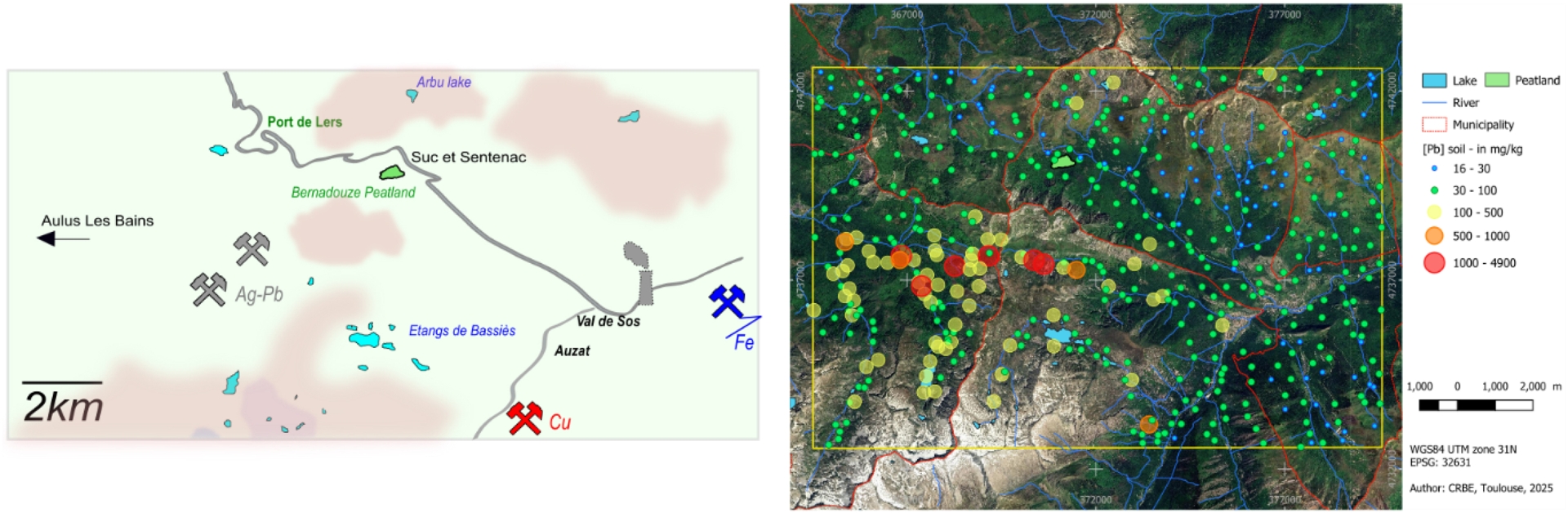
While macroplastic (>5–25 mm) pollution in mountain regions is visually evident, small plastic particles known as microplastics (<5 mm) and nanoplastics (<1 μm) present more insidious environmental challenges. While it is known that these particles can originate from both local sources, such as improperly managed waste, as well as from long-range atmospheric transport (S. Allen, Materić, et al., 2022; S. Allen, D. Allen, Phoenix, et al., 2019), their presence in mountain ecosystems still raises critical questions about their original sources, transport mechanisms, and ecological impacts.
The goal of this article is to synthesize previous research on environmental contamination in the Haut-Vicdessos Valley, with a focus on comparing the dynamics of two distinct and persistent pollutants: lead and plastics. By analyzing environmental archives, such as peat bogs and lake sediments, we integrate findings to explore the interplay between local and remote sources of contamination. This synthesis highlights the contrasting temporal and spatial patterns of legacy and emerging pollutants, framing the work as a temporal journey through past and present contamination pathways. It thereby provides a comprehensive perspective on the evolving challenges of environmental pollution in mountain ecosystems under changing socio-economic and climatic conditions, thanks to environmental archives and the prospects offered by future scenarios.
2. Lead pollution
Lead is one of the earliest metals exploited by humans, and its use dates back to the advent of metallurgy (Nriagu, 1983). Following the discovery of cupellation, lead became a byproduct of silver extraction and was widely utilized in Antiquity and the Middle Ages due to its workability and resistance to corrosion. Archaeological evidence, such as lead ingots recovered from Roman shipwrecks, underscores its role in ancient trade networks (ibid.).
In the Haut-Vicdessos Valley, lead pollution has a complex history shaped by both local mining activities and long-range atmospheric deposition (Figure 1). The region’s peat bogs serve as invaluable environmental archives to record such pollution input, and have enabled the reconstruction of lead contamination spanning millennia (Hansson, Claustres, et al., 2017). For example, using peat cores from Haut-Vicdessos Valley, Hansson et al., showed that lead pollution in the area could be traced as far back as to the Antiquity, followed by a marked decline linked to the collapse of the Roman Empire. Pb emissions and subsequent deposition then resurged during the Middle Ages, driven by intensified metallurgical activities on a more regional level.
The mining and smelting activities were then further intensified during the industrial revolution, leading to even larger lead contamination inputs into Pyrenean ecosystems and thereby exacerbating the pollution problem even further. Although these mining activities certainly played an important role, the widespread use of leaded gasoline in the post-World War II era is what caused a dramatic increase in lead deposition, as atmospheric aerosols laden with lead were transported globally, reaching even remote mountain regions such as Haut-Vicdessos. Such contaminant reconstructions, and deciphering the source of origin of the lead, are made possible by isotopic analysis which provides critical insights into the pollution sources, and enables a distinguishing between industrial and automotive emissions (Le Roux, Hansson and Claustres, 2016).
Environmental campaigns in the 1980s and 1990s led to the phasing out of leaded gasoline, resulting in a significant reduction in atmospheric lead deposition. Nevertheless, lead concentrations in contemporary peat and soils remain above prehistoric levels, and continue to pose an ongoing ecological risk (e.g. Hansson, Grusson, et al., 2019). For example, secondary mobilization of lead from historical deposits in soils and sediments has been observed in the Haut-Vicdessos region, with a subsequent bioaccumulation of mining derived legacy lead pollution seen in aquatic biota such as brown trout (Salmo trutta fario) (ibid.).
3. Plastics
Plastics, synthetic polymers invented during the late 19th and early 20th centuries, have revolutionized material science and permeated every aspect of modern society. These versatile materials, which are often modified with chemical additives to enhance their properties, are indispensable for innovation and daily life. However, their widespread use has led to significant environmental challenges, particularly in natural and remote ecosystems.
In mountain environments like the Haut-Vicdessos Valley, plastic pollution is evident at multiple scales. For example, macroplastics—large plastic debris visible to the naked eye—are found even in protected areas, such as the Bernadouze peatland which is part of the Natura 2000 network (Figure 3). These large plastics originate from improper waste management, littering, and the accumulation of past and present waste deposits. Inaccessible terrain and a lack of operational waste management infrastructure exacerbate the problem, with illegal dumping sites and scattered debris being common observations. However, tourism, a key economic activity in the Haut-Vicdessos Valley, also contributes to plastic pollution (Margenat, Guasch, et al., 2024). Popular hiking trails, roadsides, and other tourist hotspots exhibit noticeable concentrations of macroplastic waste. Despite increased awareness of the environmental issues linked to plastics, these observations suggest the persistence of localized plastic pollution.
Compared to macroplastics, microplastics (particles <5 mm) and nanoplastics (<1 μm) pose an even greater environmental challenge due to their small size and widespread dispersion. While some microplastics derive from the fragmentation of local larger debris, atmospheric transport is increasingly recognized as a significant pathway for their introduction into remote mountain ecosystems (S. Allen, Materić, et al., 2022; S. Allen, D. Allen, Phoenix, et al., 2019). These airborne particles can travel vast distances, originating from urban and industrial sources, before depositing in mountain catchments through precipitation or dry deposition.
Environmental monitoring in the Haut-Vicdessos Valley within a plastics context began in 2017, focusing on microplastics in rain and snow. Initial results revealed the presence of microplastic particles ranging from 10 μm to 100 μm, and back-trajectory modeling of air masses confirmed that many of these particles originated from distant sources (S. Allen, Materić, et al., 2022; S. Allen, D. Allen, Phoenix, et al., 2019). This discovery highlighted the dual role of local and long-range transport in shaping the microplastic burden in mountain environments.
The ecological implications of microplastics are profound. Studies have documented the presence of microplastics in aquatic organisms within the Haut-Vicdessos Valley, notably in trout, with concentrations averaging 4 ± 9.9 MP⋅g−1 (Margenat, Guasch, et al., 2024). The dominant polymer types identified were polypropylene (PP, 59%), ethylene-propylene-diene monomer rubber (EPDM, 15%), polyethylene (PE, 13%), and polystyrene (PS, 11%). These findings underscore the potential for bioaccumulation and highlight the need for further research into the pathways, fate, and impacts of plastic pollution in mountain ecosystems and biota.
4. Reconstructing plastic fluxes at the scale of a mountain watershed
The originality of this work has driven us to go further by leveraging other existing resources: the environmental archives (Figure 2) available within the OHM Pyrenees Haut-Vicdessos region. A significant strength of the OHM Pyrenees Haut-Vicdessos lies in its library of peat and sediment cores, often well-dated and already characterized for chemical and paleoecological evolution. These resources provide a robust foundation for testing new approaches.
Schematic Chronologies of Lead and Plastic Accumulations in the Bernadouze-Arbu watersheds. The figure for lead is adapted from Hansson, Claustres, et al. (2017), while the microplastic sequence follows the same conceptual framework developed for lead but has not been previously published.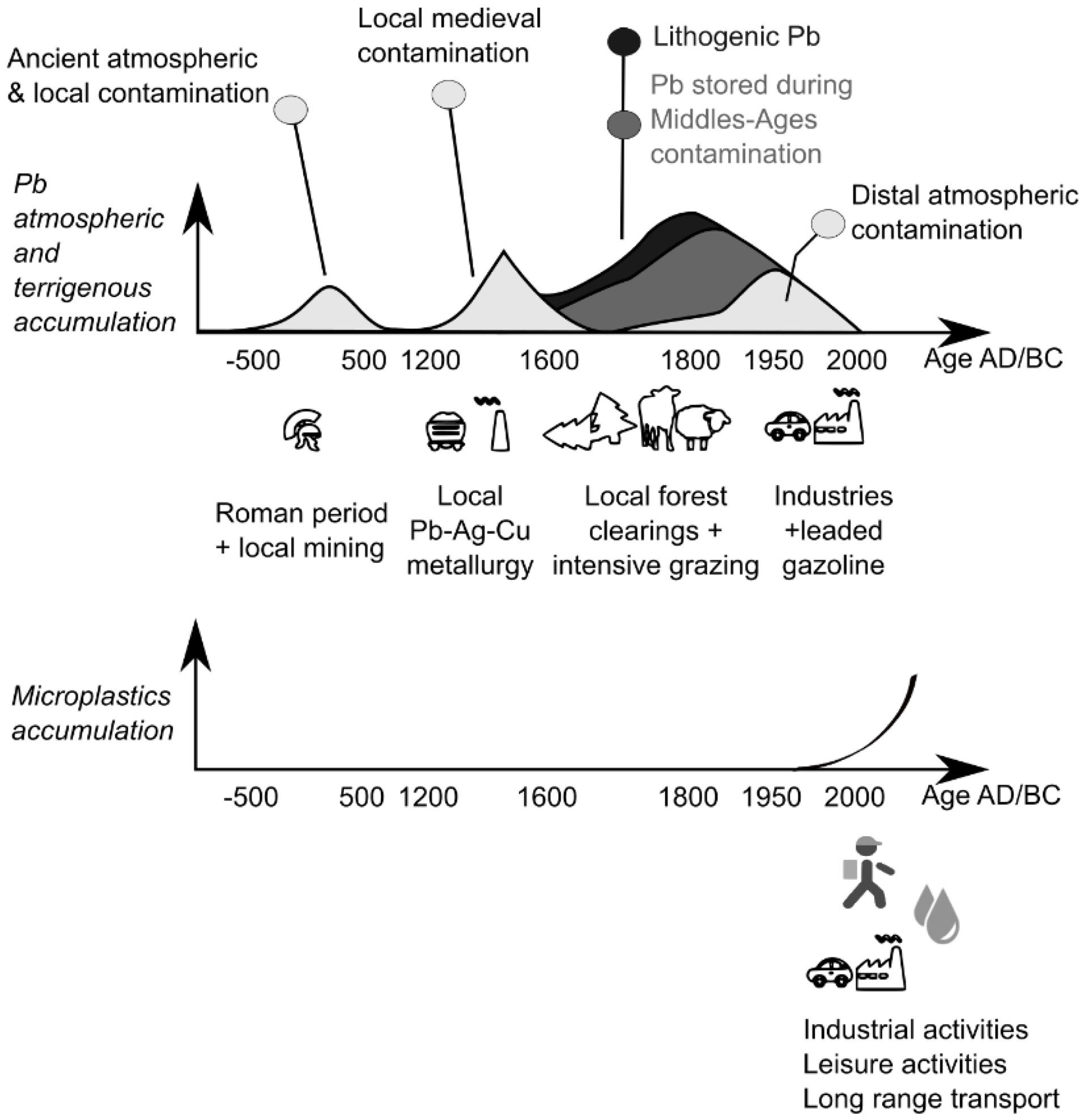
We investigated the evolution of atmospheric plastics in the Arbu catchment, located opposite the Bernadouze peatland. Both the peatland upstream of Lake Arbu and the lake itself were analyzed to assess the variability of microplastic deposition using sediment cores. The records reveal the first appearance of microplastics in the 20th century, followed by a marked increase in accumulation during recent decades. Notably, microplastics accumulate more rapidly in the peatland (178 ± 72 MP⋅m−2⋅day−1 in 2015–2020)—reflecting primarily atmospheric deposition—than in the lake (7.2 ± 1.6 MP⋅m−2⋅day−1), where additional hydrological processes influence retention and export. These contrasting patterns highlight the need to further investigate the dynamics of microplastic accumulation and transport at the scale of the entire mountain catchment.
With the support of the Interreg Plasticopyr project, we also began investigating the origins and pathways of plastics. For instance, macroplastics are present in the environment of the OHM Pyrenees Haut-Vicdessos; Figure 3 shows an example of an old tyre found in the protected Bernadouze Natura 2000 peatland. We could hypothesize that such macroplastics act as local sources of microplastics, although once fragmented into mesoplastics (5 mm–5 cm), they may also be rapidly exported downstream within the catchment. In this context, microplastics found in sediments and soils could therefore be predominantly of atmospheric origin, exhibiting distinct chemical and physical characteristics. This hypothesis will require further investigation under mixed scenarios, including mesoplastics (5 mm–50 mm) generated from tourism activities, local transport, or progressive fragmentation and “grasshopper-jump”-type redistribution along the landscape.
Examples of macroplastics observed in the OHM Pyrenees Haut-Vicdessos territory: (a) an old tyre partially buried in the Bernadouze Natura 2000 peatland, (b) a plastic fragment embedded within the peat, and (c) a child’s shoe with a yellow cattle ear tag found near the site. These objects illustrate the persistence of plastic materials even within a protected and educational mountain environment combining grazing activities and nature discovery programs.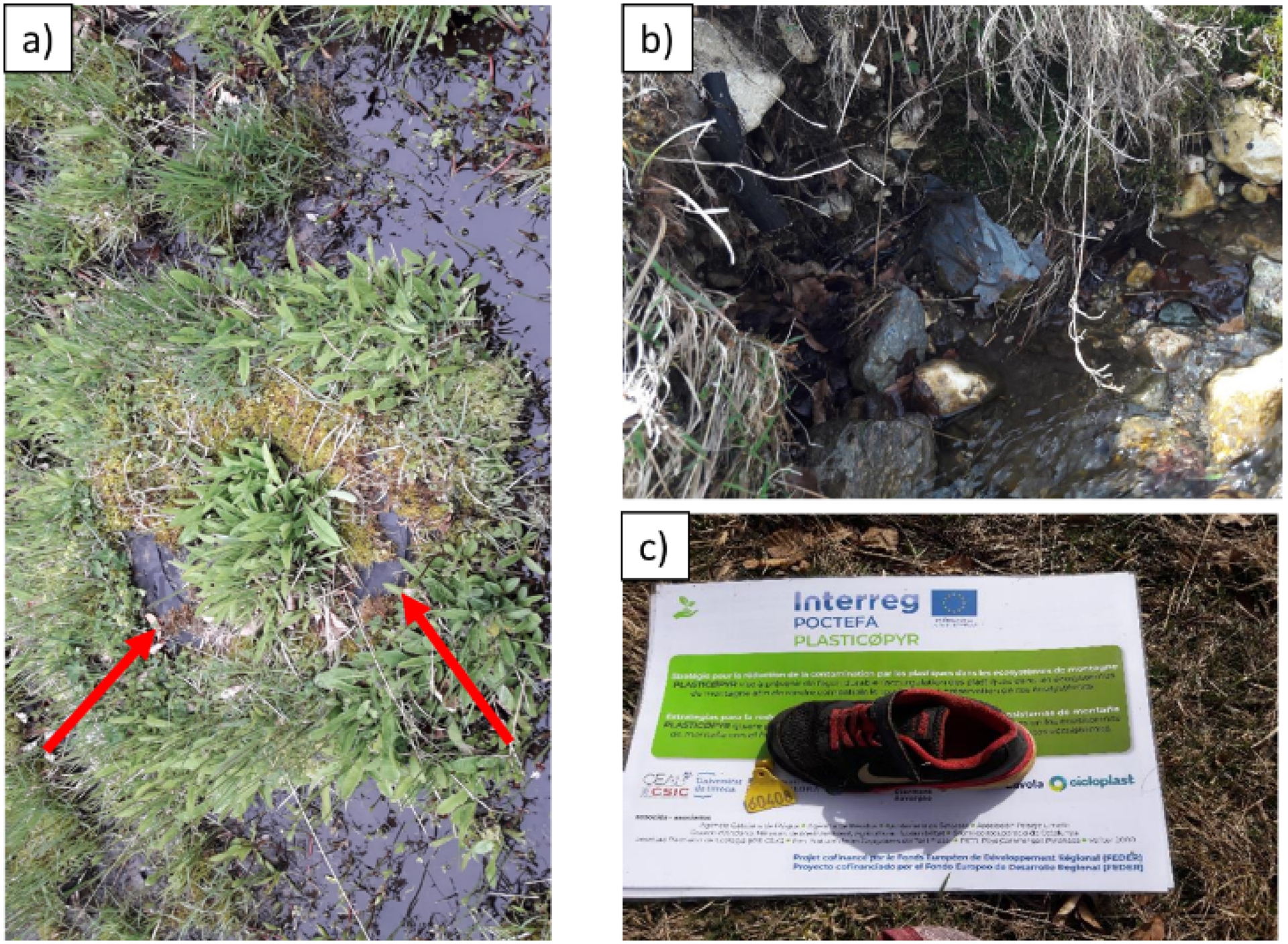
Mountains and the OHM Pyrenees Haut-Vicdessos once again emerge as sentinels of both global and local changes. Their environmental archives (peat and lake sediments) (Figure 2) underline their importance in signaling humanity’s influence on mountain environments and, in the future, in quantifying plastic stocks and fluxes originating from mountain valleys.
5. The importance of the Pyrenees Haut-Vicdessos Human-Environment Observatory
The Pyrenees Haut-Vicdessos Human-Environment Observatory highlights two key aspects that we consider essential for enabling this type of interdisciplinary research. As we have observed, plastics and lead have diverse origins that are difficult to disentangle solely through chemical tracing. It is therefore necessary to account for the specificities of the region and to immerse oneself in it. Such immersion is facilitated by its proximity—less than an hour and a half from Toulouse—which allows for regular observation in addition to the installation of automated sensors. Immersion is also made possible by the richness of environmental archives, such as lake sediments, peatlands, and others that are either underexplored or largely unexplored (e.g., speleothems, caves, and tree rings).
The Human-Environment Observatory (OHM) is an observatory in the sense described by Chenorkian (2020), marked by several transformative moments and a vibrant array of interdisciplinary research. It is also part of the Critical Zone observatory network (Service National d’Observatoire des Tourbières–OZCAR) (Gogo et al., 2021). The Bernadouze peatland, initially instrumented as a global ecology station, is linked to several observation services monitoring greenhouse gas fluxes and precipitation (e.g., SNO Tourbières and SNO RENOIR). Similarly, Lake Arbu has been instrumental and studied as part of various initiatives, such as the Lacs Sentinels, RESALPYR and Interreg REPLIM projects. This coupling, at the scale of a headwater catchment, is unique and allows us to envision future modeling efforts to better understand scenarios for the cycles of micropollutants such as lead, mercury or microplastics (Figure 4).
Conceptual view of the Haut-Vicdessos mountainscape, illustrating the spatial relationships between lakes, peatlands, and human activities. The brown semi-circles represent the peatlands of Bernadouze and the small mire near Lake Arbu, emphasizing their role as dynamic components of the mountain landscape and as key environmental archives recording atmospheric deposition. Human activities such as mining, forestry, pastoralism, and fish stocking are shown schematically to highlight the multiple pathways of contaminant transfer across the catchment. The pictograms represent human activities: fish stocking (fish), forest logging (trees), mining (hammer and pick), pastoralism including cattle grazing and use of fire (sheep and flame), and industrial activity in the valley (factory).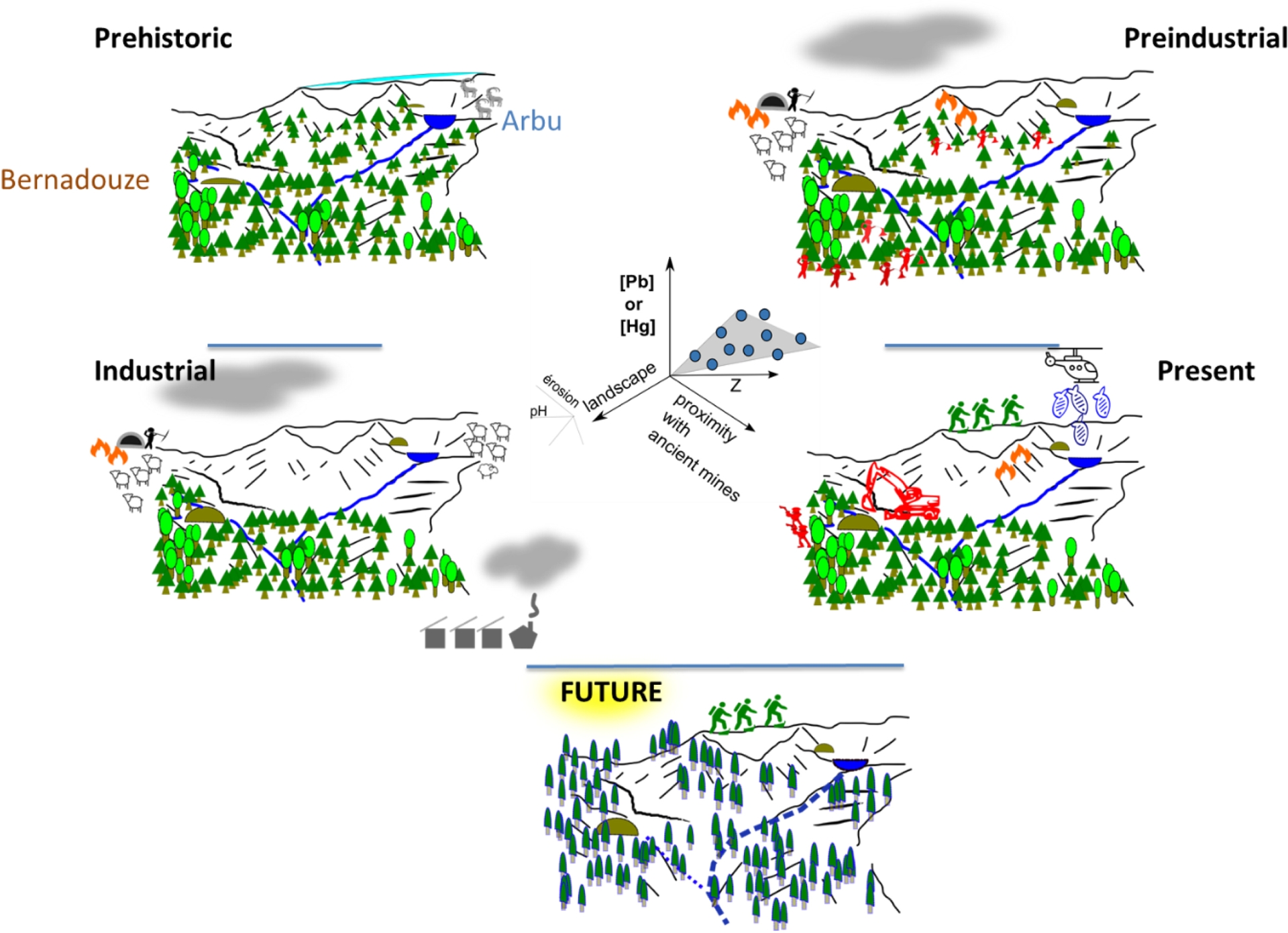
The second key aspect lies in the collective, interdisciplinary effort that brings together all stakeholders in the region, including researchers and students. Interdisciplinary collaboration is made possible by the ability to test scientific hypotheses within a defined framework, in this case that of the OHM. It is further supported by shared fieldwork, which enables real-world exchanges and the confrontation of ideas. Finally, it is crucial to acknowledge the scientific legacy of numerous previous studies in the same area, conducted by geographers, environmental scientists, geochemists, and ecologists. This collective effort also engages local residents, particularly younger generations, through mountain education center or leisure centers. For instance, we initiated a citizen science project (Margenat, Ruiz-Orejón, et al., 2021) within the framework of the Interreg Plasticopyr project, involving the leisure centers of Tarascon and Auzat in activities related to plastics in mountain environments.
6. Conclusion and perspectives
Our interdisciplinary studies, combining biogeochemistry, paleoecology, and atmospheric sciences, have highlighted the dispersion of metals, including lead with its millennia-long history, in the Haut-Vicdessos region, as well as the presence of plastics in a mountain environment that is, at first glance, relatively untouched by human influence. Climate change is expected to alter the balance between ecosystems, potentially exacerbating the export of micropollutants to rivers due to extreme events such as floods or droughts. However, local activities must also be considered, as they are crucial even in mountain environments for mitigating the impacts of climate change and addressing both legacy and contemporary contamination. This is precisely the value of studying a region like Haut-Vicdessos.
Future research should therefore aim to deepen our understanding of contaminant dynamics in mountain ecosystems by integrating multidisciplinary approaches. In this context, several key avenues are proposed:
6.1. Closing the mass balance of metals and plastics
Efforts should focus on completing the mass balance of metals at the scale of the peatland and the watershed (critical zone). This includes applying the same methodology to plastics, using a combined cartographic approach and continuous monitoring. However, it is essential to acknowledge the challenges of conducting consistent monitoring in high-altitude mountain environments, where critical moments—such as extreme weather events—are often missed. This limitation has been highlighted by Rosset et al. in their work on the Bernadouze site (Rosset et al., 2019).
6.2. Plastic fluxes in mountain catchments
Understanding the dynamics of plastic accumulation and export in mountain catchments remains a priority. Expanding monitoring networks and leveraging existing environmental archives, such as sediment cores, tree rings, and other proxies, could improve our ability to track the temporal and spatial patterns of plastic fluxes.
6.3. From legacy contaminants to emerging risks in mountain ecosystems
While lead and microplastics are elements and materials that do not tend to bioaccumulate in the environment, the example of mercury highlights how human activities, such as fish stocking, can introduce unexpected dynamics. Fish stocking in mountain lakes has been shown to alter trophic structures, potentially enhancing mercury methylation and its bioaccumulation in aquatic food webs, as well as introducing a new source of marine-derived mercury (Hansson, Sonke, et al., 2017). This demonstrates that interactions between human activities and mountain ecosystems can lead to surprising consequences, both negative and positive, necessitating further studies on feedback mechanisms and their implications for ecosystem health and contaminant cycles.
Similarly, the role of organic pollutants associated with plastics deserves greater attention. These compounds, often released during polymer degradation, can be persistent and, in some cases, bioaccumulative. Once in the environment, they may interact with existing contaminants or directly affect biota, thereby amplifying ecological risks in mountain ecosystems. A better understanding of these coupled chemical and biological interactions is essential for assessing cumulative impacts and developing effective mitigation strategies.
6.4. Collaborative management strategies
Addressing contamination in mountain ecosystems demands interdisciplinary collaboration and community engagement. By integrating scientific findings with local and regional management plans, stakeholders can develop more effective strategies for mitigating pollution. Citizen science initiatives, particularly those involving local residents and youth, offer a valuable pathway for raising awareness and fostering sustainable practices.
The Haut-Vicdessos region, as part of DRIIHM LabEx, InterDisciplinary Research Facility on Human-Environment Interactions wich aggregate 14 human-environments observatories, represents a unique opportunity to advance these objectives. Its extensive environmental archives, coupled with existing research infrastructure, provide a solid foundation for future studies that address both legacy and emerging pollutants in mountain ecosystems.
Acknowledgements
This publication was supported by ANR-20-CE34-0014 ATMO-PLASTIC (GLR) and the Plasticopyr project within the Interreg V-A Spain-France-Andorra program (HG, GLR) as well as Observatoire Hommes-Milieux Pyrénées Haut Vicdessos - LABEX DRIIHM ANR-11-LABX0010 (GLR).
We sincerely thank Emilie Lerigoleur, Florence Mazier, and the entire OHM research community, as well as the inhabitants of Haut-Vicdessos, for their invaluable contributions and support. Their dedication has been essential to this work.
This work is dedicated to Didier Galop, founder of the OHM Pyrenees Haut-Vicdessos. A passionate researcher and visionary, he was a pioneer in integrating paleoenvironmental studies into human-environment observatories. His commitment and contributions to the field remain an enduring inspiration. Didier Galop passed away in 2023, but his legacy continues to guide our research.
Declaration of interests
The authors do not work for, advise, own shares in, or receive funds from any organization that could benefit from this article, and have declared no affiliations other than their research organizations.