



 CC-BY 4.0
Experts that have been working on climate change and its effects would generally agree that this is a universe of high nonlinearity. From my experience as a young researcher in 4-dimensional topology, dynamical systems and singularity theory, decades ago, having later worked with the aerospace sector and, in the last twelve years, on innovation in the face of climate change, I have had abundant opportunities to observe how much the notion of nonlinearity is unfamiliar and counterintuitive to the vast majority of people, including probably most university graduates. When it comes to climate change, this is quite problematic, as linear thinking by default hampers the basic understanding of physical phenomena, of risks and threats, and also of the effects, positive or negative, of human interventions for climate change mitigation or adaptation. It is true for climate modelling, it is also true when it comes to planning, implementing innovation roadmaps and to understanding their actual impact.
Similar misconceptions will also occur when we think of climate action at different geographic scales. When we started trying to work as a community across Europe, a widespread idea was that impact at scale would naturally result from validating theoretical concepts in research laboratories, testing them at very local levels, transferring them to markets at regional and national levels, and that European networks would then help them get to the continental level and beyond. While this is not completely wrong, it grossly oversimplifies the many ways different scales interact and the complex factors that, at every level, will challenge assumptions of linear growth and scaling models. One of the key lessons we have learnt, from fifteen years exploring the possibilities of innovating for the climate, is that the capacity to progress at the scale of countries and continents requires long and deep immersions in the realities and singular features of cities, landscapes and regions.
This short paper could not possibly touch upon all the dimensions of our experience, or of what joining forces across Europe can bring to climate action. The conference L’urgence climatique: un tournant décisif ? (Climate emergency: a decisive turning point?), organized in March 2024 by the French Academy of Sciences, gave us the opportunity to provide a glimpse at what we have been doing with the European Commission, our community and a range of stakeholders (Lê, 2024). This is an enriched summary of my contribution to the conference, and an invitation to join us for further exploration of the fast evolving, urgently needed, but still largely experimental field of climate innovation.
1. System innovation in the face of climate change: the Climate KIC approach
Climate KIC (or EIT Climate-KIC before 2025) is an organization and community, selected in 2009 by the European Commission through the European Institute of Innovation and Technology to bring together and grow the dynamics of innovation in the face of climate change, at continental, national and subnational levels. It has been gathering universities, research bodies, businesses of all sizes, public authorities, NGOs and others, across some forty countries, as well as thousands of start-ups, students and professionals supported through our acceleration and education programs.
The foundational hypothesis is that the urgency and complexity of climate-related challenges require something different from the traditional approach to innovation, as shown on the left of Figure 1 below. While there can be rich debates on how, and where, the notion of “transformation” is relevant to inspire and guide climate action, with ideological and political undertones too often associated with it, what we want to convey here is the necessity of profound, deliberate and wide-ranging change in the way communities and organizations are empowering themselves to act. To support in-depth transformation, we need to move towards “portfolios” of closely connected projects that combine a range of levers for change, not only technological but also societal, behavioral, natural, economic, financial and regulatory.
From incremental to transformational. Source: Climate KIC document, 2023.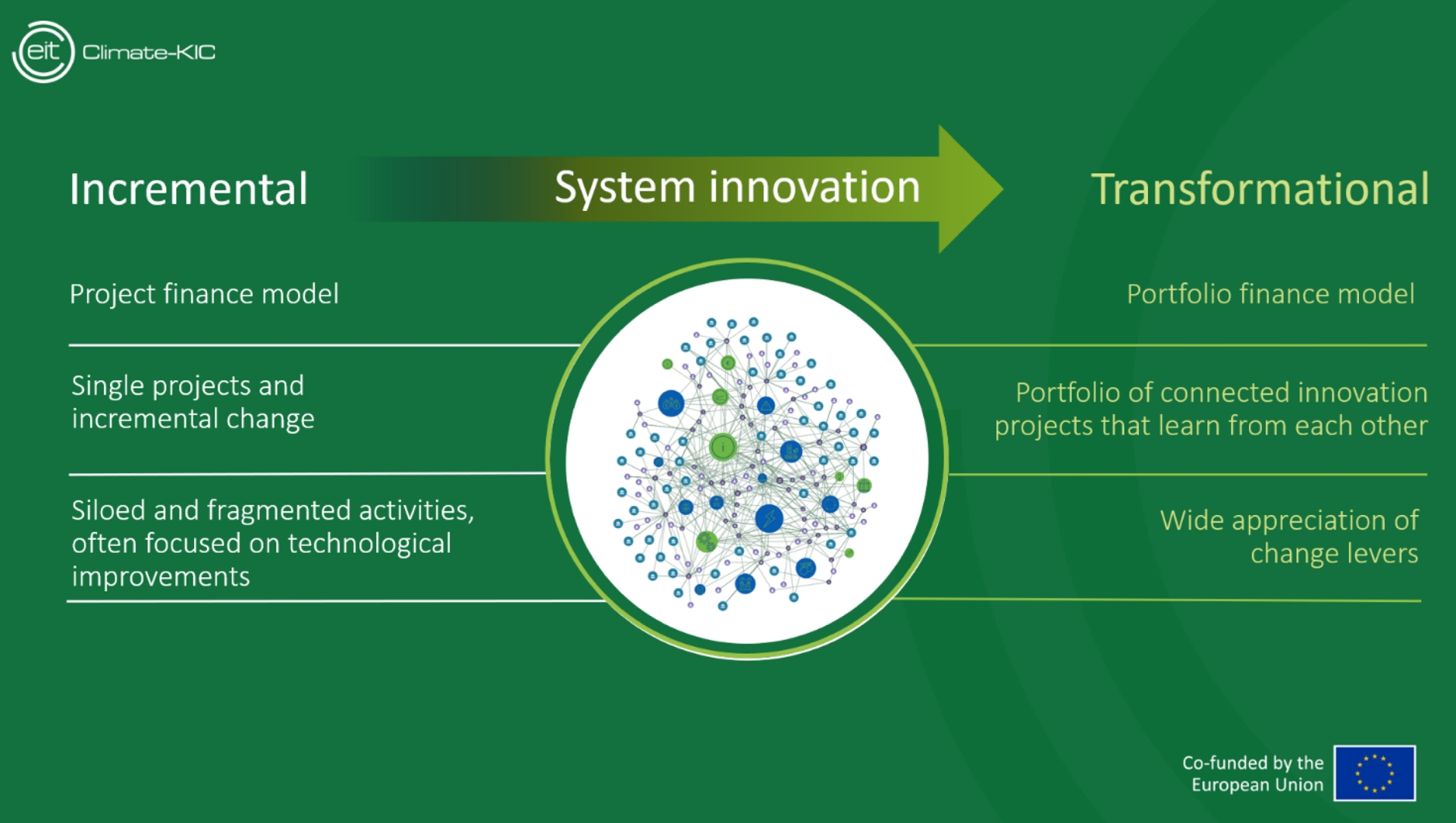
The scope of Climate KIC’s activities is articulated around six main themes: the built environment, regional adaptation and resilience, integrated landscapes as carbon sinks, regenerative agriculture, just transformation, waste and circularity. Starting with hundreds of independent innovation projects, start-up acceleration hubs and educational programs, we have evolved over the years towards an integrated approach on the scale of cities, regions and even countries.
In programs called Deep Demonstrations (Figure 2), stakeholders recognize that the climate-related challenges in their area cannot be decisively tackled through incremental, siloed approaches. We work with them to define the scope of these challenges, explore the range of possibilities to act on them, and identify their priority objectives. On this basis, we co-develop together portfolios of diverse experiments, with their learning cycles, to respond to the challenges identified in a much more coherent, precise and deep-probing way. The Deep Demonstration methodology will inevitably come in many variants to address the diversity of specific contexts, cultures and challenges. It generically consists of four phases: intent, frame, portfolio of action, and sensemaking.
Deep Demonstration schematic structure. Source: Climate KIC document, 2023.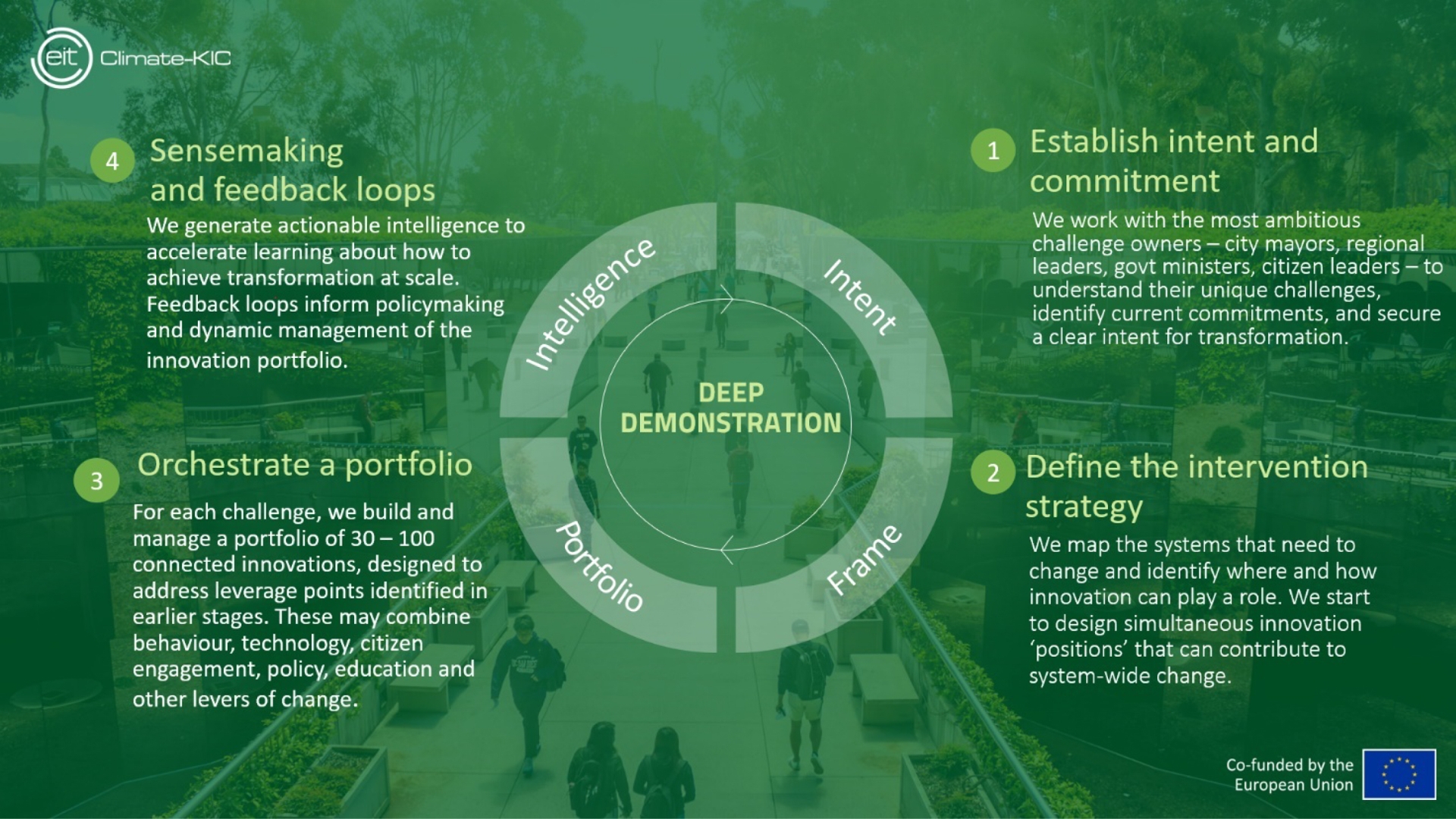
In the Intent phase, we work with challenge owners to secure commitment. “Challenge owners” can typically be national, regional or provincial governments, city authorities, sectoral confederations. However, while the initial commitment from such actors is essential, a much wider range of local public and private actors is convened very early in the process. Building ecosystems of actors for such programs is a complex endeavor, in which identifying and bringing together the relevant actors is only the starting point, up to the stage where innovation communities are organized and ready to effectively work on deep systems transformation.
In the Frame phase, we describe together the systems to be addressed in more detail and from multiple viewpoints, and we map the needs that local actors identify as priorities, barriers, relevant innovations to date or in the pipeline; we agree on leverage points to intervene in the systems; and actively engage in mobilizing public funding, private finance and investment.
In the Portfolio of Action phase, the focus is on deploying innovative solutions, policy labs, on testing new financial models, on pursuing work around multi-level governance, interconnected decision-making, complemented with matching business solutions to demand (notably through accelerator programs), and with building capacity, upgrading skills, learning with stakeholders.
The Intelligence phase is not consecutive to the other three but is more of a permanent, iterative sensemaking effort, collecting intelligence, business cases, pursuing financial mobilization in more specific schemes, implementing or further developing monitoring, evaluation and learning processes, and creating assets from all the insights and learning, further supporting decision and investment.
Importantly, the Deep Demonstration approach seeks to go beyond more traditional designs for sets of projects, where each project is selected, implemented, assessed and funded independently to address a single question, and the outcome of the set is then the collection of results from those independent projects. In a portfolio of actions, not only is the set of questions determined and prioritized from a whole system perspective, but the actions launched to address those questions remain interconnected during the whole program, meaning that the component “projects” are more interdependent and can be modified, reoriented or further developed, leveraging progress across the whole portfolio.
2. System innovation in support of the Green Deal: the Horizon Europe Missions
This pioneering approach has, by now, become part of a wider dynamic at European level.
Horizon Europe, the European Union’s current multiyear framework program to support research and innovation, has introduced five “Missions”1 for climate-neutral and smart cities (shortened to “Cities Mission” in this paper); adaptation to climate change (“Adaptation Mission” in this paper); the fight against cancer; the restoration of oceans and watersheds; and the transition to healthy soils. The aim is to move away from calls for projects launched without complete concertation, spreading expertise too thinly and generating too little real momentum for progress in each area, towards better coordinating the Commission’s human and financial resources and its political and regulatory levers, and involving public authorities, businesses, farmers, investors, citizens and researchers more actively and systematically.
The Missions support the Green Deal for Europe, with a 2050 horizon including climate neutrality, and a mosaic of objectives for 2030. Brandished by its opponents as a red, even yellow or brown rag, the Green Deal has nevertheless marked a step forward in taking political account of scientific realities, with a tree structure of clearer and more coherent objectives2 . Although the Missions are an exceptional investment at the global level, it will take a thousand times more investment to achieve decarbonization or resilience in supported areas, by blending public and private funds in multiple ways. However, they will give cities and regions the capacity to direct, structure and use this funding to achieve climate neutrality and resilience. This is an enormous, essential task. Conceiving and managing a hundred million-euro projects or one hundred-million-euro investment plan are very different endeavors.
As Climate KIC, we have been involved in large projects with all Missions except for the Cancer Mission (so far). In this paper, I will focus more on our work with the Cities and Adaptation Missions.
2.1. Working with the Cities Mission to accelerate decarbonization of cities and metropoles
The EU Cities Mission has proposed that European cities should come out of the woods and state if they were aiming for carbon neutrality by 2030, subsequently selecting 112 of them for support towards that target. Climate teams in some of Europe’s most engaged cities questioned the stated objective: “Carbon neutrality in 2030? Even if you multiply what we are currently doing by three or five, it is totally out of reach”, to which the answer was, “It might well be, but it is indeed not a question of merely multiplying what you are currently doing within each unit or each program”. Indeed, one of the first tasks to radically accelerate decarbonization trajectories is to rethink multi-level governance and cross-silo decision-making. More than 350 cities and metropolitan areas responded to the Mission’s call for expression of interest, which came as a surprise to many, and as a strong signal, since selection by the Mission did not in itself entail funding, and submitted expressions of interest were announced publicly in almost all cases.
Despite a plethora of information on multiple parameters and variables, cities remain ill-equipped to make decisions that involve multiple dimensions, sectors and services. A classic, but still valid example is that in most cities, one could very well have green roofs on fire and flooding in the streets at the same time. Neither the green spaces department nor the water management department is structured to manage interdependent problems on their own. They would therefore need to first deconstruct, and then reconstruct the indicators, management and arbitration mechanisms to better connect and integrate these green and blue grids into the city. More generally, each of the actor groups in a city or a region has access to certain levers of action and not to others. And each tends to treat the boundary conditions and limitations over which they have no control as external, immovable constraints. System approaches make it possible to re-internalize and relax these constraints, so that we can respond collectively to the needs using all levers available to the entire range of actors.
Mayors and presidents of regional or metropolitan councils need to give their departments and units the explicit mandate and the capacity to work together on transformation, prioritizing cross-departmental impact objectives, while avoiding excessive expectations that can be counterproductive. But breaking down silos is a heavy-lifting endeavor that requires a long dialogue process. Conversely, such transformational initiatives must not be entirely dependent on political support, to enable consistency of action on transformations that typically extend beyond the duration of an elective mandate. In fact, while clear impulsion and support from elected leaders are essential in terms of prioritizing such initiatives, most of the actual work with local authorities will be done with civil servants and technical bodies.
While one hundred or so cities across Europe might not seem to be a large number, success for all of them in reaching or strongly approaching the 2030 target would mean that 12% of Europe’s population would be on accelerated decarbonization trajectories, making for a rich set of lessons available to all other European cities.
NetZeroCities3 is the backbone project for the implementation of the Cities Mission. It is a service platform, implemented by a consortium of 33 organizations, led by Climate KIC and supporting the Cities Mission. It supports the cities and metropoles selected by this Mission (including 9 in France) and facilitates access to the solutions they need to achieve their climate neutrality objectives, in a socially inclusive way. The first major step is the establishment of “Climate City Contracts” (CCC). The CCC brings together three interdependent components: a shared ambition, an action plan, and an investment plan, all three with a 2030 horizon. Developing a CCC requires intensive dialogue between municipal teams and with many partners. To date (December 2025), ninety-two cities have submitted their plans and obtained the Mission’s Label. The Label officially recognizes the relevance and quality of a city’s climate planning. The city can then use it as a lever to further involve citizens, stakeholders and investors.
After the labelling, the next phase of NetZeroCities helps cities to acquire the knowledge and capacities necessary to implement their plans. This includes support by city support groups; working groups focused on critical areas, such as just transitions or citizen engagement; peer-to-peer connections across different cities, both structured and informal, including through a twin cities program coupled with cities in the Mission.
Going deeper, a Pilot Cities program then aims, in the specific context of each city, to overcome the major blocks on the road to rapid decarbonization. The program in its globality aims to address all urban systems contributing to climate neutrality. The selection of pilot cities therefore takes into account the complementarity between proposed projects. The resulting set of innovative solutions should then be ready for implementation and upscaling. Learning throughout the program will develop capacities and skills, at the level of each city and between the pilot cities.
The next step is an Enabling City Transformation program. This focuses on implementing innovations necessary for the transformation of the city as a whole. Here again, the selection will constitute a portfolio of transposable interventions, which respond to the challenges that frequently emerge across the cities of the Mission, with a view to broader scalability in the medium and long term.
It is increasingly clear that these transformation processes cannot be financed primarily by the cities themselves. After completing work on their Climate City Contracts, public authorities for large cities or metropoles have been able to estimate that even if their whole budget in the upcoming years were allocated entirely to decarbonation, which will obviously not happen, they would cover only 10% of the cost of decarbonation. What municipal finance can enable must be multiplied by combinations of grants, public financing and private capital. The Climate City Capital Hub, developed by NetZeroCities with the European Investment Bank (EIB), provides technical and financial assistance to cities that have received the Mission Label, to facilitate capital flows to fully implement climate action plans. It equips cities with several tools to navigate the options for raising funds, loans and financing for sustainable urban development, including: a knowledge repository of investment plans, innovative financing mechanisms; an interactive financial guidance tool, to identify the most suitable sources of financing for their projects; and a climate investment tool, which assesses the economic viability and potential climate impact of projects.
The fact that dozens of cities and metropoles have each drafted ambitious, detailed and prioritized action plans to achieve climate neutrality, with the will to invest simultaneously in all components of this action plan, is already a remarkable step forward. One should be fully aware of the long and steep road that separates this step from a real organizational and operational capacity to finance the implementation of such plans, to accelerate them in a systemic and evolutionary way, with all that it entails in terms of interdependencies, iterations and hypotheses that need to be confirmed, invalidated or refined on a sustained basis. We can no longer treat the financing of transition as an externality, as a ready-to-use tool once cities are clear about their transformation trajectories. Financing must be an integral part of systemic transformation; it cannot be worked on exclusively within the financial sector, whether public or private, but it must experiment, question its limits and evolve in direct interplay with the other levers of urban transformation.
This embedding of financial components in the climate trajectory of cities requires profound changes within municipal administrations, where financing and investment mechanisms remain modelled on organizational silos and on the fragmentation of objectives and indicators. And cities need support from regional and national governments, in terms of commitment and of dedicated resources. However, this work cannot be limited solely to operations supported by the public authorities. If the bulk of funding for decarbonization is to come from private players, it is important to involve them in investment funds. But this will not be sufficient if they, themselves, remain within the traditional logic of performance and profitability. All this requires both the ability to respond to the specific contexts of each city and the essential pooling of effort and experience at regional, national and European levels.
In Spain, the citiES 2030 4 platform provides Spanish cities with an instrument that amplifies the benefits brought by the Cities and Adaptation Missions and anchors them fully in the national landscape. The citiES 2030 platform is promoted by the Ministry for Ecological Transition and the Demographic Challenge (MITECO) through the Biodiversity Foundation and the Spanish Climate Change Office, and is developed by Climate KIC and the Centre for Technological Innovation for Human Development of the Polytechnic University of Madrid (itdUPM). It facilitates multi-stakeholder collaboration between cities, public sector bodies, the private sector, academia, civil society and citizens; articulates collaboration at multiple levels—European, national and local—in line with the Cities and Adaptation Missions; provides a range of services tailored to cities and their stakeholder ecosystems, including summer schools, citiES 2030 breakfasts, climathons, training journeys, support for the drafting and implementation of Climate City Contracts (CCC), strategic communication, exchanges between cities (within Spain and with European cities), support to structure plans for financing the transformation involving players from the financial sector.
More broadly, it promotes dialogue and the creation of multi-city initiatives and programs, offering services to implement the portfolio of interconnected projects within each city and develop collaborative programs between the cities and organizations involved in the platform. One of its flagship activities is a massive energy renovation program with a target of 100,000 home renovations per year. The citiES 2030 platform was initially inspired by the Deep Demonstration work in Madrid, by the Spanish platform El día después (The Day After) bringing together four communities including one on urban transformation. Its development was boosted by the formal launch of the EU City Mission and a motion from the Spanish Senate to promote climate neutrality in Spanish cities within the framework of the European Cities Mission and the citiES 2030 initiative. The citiES 2030 platform currently gathers the seven Spanish cities supported by the Cities Mission plus ten others, of variable sizes, with more expected to join.
Other national platforms in support of accelerating city decarbonization, often coupled with climate resilience, have been operating or are being developed notably in Sweden, Poland, Romania, Austria. In countries such as France, where active city networks exist and quite a sophisticated set of frameworks and rules plays a prescriptive and normative role in climate and energy objectives and indicators, it could be very relevant and powerful to couple the integrated approach underlying EU Missions and systemic initiatives such as Deep Demonstrations with the elaborate analytical instruments with which all regional and local authorities and administrations have to comply, and to do so with the support of permanent national platforms where collaborations and joint experimentations by regions and cities are at the core, and national bodies can identify where their investment, regulatory role and capacity to provide data, assistance and resources would be the most effective and needed.
2.2. Working with the Adaptation Mission to design and enable the implementation of pathways to regional climate resilience
The Adaptation Mission supports the implementation of the European Strategy for Adaptation to Climate Change, which aims for smarter, faster and more systemic adaptation. More and more regions are calling for climate mitigation and adaptation to be combined with climate justice, sobriety, circularity and biodiversity. A sociologist once remarked that the net-zero carbon objective could not claim to form a new social contract just by itself. This could be debated, but the observation was quite to the point. When it comes to adaptation, the parameters, variables and metrics are more diverse than for mitigation, and the objectives depend more on societal choices and the place-specific priorities of each country or region, even though global perspectives remain essential—hence the focus on regions and communities.
In contrast to the Cities Mission, the Adaptation Mission has not started by selecting the regions it will support. It has drafted a charter, signed by more than three hundred regions and communities to date. Its support for the regions is then being implemented through calls for Horizon Europe (HE) projects. And the overall coherence of this support across HE Adaptation Mission calls and activities is explicitly put forward, from the design of the calls to the selection, implementation, dissemination, synergies and complementarities between projects.
One of the Adaptation Mission’s backbone projects, Pathways2Resilience5 (P2R) will support a hundred regions in building a shared vision of their future regional resilience journeys (Figure 3). Each pathway will be broken down into an action plan that can be implemented across sectors and territories, with coherent monitoring, evaluation and learning systems and the development of an investment plan to finance the pathway. The methodological framework is common to all regions. As Climate KIC is the coordinator of both NetZeroCities and Pathways2Resilience, we have made sure that the framework between the two projects would be as shared or mutually compatible as possible, to foster synergies for cities and regions and to make outputs and outcomes from both projects easier to action and disseminate consistently. However, the framework is highly modulable according to different contexts and aspirations. As with NetZeroCities, the process must above all emanate from the region and be guided by its “desirable futures.”
The Regional Resilience Journey map (Pathways2Resilience). Source: Climate KIC/Pathways2Resilience document, 2024.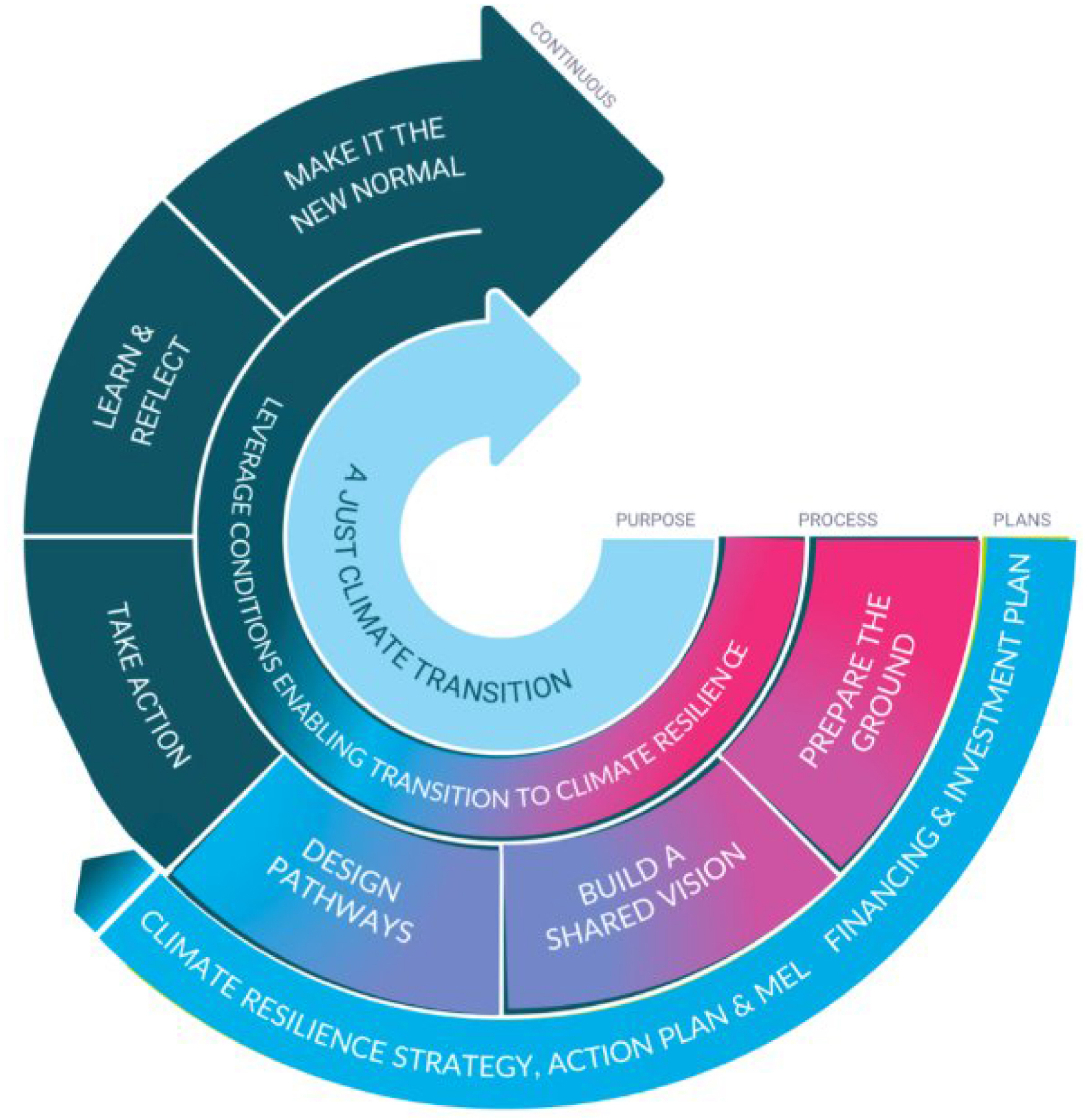
As much as access to a series of training modules, to an adaptation finance innovation lab (involving nine pilot regions for real-circumstance development and testing) and to a detailed practical toolbox, Pathways2Resilience puts emphasis on innovation practice groups that aim to support the locally led formulation of shared visions, pathways and innovation agendas, to build on existing knowledge and best practice, but also to foster and facilitate cross-regional exchanges about regional adaptation across similar challenges and widely different contexts. A first batch of forty Europe regions and communities was selected in the summer of 2024, gathering a total population of 53 million; the P2R project will have supported sixty more within its lifetime. Like other projects selected by the Mission Adaptation, P2R is taking the lens of Key Enabling Conditions for climate adaptation (access to knowledge and data; governance and engagement for innovation; behavioral change and empowerment; local economic systems; finances and resources) and cross-sectoral Key Community Systems (critical infrastructure; health & wellbeing; water management; land use & food systems; and a connection system of ecosystems & nature-based solutions).
In the downstream part of the Adaptation Mission’s portfolio, a family of seven “Innovation Action” projects, generally centered each on one European biogeographical region, is testing, refining and evaluating nature-based solutions on site and in real life. Not only are technologies validated, but also uses, economic models, regulatory barriers, behavioral patterns, and more. Climate KIC is actively involved in three of these projects (NBRACER6 in the Atlantic region, DesirMED7 in the Mediterranean region, ARCADIA8 in the Continental region). Each project has engaged eight regions not only as hosts for experiments, but as full-fledged consortium members. In the 24 regions involved, each solution is explored from the outset as a link in the regional journey towards resilience. What is the real impact of such solutions? Under what conditions do they go beyond “no regret” measures? How should knowledge and expertise in the physical and technological dimensions of solutions be much more closely, and realistically, coupled with factors linked to social dimensions, economic, financial, behavioral, regulatory, cultural, all of which have a major influence on the actual impact of solutions over time, but are often very incompletely understood and assessed, separately and even more in their combinations and interactions? Answering such questions is key to unlocking the required investment levels and to replicating and transposing such solutions on a larger scale.
Being deeply involved both in upstream and downstream projects within the Adaptation Mission’s portfolio allows us to work concretely with regions and communities on how to connect different spatial and temporal scales. For instance, each of the demonstration sites in the above-mentioned Innovation Action projects is concentrated in small areas (generally ranging from a few hectares to a few square kilometers). Aiming for a deep, comprehensive understanding of the actual solutions tested in real-life contexts demands to delve into the specifics of places, engaging with very local expertise, notably in regions such as Flanders where the social culture itself is highly focused on local and hyperlocal scales. At the same time, one core objective of these projects is to identify how relevant nature-based solutions could, and should, be much better streamlined and leveraged to accelerate regional resilience journeys.
Part of the work is then to make clearer and more tangible the interplay between local experimentation and learning, as delivered in demonstration sites, and the development of the pathways to resilience at regional levels, not only conceptually but, most importantly, in the actual practice of all stakeholders involved. Concrete reflection and collaboration work across the regions involved in these projects is no less important, notably to test how the wealth of knowledge created during the projects’ lifetime does not end up as mere reports gathering dust on shelves, but can be effectively turned into a keyboard of possibilities, further inspiring relevant solutions for communities within and beyond those regions, and into actual guidance to implement them in ways that make the best of their potential impact on climate resilience.
Obviously, this work also requires building consistency of action across different time scales as well. There is real urgency to make visible the first lessons learnt and progress made in actual sites, to maintain and grow the momentum and citizen engagement generated by preceding projects (for instance in Porto with the URBINAT project). There is also a pressing need to challenge and improve, or to substantiate and validate, choices made by incumbent political leaderships and public administrations, so that the learning and determination to act can be anchored and made more sustainable beyond political mandates, while it is acknowledged that achieving regional resilience will happen over longer time scales.
Reconciling and integrating the local and the regional, the short, the medium and the longer terms in climate adaptation are, once again, a matter of breaking silos, not only between different organizations and units but also between the priorities and objectives set within organizations and units themselves.
3. Of the role of data for climate action
The use of data in support of climate action is a critical issue, as mentioned in a short paper Hervé Le Treut and I wrote in 2023 on the potential of climate data (Le Treut and Lê, 2023). Identifying, collecting, understanding, organizing, connecting Earth Observation data, historical data, traditional or indigenous data, on physical and socio-economic dimensions, on causes and impacts, and making them accessible, intelligible and actionable by multiple actors in regions and communities, is an extraordinarily complex, daunting task but an essential requirement. Regional and local actors need to be able to base their decisions on data that they trust and consider relevant, and to acquire the capacity to appropriate it and take action.
Several years ago, the Horizon 2020 MARCO project that I coordinated (also cf. its sister project EU-MACS) was a pioneering attempt to better understand the current state and the potential of the European market for climate services, on which opinions were markedly divergent at the time (Lê et al., 2020). One of the main points that MARCO amply confirmed was the gap between the way this emerging climate services market was conceived and structured by the supply side (data providers and the chains of downstream service developers, providers and purveyors) and how it was actually perceived by the demand side, which mostly struggled to identify which services could be truly relevant to the actual needs as users experienced them, and how.
Certainly, in recent years, significant progress has been made through the adoption of more detailed regulations that have boosted the demand for climate services (under that name or others) and their use. We would, however, challenge the assumption that more explicit regulatory demands, while necessary, are sufficient in themselves to unlock the potential impact of services for climate mitigation and adaptation. There is still, in our experience, a loss in translation at multiple levels of the value chains between data and action by decision-makers and final users.
In addition to the promising work being engaged around data and monitoring, evaluation and learning (MEL) within Innovation Action projects, for instance in Nouvelle-Aquitaine as part of the NBRACER project, it is worth mentioning a few more Horizon Europe projects which aim to ensure that climate services are modelled on the real information needs of local authorities.
One of them is VALORADA9 , part of the Adaptation Mission portfolio, which aims to raise awareness of the untapped potential of existing data in effectively adapting to climate change, through a comprehensive approach that integrates technical and governance perspectives, seeking to create interdependencies between various types of data, notably emphasizing the importance of ground data for climate analyses, observation, and tool validation. The co-development of data manipulation tools and climate data, and further capacity-building, scalability and replicability activities, are done with public authorities and local service developers across several European regions.
Taking a complementary perspective, the PROTECT10 and PCP-WISE11 projects apply innovation procurement instruments, in this case pre-commercial procurement (PCP) as adopted and further developed by the European Union, to climate services, both for adaptation and for mitigation. From a current state where the identification of needs for climate-related data is generally incomplete and scattered across administrative units of public bodies, leading to the purchase of isolated tools that imperfectly meet the needs and are underutilized, the aim is to move to a more integrated expression of demand at an organizational and, further, local or regional level, that can generate both greater clarity and a critical mass of users for climate service providers. The PCP process shall then allow potential service purchasers and service providers to build a joint understanding of the needs and of the current and near-future capacity to address them, and to test assumptions through R&D, before actual tenders can be issued at the end of the projects, enabling more strategic and effective procurement from public organizations.
4. System innovation for regional transformation: learning from Deep Demonstration initiatives
As previously highlighted, for the systemic transformation of a region, it is essential to be anchored in its specific characteristics. As an organization and community with constantly evolving membership working across Europe and beyond, Climate KIC is seen as neutral in the local landscape. Our role is not to choose between opposing sides. It is to support the region and its components to define, with sufficient detail and diversity of perspectives, what are the desirable futures they can envision across their diverse identities and needs and they want to choose from; what systems do they need to transform in integrated ways to open pathways to such futures; and how to design, through innovation portfolios, and enable roadmaps to implement those pathways. This allows us to convene stakeholders to open dialogues of which no one holds full control and ownership. But if we are to support far-reaching and demanding transformations, to turn methodologies and concepts into actual moves towards positive climate impact, we need to immerse ourselves in the region, the ways it breathes, its specific tensions and contradictions. This is what inspires the Deep Demonstration approach and must guide how to land it into the reality of places.
A region’s identity can be a driving force, if it is not used as a tool for exclusion. Take the example of Gipuzkoa, the smallest Spanish province and one of the seven traditional Basque provinces. In its global strategy Etorkizuna Eraikiz (Building the Future), the provincial government describes the “Gipuzkoa Model” as the conjunction of values and capacities of the province, that explains how its economic and social development has been built, and forms the basis for the shared construction of the future of Gipuzkoa. Those values and capacities are (a) the leadership, vitality and capacity for cooperation of Gipuzkoan society, a high level of social capital; (b) a recognized socio-economic model, which successfully combines wealth creation and social protection, and promotes balanced development in the territory and a supportive community, with a Basque culture and its own language; and (c) a future anchored in the principles of competitiveness, equality and collaboration.
Interestingly, the strategy is not primarily structured in terms of priority sectors but in terms of coherence with the Gipuzkoa model, of collaborative governance, a new public agenda based on collaboration and experimentation, and of generating democracy, trust and public value. The strategy is then divided into three layers: a space for deliberation; a layer consisting of 11 reference centers and strategies, which are collaborative workspaces generating their own ecosystems, one of them, Naturklima, focused on climate change; and a space for experimentation. It is a particular challenge to explore transformation trajectories for the climate in such a mental, political and social framework. While the Gipuzkoa strategy is ambitious, provincial authorities did not yet feel that it was sufficiently defragmented and concrete. This is how a Deep Demonstration program12 was designed with Climate KIC, where the province wanted to make deeper progress, focusing on two “missions”: sustainable food and new forms of mobility. The structure of the program integrates all the categories of players involved, and also the three main levels of governance: the Basque Country, Gipuzkoa, and the development agencies in each of the valleys.
In Ireland, the agri-food value chain accounts for 37% of Irish greenhouse gas emissions. Our ongoing Deep Demonstration program13 with the Department of Agriculture, Food and the Sea, currently engaging with further ministries and agencies, aims to reconcile prosperity for farming and rural communities, sustainable business models for agri-food and bio-based industries, and ambitious climate targets.
A complete mapping of the agri-food system has been carried out. The choice of priority trajectories was then made by the Irish stakeholders, and this process was conducted in a very inclusive way, resulting in the definition of seven “flagships”, some overarching and structural (“Vision 2050: re-imagine Ireland’s land and agri-food system”, “Foster innovation and investment in new value chains to diversify the sector”), others with more focus on thematic areas (“Promote circular bioeconomy models in regions and multiple value chains”, “Diversify incomes through a carbon farming and nature credit framework”) or specific value chains (“Produce and certify climate-neutral beef”, “Accelerate emission reduction and sustainability in dairy farms”, “Grow and diversify the tillage sector”). For example, flagship no. 6 works with the dairy sector with several major projects: defining what “fully sustainable dairy production” means, demonstrating emissions reductions with stakeholders from dominant and alternative systems, and informing Irish and European policies. The list of these seven flagships may not be very vegan, but it is ambitious, concrete and motivating for the players involved, and also verifiable in terms of real impact. Implementation must then take place with a selection and clustering from 280 project ideas on the ground and with partners all along the value chain. The Irish Deep Demonstration is the first to have entered the implementation of the Activity Portfolio phase.
A third program will allow to introduce a visual tool that can help design innovation portfolios. Slovenia is a pioneering country in the circular economy at the international level, having led some two hundred advanced circularity projects across the country. However, its government fully understands that going from that point to achieving near-circularity across the entire national economy is a massive change in nature, not merely a quantitative scaling problem. This was the reason why, after a long period of discussing and building mutual trust and understanding between the multiple Slovenian ministries and public organizations involved in circularity projects, Climate KIC and the EIT Raw Materials KIC, the decision was made to engage in a Deep Demonstration program14 that could enable such a change of scale and scope.
We agreed on a representation of the systems to be transformed based on three constituent elements: (a) four priority value chains: Built environment, Mobility, Food systems, Forest products—wood industry; (b) five levers to make the transformation possible: Education & training, Public policies & procurement, Entrepreneurship, support for SMEs & business models, Science, research & technology, Financial architecture; and (c) four levels of intervention to drive this transformation: Awareness & capacity, Behavioral change, Structural change, Redefining paradigms—creating the conditions for change. These elements form the three axes of a 3D representation. Through broad consultation, a series of “positions” emerged, i.e., points in the systems where one can concretely intervene, experiment and catalyze the transformation towards near-circularity. In the very simplified diagram below (Figure 4a,b), some of these “positions” are mentioned and graphically represented along the three axes.
Simplified representation of a problem space (Deep Demonstration in Slovenia). Source: Deep demonstration of a circular, regenerative and low-carbon economy in Slovenia: implementation of Phase 2, Del 2.1 (April 2023).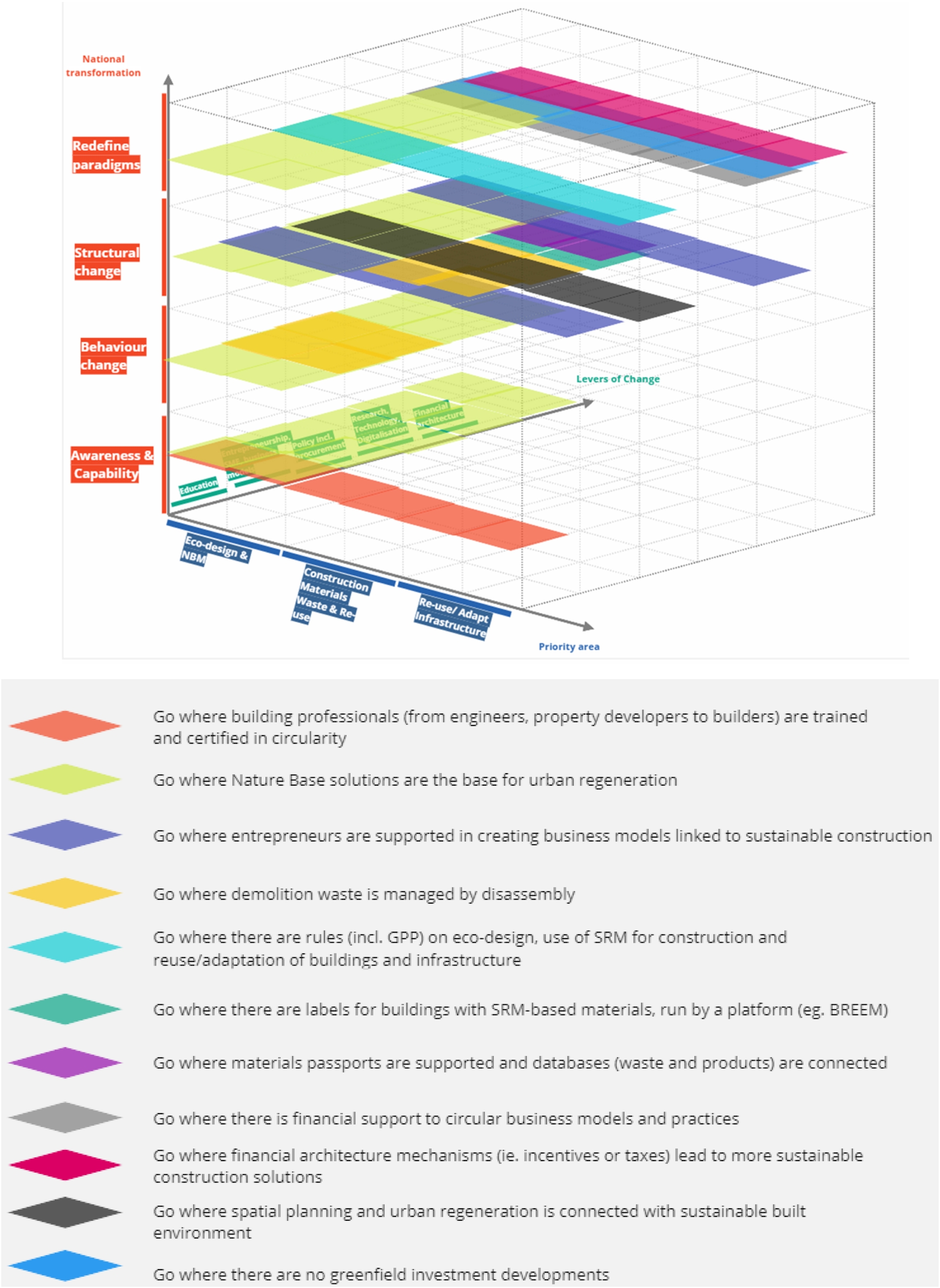
Finally, one can refine the representation by showing all existing projects that are relevant to the circularization of Slovenia, and then identify by projections where new projects, capacities and expertise need to be developed to build a comprehensive and consistent portfolio of interventions across the system. This kind of representation requires time and practice to acquire familiarity and precise agency with it, but it then helps to design actual innovation portfolios, connected and integrated, which together meet the needs to get closer to the targeted systems transformation.
5. Enabling and boosting “concrete” climate-relevant innovation
The projects and initiatives described above obviously all strive to be anchored in reality, providing communities and organizations with actionable schemes, methodologies and knowledge, creating actual space for their collaborative systemic approaches, and empowering them to create impactful solution portfolios. However, some more examples of specific activities (arbitrarily sampled among hundreds) might help the reader visualize more “concretely” the range of innovations that Climate KIC has catalysed, nurtured or boosted over the years.
Thousands of start-ups across Europe and, in the last few years, on other continents have benefited from our climate acceleration programmes. A few examples of supported innovation include wood fractionation to enable circular bioeconomy (Chrysalix Technologies/Lixea), low-carbon, high-performance computing (Qarnot), precision monitoring of ecosystems, vegetation and carbon (OPENFORET), high-energy density solar technology (Naked Energy), home thermostats and intelligent cooling (tado°), electrically powered personal mobility (Lilium, Volocopter), automated wind-assisted propulsion systems for maritime transport (bound4blue).
Among the many collaborative projects born within the Climate KIC community, let us mention the early, pioneering CarboCount15 and CarboCountCity (precision monitoring of greenhouse gas sources across large forested regions and across metropolitan areas respectively—lead CEA/LSCE; fed notably into the Low Carbon City Lab programme, LoCaL16 ), OASIS (open-source climate risk monitoring frameworks, involving major insurance and reinsurance companies, which was further developed by OASIS LMF17 ), WINnERS and ARISE (protecting smallholder farmers in Africa and building climate-resilient agricultural supply chains—lead Imperial College London; with further developments to this day18 ), Climate VAR19 disclosing the risks to companies’ assets under the Task Force on Climate-related Financial Disclosures—Carbon Delta and Climate KIC; further developed and deployed by MSCI), Cool Farm Tool20 (standardised metrics for the framing sector on greenhouse gases, biodiversity, water use, and food loss and waste), SATURN21 (enabling economically sustainable, multi-functional land use around three cities, based on landscape identity—lead Fondazione Edmund Mach), LOOP-Ports22 (transitioning to a circular economy in the port sector—lead Fundación Valenciaport; fed notably into ongoing Deep Demonstration in Lavrio23 and CO-WATERS24 project), SuSMo25 (lifting barriers to the implementation, monitoring and evaluation of shared mobility—lead Cenex Nederland), Reboost26 (developing resilient and robust sustainable development strategies in three lignite-dependent regions—lead Potsdam IK; early seed of a rich portfolio of current post-coal projects linking to the European Just Transition Mechanism), or the Horizon Europe projects ClieNFarms27 (co-developing and upscaling systemic, locally relevant solutions for climate-neutral and climate-resilient sustainable farming—lead INRAE) and Credible28 (building consensus on the methodologies to maximize the capacity of soils to act as carbon sinks—lead Climate KIC). Larger initiatives, such as those described in previous sections, also abound in concrete case studies, from regeneration through natural urban spaces in Ukraine29 (Bucha Forest Classroom, with EIT Community New European Bauhaus) or lighthouse districts for low-emission collective heating systems in Leuven30 (as part of the Deep Demonstration of Healthy, Clean Cities) to piloting sustainable construction and green budgeting in Zagreb31 (with NetZeroCities).
6. A few insights from the first fifteen years of the Climate KIC journey
A complete overview of what Climate KIC’s journey to date has been would widely exceed the scope of this paper, and other documents published by Climate KIC will do it more comprehensively and from an organizational perspective. I will therefore limit myself to a few personal insights.
The European Institute of Innovation and Technology was proposed by the European Commission and established in 2008. The first three Knowledge and Innovation Communities (KICs) were selected through competitive calls at the end of 2009, Climate KIC being the community chosen to work on the topic of climate change. As there was no economic sector focused on tackling climate change and its consequences, and no large, interconnected market beyond a few emerging niche markets, the very notion of focusing on a growth and job agenda around climate change was challenged by some as hardly being realistic. In parallel, it is fair to say that the creation of KICs was initially seen by some public and private organizations primarily as a new source of EU subsidies that could add to existing R&D funding mechanisms.
While none of the above was groundless, what quickly emerged was that Climate KIC should not be yet another traditional counter to apply for project subsidies or start-up grants. One of the reasons was that markets for solutions were mostly immature, latent or even non-existent, and that they would not develop merely out of push from the technological side or of economic demand. There was also very early awareness that the nature and complexity of climate-related challenges would probably require something other than an accumulative approach, based solely on the addition of point solutions and incremental progress, and that technology would not be the only lever to activate to foster innovation at scale and in time.
The systems narrative was present from the very first phases of Climate KIC’s history. It is quite interesting to observe that although Climate KIC has been one of the most constantly changing and evolving in the family of KICs in terms of community members, organizational structure and formats, programs, areas of work and more, some of the fundamental assumptions were already present from the onset.
In the first ten years, innovation projects of all sizes were selected through competitive calls on a range of topics. In the very first phase, we all had to explore together whether there was appetite and potential to generate a critical mass of innovative ideas, and proposals were very eclectic in scope and evaluated essentially on their individual merits, not yet in a project portfolio logic. The same applied even more to the selection of start-ups accelerated across Europe and, in different ways, to education programs such as the Journey summer schools, Pioneers into Practice and many others. Within two or three years, we had moved to a more thematic approach. In contrast with usual EU calls, ideas were always discussed within the community, both collectively and bilaterally between Climate KIC teams and community members, upstream from proposal submission, after project selection and during the whole lifetime of the project, or even beyond. This did not create bias in selection processes but opened space for joint progress and significant reorientation of projects, based on what all those involved had learnt and tried together.
In retrospect, it might seem difficult to assess exactly what lasting impact was created in those early years, to which extent each of the individual projects was successful. One has to remember that not only markets were emerging (and many still are, despite the progress made worldwide in the last fifteen years and the accelerating pressure coming from tangible effects of climate change), but also that various organizations in the community had very different perceptions of what mattered or not, depending on their positions between science and business, their topics of expertise, their sectors, their geographic locations and more. However, a lot was learnt through facilitating and enabling organizations and teams who had never worked together, or only in contractual, provider to customer relations, to gather around climate-related challenges on which none had full control and expertise. We also learnt a lot from what failed, or at least stayed far from anticipated outcomes, not only about the inadequacy of some ideas but also, more probably, about the enabling conditions required to unlock the potential of innovative ideas. While it has always been difficult to trace and monitor the benefits of projects after they ended, we keep discovering, in discussions with long-time or former community members, that our joint activities contributed in multiple ways to developing further products and informing strategic choices, beyond the hundreds of solutions that were made available as more direct results from projects.
Some of the most valuable lessons learnt along the years were transversal to the specific topics of projects and, therefore, harder to capture in reports or deliverables. One virtue of working with a logic of community and longer-term partnership is that it gives space to create trust. I shall come back to this in the closing remarks, but what I have in mind here is the opportunity to share some of the actual, harder barriers that teams and organizations are facing, and which are not routinely discussed in project meetings or in public conferences. Those can pertain to internal tensions, to resistance from local communities, to doubts about the viability of current business models, to the capacity and determination of organizational leadership to prioritize actions consistently with longer-term challenges, but also to cultural misalignment within project consortia, to defiance and conflicting time horizons between academic and industrial actors, and more. While none of those are unheard of, working on a wide diversity of topics and formats, often in unchartered combinations, opens a window upon more complex and stimulating dialogues.
Working with places through national hubs, in regions and cities has also allowed us as a community and organization to deepen our experience of building climate innovation ecosystems, and to understand how much more it meant than merely identifying the best actors and bringing them together within project consortia. Significant time and energy were wasted in the early days after some projects were kicked off, when the lack of mutual knowledge and vastly different working cultures created confusion about expectations, roles, and even the actual ambitions and expected outcomes of projects beyond formal results. As the emphasis on system innovation became stronger towards the end of the 2010s, notably with the development of the first Deep Demonstration initiatives, the role of “challenge owners” became more central, and the traditional logic of project consortia needed to be revisited, all the more so, since KICs had to diversify funding sources and the share of subsidies from one institutional funder sharply decreased. This now leads the community, and its subsets focusing on more specific topics, to increasingly self-organize, to embrace more roles than simply delivering a work package or a task in a project. It also requires all of us to start from the challenge spaces we want to address and explore together possible schemes to fund and resource the work. However, this diversification of resources is necessary anyway to deal with the greater variety of interventions required to implement system innovation programs and roadmaps.
Maintaining, regenerating, and further growing the energy and commitment of such a diversity of organizations to work together on hard, interdependent issues is difficult. One has to accept that not every single component of systemic innovation programs can be systemic and complex in itself, and moreover, that a large part of the positive impacts on climate will probably not come from initiatives and activities that have climate change as their primary driver. Individual actors need to see, and to show, that concrete progress is being achieved within the scope of their roles and responsibilities. Yet, there is no escaping the increasing need for integrated, consistent decision-making, planning, resourcing at the scale of systems and subsystems. Supporting all stakeholders to embrace systemic approaches without creating paralysis and confusion from a sense of unmanageable complexity is a challenge that we, as an innovation community, need to address constantly.
7. Four “closing” (open) reflections
(1) “In the last ten years”, one eminent research director once told us, “we have made good progress in the scientific understanding of urban transitions, and in fifteen years from now, we should be able to start acting on it”. But can, and will, cities really wait for another fifteen years?
When it comes to acting in the face of climate change, launching innovation programs before their scientific foundations are fully mature is not only unavoidable, but creates potentially fertile ground to accelerate our understanding of these ultra-complex systems. We believe that the scientific community should accept and embrace this, beyond the discomfort and tension that it may create with the standards and demands of academic research and peer-reviewed publications. We advocate that science must be given the means and resources to remain at the heart of this race and, on various subjects, to regain the lead over time as concepts and theories advance. The main risk is not so much that urgently needed action for climate change mitigation and adaptation would be delayed until science is confident and ready enough. It is rather that communities confronted with climate challenges, their leaders, the multiple actors trying to contribute to emerging service markets shall not wait and will proceed with experimentation on, and implementation of innovative solutions, with little or no scientific insight, guidance and analysis of observed results, which is (in our view) a lose-lose situation, and a potentially dangerous one for all sides in the longer term. One critical question is then: can scientists “get their hands dirty” in conceptually impure projects, without sacrificing their careers because interdisciplinarity is still deemed suspicious, if not outright mediocre, in many academic communities, all the more so, when some of the theories involved are not yet fully mature?
(2) Financing the transformation is not just a question of figures. Not only do the capacities of local authorities or the State have their limits, but various categories of public or private organizations can take and assume different risks. Exploring the possibilities of mixed financing also falls within the scope of climate innovation.
If mitigation and adaptation could be achieved by taking each lever, each sector one after the other, we would not be complicating things just for the sake of it. Of course, we need to implement many fairly simple and potentially positive measures. But that alone will not be enough. This is where the construction of innovation portfolios becomes necessary and relevant.
One must allow projects to be redirected as the whole portfolio progresses. Failure must be accepted as an integral part of the process, and several paths must be explored concurrently to determine which one generates the most positive impact. All this needs to be built into the funding model: you do not invest only in achieving results, but in everything you learn from developing and implementing the portfolio.
Transforming complex systems entails combining multiple interventions, in ways that have not yet been fully explored. Even a clear roadmap still contains open questions—it is almost never a single possible route, entirely known in advance, to be implemented in a linear and sequential way. In other words, trial and error is not just a collateral risk, but an integral part of systems transformation. Sticking to more traditional, incremental improvements based on tested and validated point solutions might seem safer, yet it represents a much higher risk of falling far short from climate targets. Betting on a small number of isolated, disruptive technologies is equally dangerous—massive investment in simplistic solutions can fuel massive maladaptation or uncontrollable chain effects. The key point here is that, to enable the required transformations, political leaders, public and private funders, industrial actors, must explicitly build into planning and resourcing the license and the financial capacity to fail. And citizens need to understand and accept this as well. It does not at all mean that innovation should be hazardous. What we should not do is to turn our backs on open questions and on experimenting on multiple options. Greater uncertainty demands a higher sense of responsibility, integrating all relevant knowledge, especially when innovation needs to progress before supporting science is fully mature.
Even though combining policy instruments, blending funding mechanisms, coupling transformation levers create more complexity and apparent uncertainty, it is key to understanding more quickly how systems actually react, and ultimately to better adjust and control the implementation of bolder climate pathways.
(3) Five or six years ago, when we advocated more “systemic innovation”, we were asked “do you mean systematic”? Now, we are being told “of course you are doing systemic innovation, like everyone else”.
In reality, not everyone who talks about systems and follows fashion does systemic work. Many are launching activities in several sectors in parallel, but still in silos. We, in the Climate KIC organization and community, may have genuinely pursued systems thinking and started to experiment with real challenge owners for several years, but we (as anyone else) still have an enormous amount to learn about the practice of system innovation in the field, and from addressing the conceptual and operational challenges that emerge from it. It is a huge undertaking, far from being well-defined or mastered yet, one that cannot be further delayed. This makes it all the more urgent that we really embrace and tackle it together.
Some equate systemic approaches with a dissolution of responsibilities: if so much is based on interdependencies and systemic coherence, would the players no longer be individually accountable for the efforts expected of them? This is obviously misleading: the more complex a system is, the more acutely it can react to the contributions of each of its players. To use a musical metaphor, just because you play an instrument in a symphony orchestra, with a conductor to lead the ensemble, you cannot afford more false notes than a lone performer, if you truly respect and serve the musical intent.
(4) A central issue, as mentioned before, is trust. It cannot be decreed or imposed; it must be crafted, built together, and deepened. In the course of the Deep Demonstration work in Slovenia, funding agencies that had seen themselves as competitors within the same government ministry came to develop common criteria for selecting low-carbon projects. Those new criteria, in turn, are building coherence and confidence in the economic sectors, and transparency in public debate by reducing opacity and the risk of greenwashing. They create a framework in which civil servants have a mandate to experiment and an explicit right to fail before identifying promising avenues.
Obviously, this need to create and maintain trust, and to understand the many factors that enable and unlock or erode and destroy trust, is not at all limited to public administrations. Working with a variety of people and organizations, we regularly meet exasperation, and even desperation, that knowledge, expertise, know how, are not being applied while they have the capacity to solve the climate crisis. This is particularly frequent with academic experts, but also with providers of technological solutions, and in different ways with militants and activists. Much of this sense of exasperation is understandable and even highly justified, when clear science keeps being neglected, downplayed or even contested with weak, dubious arguments or downright with demagogical lies.
Those, however, might be only the tip of the iceberg. Beyond the political games and the vested interests, there is also the more or less implicit perception that between the theoretical potential of applying and implementing what science and technology are telling us about climate phenomena, indicators, levers for performance improvement, and the actual impact of this knowledge on complex human and natural systems, multiple factors and their interdependencies come into play and can either improve or hamper impact. Not all of them can be precisely modelled and monitored at this point, and even less their interplay. Nonetheless, treating them as marginal or immaterial, or ignoring them altogether, will also erode confidence in their full relevance to concretely resolve climate-related issues and their capacity to inform the decisions that public and private actors have to take, and that are not limited to climate dimensions. Awareness of such gaps is finally starting to grow, but acting on them proves to be more difficult. This is not least because most actors have quite strictly delineated conceptions of what their role should or shouldn’t be, because organizations and their internal subdivisions are siloed; and because increasing pressure to focus on one’s own objectives, indicators and resources is not conducive to tackling such gaps in collaborative and effective ways, which is complex work that takes time and demands conscious, sustained efforts from all involved.
The necessary transformation of a system only begins when the key players in the system have the confidence to admit that none of them can achieve this transformation under their sole control, and that in spite of the countless obstacles created by different cultures, organizational patterns, economic models, temporal and geographic scales, definitions of impact, there is no alternative to deep collaboration.
Acknowledgements
The author would like to thank the organizers of the conference “Climate Emergency: A Decisive Turning Point?” for their invitation, Hervé Le Treut and Alain Dupuy for many highly enriching conversations on climate adaptation and resilience, as well as his colleagues and former colleagues at Climate KIC for their information on systemic innovation programs, in particular Andoni Hidalgo, Bart Stegeman, Denyse Julien, Ekaterina Smaguina, María García Rodríguez, Marlène Zanier and Stefka Domuzova.
Declaration of interests
The author is employed by Climate KIC, a Knowledge and Innovation Community supported by the European Union (European Institute of Innovation and Technology).
5 https://www.pathways2resilience.eu/.
8 https://www.arcadia-adaptation.eu/.
9 https://valorada-project.eu/.
10 https://www.protect-pcp.eu/.
12 https://www.climate-kic.org/spotlight-initiatives/gipuzkoa/.
13 https://www.climate-kic.org/sustainablefoodireland/transforming-irelands-agri-food-system/.
14 https://www.climate-kic.org/circularslovenia-2-2/.
15 https://anr.fr/fileadmin/documents/2015/posters/Poster_CarboCount.pdf.
16 https://www.climate-kic.org/news/curbing-carbon-cities-climate-finance-get-connected/.
21 https://sites.google.com/fmach.it/saturn-project/home.
23 https://hradf.com/wp-content/uploads/2023/10/Green-Port-Lavrio-flyer_DIGITAL.pdf.
25 https://cleantech.bg/en/project/susmo-shared-mobility-transition-guidance-tools/.
26 https://www.climate-kic.org/news/lignite-regions-just-transition/.
27 https://clienfarms.eu/ and https://www.climate-kic.org/news/towards-climate-neutral-agriculture-system-insights-from-clienfarms/.
28 https://www.project-credible.eu/.
29 https://www.climate-kic.org/news/how-a-ukrainian-city-is-finding-resilience-in-nature/.
30 https://www.climate-kic.org/news/leuvens-lighthouse-districts-green-heat/.
31 https://www.climate-kic.org/news/netzerocities-zagrebs-model-for-sustainable-urban-transformation/.