


 NUMERO THÉMATIQUE À VENIR
DENDRIMÈRES: UN POINT SUR LEURS PROPRIÉTÉS
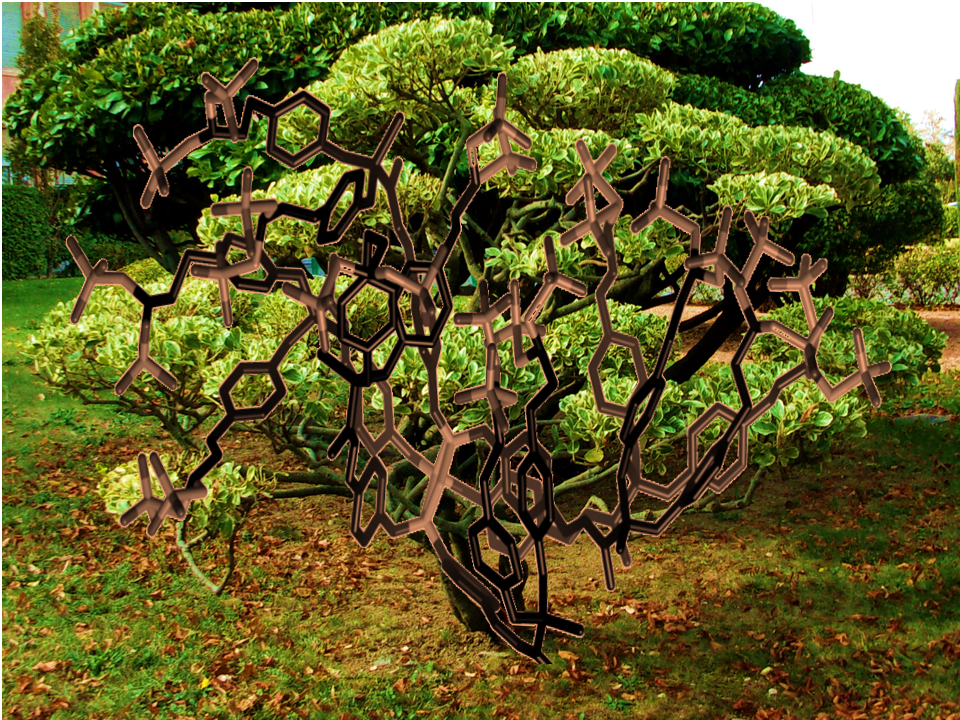
Les dendrimères sont des macromolécules hyper-ramifiées, synthétisées étape par étape, par la répétition de réactions quantitatives à partir d’un cœur multifonctionnel, pour donner des structures globalement sphériques, qui sont aussi appelées « arbres moléculaires ». Les dendrimères appartiennent à la fois au monde des polymères parce qu’ils sont constitués d’unités répétitives, au monde des macromolécules, et au nanomonde grâce à leur taille nanométrique. Du fait de leur structure hyper-ramifiée, les dendrimères ont un grand nombre de fonctions chimiques facilement accessibles puisque situées en surface, et donc aisément modifiables pour donner au dendrimère les propriétés souhaitées.
Les premières recherches se sont concentrées sur la synthèse, et ont permis de mettre au point les méthodes pour obtenir des dendrimères dont les plus connus sont les PAMAM (polyamidoamine), PPI (polypropylèneimine), P-Lys (poly L-lysine), CSi (polycarbosilane), PPH (polyphosphorhydrazone), et PBE (polybenzylether), ce dernier ayant surtout permis la synthèse de dendrons, qui sont comme une branche de dendrimère.
Les recherches actuelles se concentrent sur les utilisations des dendrimères (et dendrons), et elles sont nombreuses. On peut citer par exemple des utilisations dans le domaine de la catalyse, avec en particulier la récupération et réutilisation des catalyseurs dendritiques, ou les matériaux, avec des modifications à l’échelle nanométrique de leur surface par exemple pour en faire des capteurs, ou l’intégration des dendrimères dans des matériaux pour en modifier les propriétés. Mais le plus grand nombre de recherches actuelles concerne le domaine de la santé, avec des recherches contre les cancers, les maladies infectieuses, les maladies inflammatoires, etc… même s’il n’y a actuellement que peu d’essais cliniques avec des dendrimères.
Ce numéro spécial fait le point sur les avancées récentes dans le domaine des dendrimères, essentiellement sous la forme de mises au point sur les travaux de groupes travaillant dans le domaine, présentées par leurs auteurs.
 Pour ce numéro spécial 2025, je tiens à remercier Janine Cossy et Pierre Braunstein pour avoir accepté avec enthousiasme ma proposition, et Julien Desmarets pour son aide et conseils dans sa réalisation. Merci également à tous les auteurs et co-auteurs pour avoir accepté de participer à ce numéro spécial, en espérant qu’il sera une source d'inspiration pour ses lecteurs et lectrices.
Laboratoire de chimie de coordination (LCC) Toulouse