





 CC-BY 4.0
1. Introduction
According to the Food and Agriculture Organization (FAO) of the United Nations, global citrus production has reached record highs in recent years. In 2024, the total global production of citrus fruits was approximately 152.2 million metric tons [1]. Oranges account for the largest share, roughly 44.2% of total production (∼67.2 million tons), while tangerines, mandarins, clementines are the fastest-growing segment, accounting for roughly 34.2% (∼52 million tons). Lemons and limes account for approximately 15.2% (∼23.2 million tons) and finally grapefruits and pomelos contribute by 6.4% with ∼9.8 million tons [1].
While production volume is massive, it is subject to climatic volatility. However, the market value is growing steadily. The production volume compound annual growth rate (CAGR) (2018–2023) was approximately of 2.3%.
Citrus production is heavily concentrated in the Northern Hemisphere, specifically in Asia and the Americas. China accounts for 35% of total output and supplies 59% of global mandarin demand. Brazil constitutes 34% of the orange market, while India produces 22% of the global lemons.
These and other regions experience significant pollution resulting from inadequately managed citrus waste [2]. Indeed, the citrus processing industry (primarily for juice) generates massive amounts of waste. It is estimated that for every ton of citrus processed, roughly 500–600 kg of waste (wet weight) is generated. This equates to approximately 80–100 million metric tons of wet waste globally per year. This waste is generally categorized as citrus peel waste or citrus processing waste. The heterogeneous mixture of solid residues commonly referred to as pomace represents the main by-product of juice extraction. This pomace is primarily composed of peel, segment membranes, seeds, and pulp residues. The peel itself consists of two distinct layers: the outer colored skin, known as the flavedo, and the inner white spongy layer, called the albedo. The flavedo is particularly rich in essential oils, especially D-limonene, while the albedo contains significant amounts of pectin and structural polysaccharides. Together, these layers also contain valuable bioactive compounds such as flavonoids, including hesperidin and naringin.
In addition to the peel, the segment membranes (often referred to as the rag) form the fibrous network that holds the juice vesicles together. This fraction is characterized by a very high content in pectin and cellulose, making it structurally robust and particularly interesting for fiber and biopolymer recovery. Seeds constitute another important fraction of citrus waste. They are notable for their high oil content, commonly referred to as citrus seed oil, and for their significant protein levels. Seeds also contain limonoids, a class of bioactive compounds with recognized functional properties. The pulp or pulp wash residue, which remains after juice extraction and washing steps, consists mainly of fibrous material rich in structural carbohydrates.
From a chemical perspective, citrus waste is characterized by a high moisture content, typically ranging between 70% and 80%, which implies a substantial energy demand for drying if thermal valorization routes are considered [3]. In dried citrus peel samples, moisture content ranges from 5.34% to 23.31%, depending on drying methods and citrus species [4].
The organic fraction includes soluble sugars, such as glucose, fructose, and sucrose, generally representing about 10–15% of the total mass [5, 6]. In more detailed compositional analyses, dried citrus peels have been shown to contain significant sugar concentrations, with total soluble sugars ranging from 0.487 to 0.591 g per gram of dry weight biomass [5].
Dietary fibers, including cellulose, hemicellulose, and lignin, account for approximately 10–20% [6]. Compositional analysis of orange waste has revealed specific percentages: cellulose at 69.096%, hemicellulose at 9.015%, and lignin at 19.801% of the total dry matter [7]. These structural polysaccharides comprise the primary components of the citrus peel’s cell wall architecture and represent important substrates for biorefinery applications.
Pectin is a particularly valuable component, representing about 15–30% of the peel’s dry weight, and is widely used as a gelling agent in food and pharmaceutical applications [8]. Recent studies confirm pectin yields ranging from approximately 11% to over 34% under various extraction conditions, with optimal recoveries reaching up to 45% depending on extraction methodology and optimization of parameters [9].
Essential oils, predominantly D-limonene, are present at about 0.5–1.0% of the wet waste weight. Lemon peel oil contains approximately 1.5% essential oil by weight, while orange peel yields approximately 3.4%. The concentration of limonene varies considerably among citrus species, with orange peels typically containing higher levels—reaching 98% of the total essential oil composition. Although highly valuable for green chemistry applications, D-limonene is also highly flammable and can create operational and disposal challenges if not properly managed [10].
Finally, citrus residues contain phenolic compounds and flavonoids such as hesperidin and naringin, which exhibit antioxidant properties and enhance the potential for high-value biorefinery pathways [11]. Hesperidin and naringin are the predominant flavonoids in most citrus species, with hesperidin concentrations in citrus peels documented at levels ranging from 27 to 35 mg/kg, while naringin ranges from 26 to 36 mg/kg of dry peel material [12]. These bioactive compounds have demonstrated significant antioxidant, anti-inflammatory, and health-promoting properties, making them increasingly valuable for functional food development and nutraceutical applications [13].
Currently, much of this waste is dumped or used as low-value animal feed (due to high acidity and limonene, it can be toxic to livestock if not treated) [14]. Traditional disposal methods, such as incineration and landfilling, are costly and environmentally unsustainable, prompting the search for innovative valorization strategies [15]. Hydrothermal carbonization (HTC) has emerged as a particularly promising thermochemical process for converting high-moisture citrus residues into value-added products, including hydrochar, bio-oil, and platform chemicals, under subcritical water conditions (typically 180–300 °C) [14, 16, 17, 18].
Recent research has demonstrated the versatility of HTC for citrus waste, with process optimization studies highlighting the influence of reaction temperature, residence time, pH, and biomass-to-water ratio on product yields and quality. HTC also enables the recovery of limonene and other monoterpenes from orange peels, expanding the range of marketable coproducts [17]. The process is energy-efficient for wet biomass, eliminating the need for energy-intensive drying steps required by conventional thermochemical treatments [19].
Beyond fuel applications, hydrochars derived from citrus residues have shown promise as adsorbents for environmental remediation, such as dye and pharmaceutical removal from water, due to their high surface functionality and tunable porosity [20, 21]. Process water recirculation during HTC can further enhance carbon recovery and reduce water consumption, though it introduces new challenges related to the management and valorization of the aqueous phase [22, 23, 24]. Pilot-scale and industrial demonstrations have validated the technical feasibility of HTC for citrus waste, but upscaling remains constrained by reactor design, process water treatment, and economic considerations [25, 26, 27].
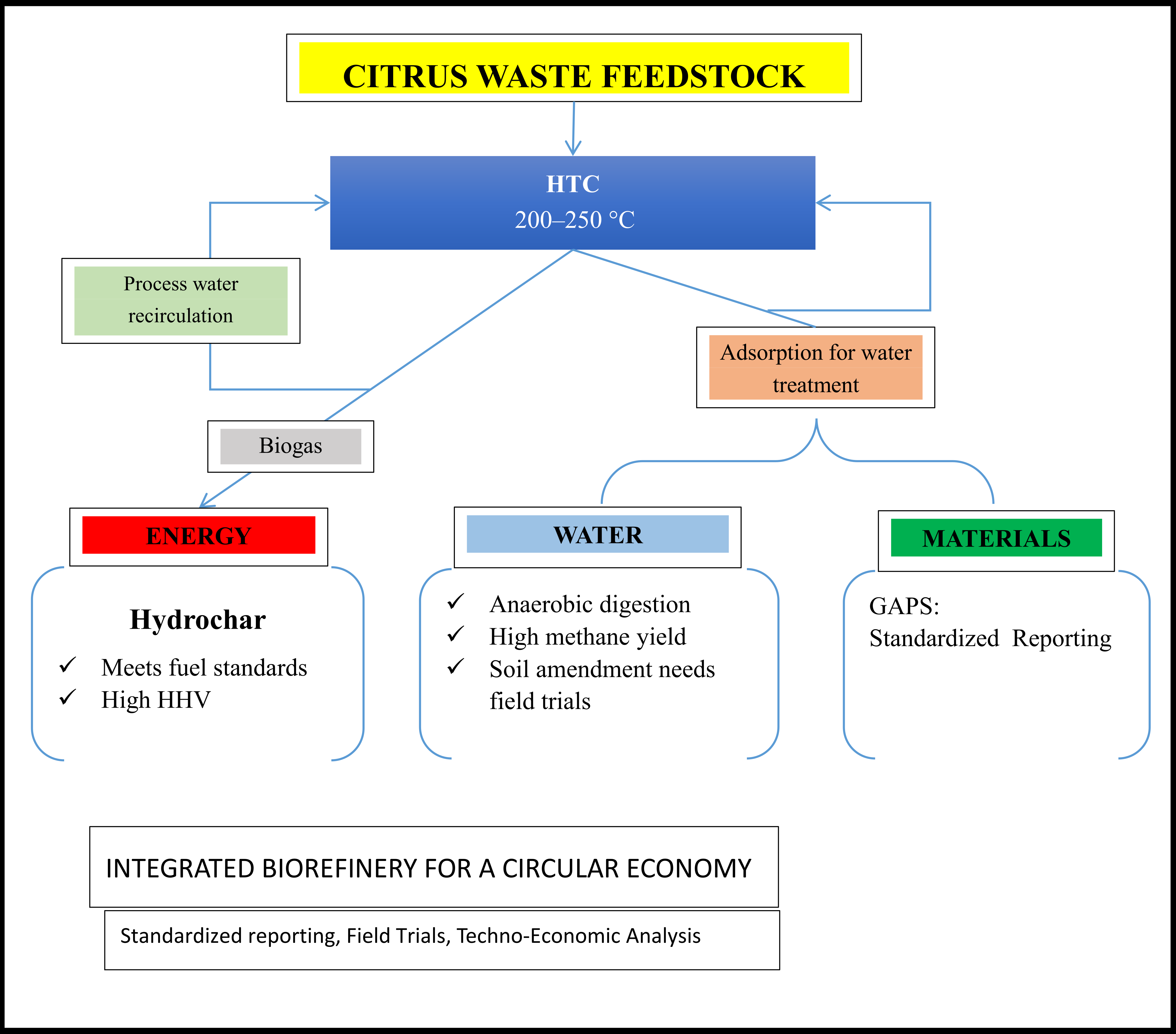
Since 2015, research has progressed from establishing fundamental feasibility to demonstrating applications at pilot scale [28]. This article consolidates evidence on the experimental real-world applications of HTC for citrus wastes, providing a quantitative benchmarking across different product streams and end-uses. It critically evaluates the readiness of each application domain, identifies persistent gaps, and offers a synthesis of operational parameters and citrus-specific attributes that influence process outcomes.
2. HTC process for citrus residues
2.1. Operating parameters
Reported operating conditions for citrus waste HTC (Table 1) generally align with canonical HTC ranges, with temperatures of 180–250 °C and residence times of approximately 1 h being common for adsorption and recirculation studies [20, 22]. Extended reaction times at moderate temperatures (e.g., 210 °C for 180 min) have been shown to maximize hydrochar yield in orange peel biorefinery contexts [14].
Reactor scale and operating modes
| Feedstock | Reactor/scale | Operating notes and | Ref. |
|---|---|---|---|
| Orange peels (with olive pomace comparative) | Continuous-flow pilot (TORWASH®) | Mild HTC; 28 days continuous operation (orange peel) | [29] |
| Lemon peel waste | Lab batch | PW recirculation; 180/220/250 °C, 60 min, 20 wt% solid loading | [22] |
| Orange peel (plus grape skin) | Lab batch | 180/220/250 °C, 1 h | [20] |
| Orange peel waste | Lab batch | 180–300 °C, 60–300 min | [14] |
| Orange pomace | Lab batch | Product characterization plus anaerobic digestibility of process liquor | [30] |
| Orange peel | Lab batch | 200 °C/2–16 h | [31] |
| Orange peel-derived hydrochar (urea-assisted) | Lab batch | Urea-assisted HTC, N-doping, KOH activation 600–800 °C | [32] |
| Orange peels | Lab batch | Thermal activation/chemical activation with phosphoric acid | [21] |
| Citrus waste HTC aqueous organics (bio-oil) | Pilot/bench AD reactor | High-loading hybrid anaerobic reactor | [33] |
| Orange juice | Lab batch + post-HTC activation and graphitization | 180 °C, 6 h, KOH activation at 800 °C/Graphitization | [34] |
The unique chemistry of citrus waste, characterized by high pectin, sugar, and acid content, specific ash composition (high K, Ca), and essential oils, accelerates the HTC reaction and distinctly shapes product distribution. Lower severity favors the formation of furans and organic acids in the process water (PW), while higher severity increases carbon densification but reduces mass yield and increases the organic load of the PW [14, 29].
The successful scale-up to continuous stirred/screw reactor systems (TORWASH®) over four weeks confirms the robustness of the process for orange peels, with dewatering and pelletization identified as integral downstream steps [29].
Ugolini et al. assessed industrial-scale HTC environmental impacts for orange peel among three wet residues and performed cradle-to-gate LCA (ReCiPe) with Monte Carlo sensitivity, comparing solid pellets and biogas outputs. While providing process-level LCA data, they reported impact categories (climate change, PM, acidification) [35].
2.2. Comparisons to alternative thermochemical routes
For high moisture citrus residues, HTC avoids pre-drying and produces hydrochars with improved hydrophobicity and handling relative to raw peels. By contrast, pyrolysis and torrefaction typically require pre-drying (10–20 MJ/kg moisture removal penalty) and yield chars with higher aromaticity but lower mass yields [36, 37, 38]. Activation processes further reduce solid yield while enhancing surface area (Tables 2 and 3).
Comparative performance of thermochemical processes for citrus peel waste (orange, lemon, grapefruit, tangerine)
| Process | Temperature (°C) | Mass yield (wt%) | Energy yield (%) | HHV (MJ/kg) | Ash content (wt%) | Feedstock moisture requirement | Ref. |
|---|---|---|---|---|---|---|---|
| HTC | 180–250 | 34–56 | 70–87 | 24.8–28.5 | 1.5–4.0 | 75–90% (wet process) | [14, 29, 39] |
| Slow Pyrolysis | 400–500 | 21–41 | 45–65 | 26.3–31.0 | 2.0–9.0 | <15% (requires drying) | [40 , 41 ] |
| Fast Pyrolysis | 450–550 | 27–33 | 35–50 | 25–29 | 2.5–8.0 | <10% (requires drying) | [42 ] |
| Torrefaction | 200–300 | 52–94 | 71–99 | 19.9–27.7 | 3.4–9.8 | <10% (requires drying) | [43 ] |
| Activation (KOH/H3PO4) | 400–800 | 10–30 | 20–40 | 28–32 | 1.0–5.0 | Pre-carbonization required | [42, 44] |
Energy yield calculations: standardized basis for citrus waste
| Process | Gross energy yield (%) | Net energy yield (%)a | Drying energy penalty (MJ/kg feedstock) | Ref. |
|---|---|---|---|---|
| HTC (220 °C, PW recirculation) | 85 | 80–82 | 0 (wet feed) | [22, 45] |
| HTC (250 °C, no recirculation) | 65–70 | 60–65 | 0 (wet feed) | [22, 29, 45] |
| Slow Pyrolysis (500 °C) | 45–55 | 35–45 | 3.2–3.8 | [40, 46] |
| Torrefaction (250 °C) | 90 | 55–65b | 3.2–3.8 | [46 , 47 ] |
| Fast Pyrolysis (500 °C) | 40–50 | 30–40 | 3.5–4.0 | [42] |
aNet energy yield accounts for process energy inputs and drying requirements.
bTorrefaction net yield assumes 80% initial moisture citrus peel requiring drying to <10%.
Pilot evidence shows that HTC can upgrade citrus ash behavior (reduced K/Cl, higher deformation temperature) to meet industrial pellet specs, which is an advantage for combustion readiness of citrus residues [29], whereas direct combustion or torrefaction of peels often faces slagging/fouling risks due to alkalis [48].
In Table 2, mass yield is the percentage of solid product (hydrochar) recovered after HTC relative to the initial dry mass of the feedstock (biomass/orange juice). The common formula (dry basis) used is:
| \begin {equation*} \mbox {mass yield } (\%) = \dfrac {\mbox {mass of dry hydrochar}}{\mbox {mass of dry feedstock}} \times 100 \end {equation*} |
Energy yield represents the percentage of the original energy content of the feedstock that is retained in the hydrochar after HTC. It combines the effects of mass loss and energy densification. The common formula is:
| \begin {equation*} \mbox {energy yield } (\%) = \mbox {mass yield} \times \dfrac {\mbox {HHV of hydrochar}}{\mbox {HHV of raw feedstock}} \end {equation*} |
Moreover, Catalkopru et al. [45] demonstrated that recirculating PW during HTC of orange pomace at 225 °C increased both mass and energy yields through accumulation of organic acids that catalyze dehydration and reduce solubilization of degradation products. Picone et al. reported that PW recirculation at 180 °C increased lemon peel hydrochar mass yield from 50.1% to 55.9% (first recirculation) and energy yield proportionally, reaching up to ∼85% energy retention in the solid phase. However, excessive recirculation can accumulate inhibitory compounds, creating a trade-off between yield and process stability [39].
For orange peel, the optimal temperature window is 180–220 °C. Below 180 °C, carbonization is incomplete; above 250 °C, excessive decarboxylation and dehydration reduce mass yields to 40–45% despite higher HHV. Satira et al. [14] found that 210 °C and 180 min residence time maximized orange peel hydrochar yield (30.1 wt% on wet basis, ∼55–60% on dry basis), while higher temperatures favored liquid product formation (5-HMF, furfural) over solid retention. Higher solid loading (e.g., 1:6 w/w orange peel:water) improves energy efficiency by reducing water heating requirements, though excessive loading (>1:4) can cause incomplete heat transfer and uneven carbonization. Acidic conditions (pH 3–4 using acetic or sulfuric acid) can increase hydrochar yields by 50% (from ∼20% to 30% for orange peel) by promoting hydrolysis of hemicellulose and pectin while inhibiting excessive degradation to soluble organics [14, 29].
In Table 3, gross energy yield represents the total chemical energy recovered in the solid fuel (hydrochar) relative to the energy originally present in the raw biomass. It accounts only for the energy content of the material itself, not the energy required to produce it.
It is calculated as:
| \begin {equation*} Y_{\mathrm {gross}} = \dfrac {M_{\mathrm {char}} \times \mathrm {HHV}_{\mathrm {char}}} {M_{\mathrm {raw}} \times \mbox {HHV}_{\mathrm {raw}}} \times 100 \end {equation*} |
Net energy yield subtracts the external energy consumed during the conversion process (electricity for reactors, heat for maintaining pressure, etc.) from the energy stored in the final product. A positive Net Yield means that the process produces more energy than it consumes (energy-positive) while a negative one means the process consumes more energy than the fuel it produces is worth (common in early-stage laboratory setups).
The drying energy penalty refers to the specific energy cost required to remove moisture from the material to make it a usable fuel. Because citrus peels are approximately 80% water, this is the hidden cost of the process. There are two stages where this penalty typically occurs: (i) pre-processing: drying raw peels before traditional thermal treatment, (ii) post-processing: drying the wet hydrochar after it comes out of a hydrothermal reactor.
3. Applications and product streams
The performance and applications of HTC outputs are detailed below and summarized in Tables 4–7. Indeed, hydrochar derived from citrus waste exhibits high surface area and porosity after activation and a richness in functional groups (carboxyl, hydroxyl, carbonyl), enhancing chemical reactivity. Tunability via HTC parameters (temperature, time, pH) allows control over morphology and surface chemistry.
Metal ion sensing applications (CD = carbon dot, LOD = limit of detection, NP = nanoparticle)
| Target analyte | Precursor material | Key features/Performance | Ref. |
|---|---|---|---|
| Fe3+/Fe speciation | Citrus-peel CDs/Grapefruit CDs | Bimodal (colorimetric + fluorescence); LOD 30–40 μg/L; pH-dependent selectivity | [50, 51, 52] |
| Hg2+ | Orange/Lemon-juice N-CDs | High selectivity; LOD ∼5.3 nM; biocompatible | [53 , 54 ] |
| Cd2+ | Citrus nobilis CDs | LOD 0.12 μg/mL; includes antibacterial activity | [55] |
| Ag+ | Mandarin-peel CDs | Detection via CD-mediated Ag-NP formation; LOD 0.6 μM | [56] |
| Cr6+ | Orange-pomace CDs | LOD 59.6 nM | [57] |
Sensing of organic pollutants, antibiotics, and biomolecules (CD = carbon dot, LOD = limit of detection, NP = nanoparticle)
| Category | Analyte | Precursor material | Performance/Range | Ref. |
|---|---|---|---|---|
| Antibiotics/Drugs | Oxytetracycline | Orange/watermelon peel | Range: 0.25–100 μM | [43 ] |
| Tetracycline | Lemon-peel CDs | LOD 50.4 nM | [44] | |
| Organic Pollutants | 4-nitrophenol | Orange-pomace CDs | LOD 14 nM | [42] |
| Tartrazine | Citrus-peel CDs | Detected alongside Fe3+ | [34] | |
| Biomolecules | Dopamine | Orange peel N-CDs | Linear up to 300 μM; ∼35% quantum yield | [49] |
| Ascorbic acid | Orange-peel carbon NPs | Coupled with Fe3+ detection | [36] |
Applications and performance proxies by product stream
| Product stream | Application type | Key performance proxies/results | Ref. |
|---|---|---|---|
| Hydrochar | Solid biofuel/pellets | Solid yield 31 wt% (orange peel), press cake dry matter 42%; HHV increased; ash reduced; pellets met industrial requirements | [29] |
| Hydrochar | Effect of PW recirculation on energy recovery | PW recirculation increased solid mass yield; strongest at 180 °C (∼6% increase); TOC concentrated in liquid across cycles | [23] |
| Hydrochar | Soil amendment | Clay soil physical property changes and phytotoxicity assessed | [31] |
| Hydrochar (activated) | Water treatment (dye, emerging contaminants) | Adsorption isotherms, kinetics, thermodynamics; pHPZC and surface functionalities linked to performance | [20, 21] |
| Porous carbon (post-HTC) | VOC/halogen sorption | High performance for toluene and iodine adsorption after urea-assisted HTC and activation | [32] |
| Porous carbon (post-HTC) | Energy storage materials | High specific surface area (1725 m2/g) and porous microspheres suitable for supercapacitor electrodes after KOH activation and graphitization | [34] |
| Aqueous phase | Biological valorization (AD) | COD removals >80% for citrus HTC liquid; methane yields near theoretical at 5 gCOD⋅L−1⋅d−1 | [30, 33] |
| Aqueous phase | Recirculation within HTC | Increased mass yield; autocatalytic benefits observed | [22] |
| Gas (non-condensable) | Internal use/venting | Predominantly CO2; LCA considers biogas co-product routes | [29, 35] |
Applications and readiness across domains
| Domain | Readiness indicators | Scale relevance |
|---|---|---|
| Energy (solid fuel, pellets) | Industrial pellet specs met; ash/K/Cl reduced [29]; PW recirculation enhances yield at low temperatures [22]; dual solid+chemical production tunable [14] |
Pilot continuous validation [29]; LCA industrial-scale modeling [35] |
| Water treatment/Sorption | High activation-derived capacities for VOCs/emerging contaminants; baseline hydrochar effective for cationic dyes; pHPZC control relevant [20, 21] |
Lab-scale characterization; post-HTC processing required for high performance |
| Soil/agriculture | Soil physical property changes; phytotoxicity tests; needs field-scale validation [31] | Lab-scale incubation/assays; actionable for pilot field trials |
| Aqueous phase valorization | PW recirculation boosts yield [22]; high AD performance [COD removal >80%; theoretical methane at high loadings [30]; digestibility of citrus HTC liquor characterized [33] |
Lab-scale HTC; bench/pilot AD reactor tested [33] |
| Materials/energy storage | High-surface-area porous carbons after activation; electrode suitability [34] | Lab-scale materials development |
The oxygenated surface chemistry of citrus hydrochar makes it suitable for electrochemical sensing (detection of heavy metals, organic pollutants, and biomolecules due to enhanced electron transfer), gas sensing (functionalized hydrochar can detect volatile organic compounds), and biosensing, as biocompatibility and functional groups enable immobilization of enzymes or biomolecules for selective detection [58]. Beyond sensing, hydrochar from citrus waste has demonstrated potential in energy storage (serving as electrode material in supercapacitors and batteries due to its porous structure and conductivity [59]), in environmental remediation (adsorption of dyes, heavy metals, and organic pollutants from wastewater), and in catalysis (acting as a support for metal nanoparticles in heterogeneous catalysis [60]).
3.1. Energy applications
The production of solid biofuels from citrus waste via HTC represents the most mature application domain, substantiated by robust quantitative benchmarking and successful scaling efforts.
Hydrochar from citrus wastes shows improved energy density, combustion reactivity, and hydrophobicity compared to raw biomass and torrefied products [14, 15, 30, 61]. For wet citrus wastes, HTC offers more than 50% energy savings over torrefaction [15].
Continuous operation of HTC systems has been successfully demonstrated, addressing crucial industrial scale-up challenges. Specifically, a continuous-flow pilot HTC system (TORWASH®) processed orange peels stably for 28 days, successfully translating batch performance to continuous operation. This pilot work included integral steps like dewatering the product to press cakes (achieving 42% dry matter) and subsequent pelletization [29]. The resulting hydrochar pellets consistently met industrial fuel specifications. Key improvements include an increased HHV and significantly enhanced ash quality. Citrus peels are typically prone to slagging and fouling risks during combustion due to high alkali content. In fact, the HTC process increases the ash deformation temperature by removing problematic elements like potassium (K) and chlorine (Cl). These elements form low-melting compounds (such as potassium silicates or chlorides) that drastically lower the deformation temperature. Reducing them makes the remaining ash (richer in higher-melting components like calcium, magnesium, or silica) more thermally stable.
The solid yield achieved during continuous operation was reported at 31 wt% on a dry basis. Furthermore, system-level sustainability is being established through LCA at the industrial scale, which supports the environmental framing for orange peel HTC to pellets and biogas, particularly providing reliable assessments for impacts related to climate change, particulate matter, and acidification [35].
3.2. Adsorption applications
Baseline citrus hydrochars, derived from orange peels, effectively adsorb cationic dyes. This performance is intrinsically linked to the hydrochar’s chemical properties, specifically its point of zero charge (pHPZC) and oxygenated surface functionalities [20, 21, 32].
For applications targeting diverse or complex pollutants, such as emerging contaminants or volatile organic compounds (VOCs) like toluene and iodine, post-HTC activation and modification are generally essential. Activation methods, including treatment with KOH or H3PO4, or N-doping (e.g., via urea assistance), substantially elevate performance, transforming the hydrochar into high-surface-area porous carbons. For example, KOH activation of orange-juice-derived hydrochar achieved specific surface areas up to 1725 m2/g and graphitized microspheres [34]. While activation is necessary for advanced markets, future work should clearly delineate the performance gains attributable to the canonical hydrochar versus the subsequent post-HTC processing.
3.3. Agricultural applications
As a soil amendment, orange peel hydrochar has been shown to modify the physical properties of clay soil. Hydrochar enriches soils with Ca, Mg, P, and can act as a slow-release fertilizer. Hydrochar addition improves soil water retention, nutrient retention, and reduces contaminant leaching [30, 62]. However, phytotoxicity screening remains a critical consideration. Enhanced water retention and nutrient availability support plant growth [62]. The presence of residual organics (e.g., essential oils or organic acids concentrated during HTC) necessitates rigorous quality assurance/quality control (QA/QC) and careful dosing management to define safe application windows before transitioning to field trials [31].
3.4. Synthesis of advanced materials
A major high-value application of hydrochar is its use as a precursor for advanced functional carbon materials. The chemical composition of citrus waste, particularly its high carbohydrate and pectin content, makes it highly suitable for producing hydrochar that can be further converted into engineered carbon materials with tailored properties.
By tuning HTC conditions, citrus-derived hydrochar can serve as an excellent carbon precursor for subsequent activation and graphitization processes. For instance, hydrochar obtained from orange juice was subjected to KOH activation followed by graphitization at 800 °C. This yielded porous carbon microspheres with a remarkably high specific surface area of up to 1725 m2/g [34]. These materials exhibited excellent characteristics for electrochemical double-layer capacitors (EDLCs), making them promising candidates for high-performance supercapacitor electrodes.
In addition to energy storage applications, citrus hydrochar has also been explored for the synthesis of carbon-based catalysts. For example, acid-treated orange peel hydrochar has been successfully applied in biodiesel production through esterification and transesterification reactions [14].
Furthermore, HTC conditions can be optimized for an integrated biorefinery approach, simultaneously producing hydrochar (as a solid precursor) and valuable platform chemicals such as 5-hydroxymethylfurfural (5-HMF), furfural, and levulinic acid in the PW. Moderate-to-severe conditions (e.g., 210 °C, 180 min) favor higher hydrochar yields, while milder conditions promote the formation of furanic compounds.
3.5. Functional carbon materials
Hydrochars derived from citrus wastes represent particularly attractive precursors for low-cost sensing and biosensing materials. Their relevance stems from three key attributes:
- rich and tunable surface chemistry, dominated by oxygenated functional groups (–COOH, –OH, C=O) inherited from the high sugar and pectin content of citrus biomass [21]
- heteroatom doping capability, especially nitrogen incorporation through urea-assisted hydrothermal carbonization (HTC) [32]
- adjustable porosity and conductivity, achieved via chemical activation (e.g., KOH, H3PO4) and post-thermal treatments [34].
These features, already well established in adsorption and energy-storage applications, can be directly translated into electrochemical, optical, and biosensing platforms.
3.5.1. Structure–property relationships in citrus-derived hydrochars
Under moderate HTC conditions, citrus hydrochars exhibit carboxyl-rich and highly oxygenated surfaces, which are particularly favorable for:
- metal ion coordination (e.g., Pb2+, Cd2+, Cu2+) through carboxylate and phenolic binding sites [28, 63]
- hydrogen bonding and π–π interactions with organic pollutants [64, 65]
- post-functionalization reactions (e.g., amination, polymer grafting) for sensor fabrication [66].
Increasing HTC severity decreases O/C and H/C ratios, enhances aromatic condensation, and improves electrical conductivity, although often at the expense of surface functional group density [19, 36, 37]. Achieving a balance between conductivity and surface reactivity is therefore critical for sensing performance. In citrus-based systems:
- Activated hydrochars from orange peels show strong affinity toward emerging contaminants due to their oxygenated surface chemistry [4].
- Urea-assisted porous carbons derived from orange peel demonstrate high adsorption capacities for toluene and iodine, highlighting the role of nitrogen doping in modulating surface interactions and electronic structure [67].
- KOH-activated carbons produced from orange-juice-derived hydrochar reach specific surface areas of approximately 1700 m2⋅g−1 with partially graphitized domains [14], providing high active-site density and improved charge transfer properties.
Microporosity enhances analyte pre-concentration, while meso-/macropores facilitate mass transport in thin films and electrode coatings both essential for sensitive detection.
3.5.2. Applications in sensing and biosensing
Citrus-derived hydrochars can serve as electrode coatings in voltammetric or amperometric systems. Their defect-rich domains promote electron transfer, while oxygen- and nitrogen-containing groups enable analyte pre-concentration. Nitrogen doping (e.g., via urea-assisted HTC) further improves conductivity and catalytic activity, enhancing heavy metal and pollutant detection [68, 69].
The strong adsorption capacity and tunable surface chemistry of citrus-derived carbons enable their use in both chemiresistive and optical sensing applications. High-surface-area activated carbons obtained from orange-juice hydrochar, thanks to their hierarchical pore structure and partial graphitization, are particularly promising for chemiresistive detection of volatile organic compounds (VOCs), where pollutant adsorption induces measurable changes in electrical resistance [70, 71].
Citrus hydrochars, especially those rich in carboxyl groups from pectin-containing residues, can serve as effective precursors for the synthesis of fluorescent carbon dots (CDs) through additional post-treatment. Nitrogen doping further improves their quantum yield and enables tunable emission. These CDs act as effective fluorescent probes for detecting metal ions and small organic molecules through fluorescence quenching or electron-transfer mechanisms [70, 71].
Overall, citrus waste–derived hydrochars provide a structurally and chemically versatile carbon platform. Their intrinsic oxygen-rich chemistry, controllable porosity, and potential for heteroatom doping position them as sustainable, low-cost materials for next-generation environmental sensing and biosensing applications.
3.6. Aqueous phase (process water)
The management and valorization of the process water (PW) generated during citrus HTC are critical for overall system efficiency and sustainability, especially given the high load of total organic carbon (TOC) and organic acids characteristic of citrus residues.
One successful operational strategy involves PW recirculation, which increases the solid mass yield of the hydrochar. For lemon peel HTC, recirculation achieved the largest increase in solid mass yield (up to 6%) at lower severity conditions (180 °C), demonstrating an autocatalytic benefit where accumulated organics accelerate the carbonization process. While recirculation enhances solid yield, it simultaneously concentrates TOC in the liquid, underscoring the necessity for downstream PW management or polishing [22].
Downstream biological valorization of citrus HTC liquors is highly feasible. HTC process water (aqueous phase) from orange pomace supports anaerobic digestion for methane/biogas generation [30]. Anaerobic digestion (AD) achieved COD removal efficiencies exceeding 80% at high volumetric loadings (5 gCOD⋅L−1⋅d−1) under mesophilic conditions. Methane yields approached theoretical limits, corroborating earlier findings regarding the digestibility of orange pomace HTC liquor. This robust performance validates the feasibility of integrating HTC–AD systems, even despite the recognized inhibitory risks posed by citrus terpenoids and organic acids [33].
3.7. Gas (non-condensable)
No peer-reviewed publication specifically reports the exact gas composition data for citrus hydrochar. However, the gaseous phase generated during HTC of citrus wastes represents a minor but chemically significant product stream. Unlike pyrolysis or gasification processes that operate at higher temperatures and produce substantial gas yields, HTC of citrus wastes probably generates gaseous products accounting for only 2–5% of the original biomass mass. The primary component of this gaseous fraction is carbon dioxide (CO2), which constitutes approximately 90–95% of the total gas volume, accompanied by minor quantities of hydrogen, methane, and light hydrocarbons [72, 73].
The dominance of CO2 in the gaseous phase results probably from the fundamental reaction mechanisms governing HTC. During the hydrothermal treatment of citrus peel wastes at temperatures ranging from 180 to 300 °C, extensive decarboxylation reactions occur as the biomass undergoes dehydration and structural rearrangement. These decarboxylation pathways release CO2 as citrus-derived compounds (including citric acid, pectin, cellulose, hemicellulose, essential oils such as limonene, etc.) undergo thermal decomposition in the subcritical water environment [29, 35].
The yield and composition of the gaseous phase from citrus waste HTC are strongly dependent on process conditions, particularly temperature and residence time. Research on orange peel waste demonstrates that increasing reaction time from 1 to 3 h at 180 °C progressively favors hydrochar formation while simultaneously increasing gas generation and decreasing bio-oil production [33]. This time-dependent shift in phase distribution indicates that extended residence times promote secondary reactions that convert liquid intermediates into gaseous products through further decarboxylation and cracking reactions.
Temperature elevation generally enhances gas production across all citrus waste types. Studies on lemon peel waste HTC conducted at 180, 220, and 250 °C revealed that higher temperatures accelerate the degradation of biomass macromolecules and promote the formation of organic acids, which subsequently undergo decarboxylation to generate additional gaseous products [22]. At 250 °C, the PW concentration of soluble organic compounds decreases as these species participate in polymerization reactions or convert to gas-phase products.
The initial pH and solid-to-liquid ratio also influence gas evolution during citrus waste HTC. Acidic conditions typical of citrus wastes (due to inherent citric acid content) catalyze hydrolysis reactions that release CO2 during the breakdown of pectin and hemicellulose structures. However, unlike other thermochemical processes, the solid-to-liquid ratio has been found to have insignificant effects on mass distribution between phases for citrus wastes.
Citrus wastes present unique characteristics that affect gaseous phase composition compared to other lignocellulosic feedstocks. The high moisture content (typically 80–96%) and distinctive chemical composition, rich in sugars, pectin, flavonoids, and D-limonene, create specific degradation pathways during HTC [33]. Limonene, a monoterpene abundant in citrus peels, poses particular challenges for conventional AD due to its antimicrobial properties; however, HTC effectively mitigates this inhibition by converting limonene into other compounds or releasing it into the gas phase [33].
The sugar-rich nature of certain citrus wastes (particularly grapefruits and oranges with high fructose/glucose content) can lead to anomalous mass yield trends with increasing temperature, as observed in comparative studies with other fruit wastes [74]. These carbohydrate-rich fractions may undergo Maillard reactions and caramelization, influencing the partitioning of carbon between solid, liquid, and gaseous phases.
While the gaseous fraction from citrus waste HTC is relatively small in mass yield, its composition has important implications for the energy balance and environmental footprint of the process. The high CO2 content makes this gas stream suitable for carbon capture and utilization applications, particularly in greenhouse agriculture, where citrus wastes are often generated. The minor hydrogen and methane fractions, though present in small quantities, indicate potential for integrating HTC with downstream AD of PWs to enhance overall biomethane production [14].
Recent research has explored the integration of citrus waste HTC with AD systems, where PW (containing dissolved organic matter from the HTC treatment) serves as a substrate for biomethane production. This hybrid approach addresses the challenges of inhibition by limonene in direct AD of citrus waste while maximizing energy recovery from both liquid and gaseous process streams [33].
4. Limitations and gaps to address
Despite the rapid expansion of the scientific literature on HTC of citrus residues, the translation of laboratory findings into robust, real-world industrial applications remains limited. While numerous studies demonstrate technical feasibility at bench scale, far fewer provide evidence from pilot units, demonstration facilities, on-site industrial trials, or field applications of HTC-derived products.
This section critically evaluates the current state of real-world HTC implementations for citrus wastes, with particular attention to four interrelated dimensions: (i) process- and system-level constraints, (ii) methodological and reporting shortcomings, (iii) product performance and application-specific limitations, and (iv) comparative and benchmarking deficiencies.
4.1. Process- and system-level constraints
Most studies that claim real-world relevance are still conducted at small pilot scale, over short operating campaigns, and under highly controlled feedstock and process conditions. Consequently, important operational uncertainties remain unresolved. Dang et al. provided a comprehensive overview of HTC research gaps, emphasizing the lack of long-duration pilot campaigns, methodological inconsistencies, and benchmarking deficiencies [16].
Indeed, a major limitation concerns the lack of long-duration operational data. Very few investigations report continuous HTC operation on citrus residues for periods exceeding three to six months [75]. As a result, critical industrial issues such as fouling, corrosion, and reactor plugging, particularly those associated with pectin, essential oils, and inorganic scaling, are not well quantified [76]. Maintenance requirements, downtime statistics, and reliability indicators are almost entirely absent from the literature. In the absence of such data, techno-economic analyses (TEAs) and LCAs frequently rely on assumed plant availabilities and uptime factors that may be overly optimistic.
Integration with existing citrus processing chains is also weakly addressed. Experimental studies rarely consider how HTC could be coupled with juice or essential oil extraction lines, for example by treating peel after oil recovery rather than raw peel [77, 78, 79]. Similarly, opportunities for heat cascading from existing boilers or combined heat and power (CHP) units to supply HTC thermal demand are seldom experimentally evaluated. On-site management and reuse of PW, whether in washing, cleaning, or irrigation, are also poorly documented. Consequently, many system-level studies effectively model HTC as a standalone facility, which may overestimate capital intensity while underestimating potential industrial synergies [79].
Scale-up correlations are another critical gap. Hydrodynamic and heat-transfer characteristics, such as mixing efficiency, heating rates, and residence time distributions, are rarely characterized at pilot scale. Scale-up is typically justified through geometric similarity and nominally identical operating conditions (temperature, residence time, solid loading), without accounting for differences in heating profiles, non-uniform residence times in continuous or semi-batch reactors, or altered reaction pathways [75]. This undermines confidence in the transferability of laboratory-derived yields and product properties to larger-scale systems.
Citrus residues are inherently heterogeneous and strongly seasonal, yet these aspects are insufficiently treated in real-world studies. Most investigations rely on a single, well-characterized feedstock and the influence of citrus species and varieties (e.g., orange versus lemon or mandarin), residue types (peel, pulp, seeds, whole pomace, mixed sludges), and pre-processing steps (limonene extraction, washing, enzymatic treatment) on HTC performance remains underexplored at pilot scale [14, 80].
Many studies provide HHV data and mass yields for hydrochar, yet fail to report actual thermal energy input, electrical consumption, or heat recovery efficiency at pilot scale. Consequently, reported energy yields often reflect only the feedstock-to-hydrochar conversion, excluding parasitic loads such as pressurization, pumping, agitation, and heat losses. This weakens the credibility of claims regarding net energy gains or reductions in greenhouse gas emission [33].
Management of PW is similarly underdeveloped. Citrus HTC liquors contain high concentrations of dissolved organics such as sugars, organic acids, phenolics, limonene derivatives, and inorganic species [45]. Although COD, BOD (biochemical oxygen demand), and ecotoxicity are sometimes characterized at laboratory scale, pilot-scale treatment trials (e.g., anaerobic digestion, stripping, advanced oxidation) remain rare [30]. For other wastes, some studies quantify water reuse within the HTC process or surrounding industrial operations, and comprehensive nutrient balances (N, P, K) across solid, liquid, and gaseous phases, but none is found for citrus waste. Water footprint indicators are entirely absent.
4.2. Methodological and reporting shortcomings
Substantial heterogeneity exists in experimental design, even among studies presenting pilot-scale relevance [81]. Operating conditions (temperature, residence time, and solid loading) vary widely, sometimes without clear justification or optimization. Critical parameters, such as heating and cooling rates, initial pH, and mixing intensity, are frequently omitted, despite their strong influence on the HTC of carbohydrate- and oil-rich citrus matrices [81]. Reaction pathway analysis and kinetic modeling are also limited [82].
Hydrochars and PWs derived from citrus HTC are often insufficiently characterized for real-world deployment. For fuel or soil applications, many studies report proximate and ultimate analyses alongside HHV values [83], but omit critical attributes such as ash composition and speciation, soluble versus insoluble salts, chlorine and sulfur content, heavy metals, organic micropollutants, leaching behavior, and mechanical properties (e.g., attrition resistance, pelletization performance). Without such data, compliance with fuel standards, soil amendment regulations, or adsorption media specifications cannot be reliably assessed [84, 85].
The liquid and gaseous phases are frequently treated as secondary by-products [22]. However, environmental assessment requires detailed speciation of dissolved organics, evaluation of biodegradability, and quantitative gas composition analysis (CO2, CH4, VOCs). The limited attention given to these streams risks underestimating both environmental constraints and valorization opportunities.
Replication at pilot scale is also rare due to cost and complexity, resulting in limited uncertainty analysis. Variability in yields and product properties is often underreported, and the sensitivity of results to operational fluctuations is poorly understood [16]. Furthermore, raw data, such as full mass balances, or energy and water flow, are seldom made publicly available. This restricts reproducibility and hinders meta-analysis and cross-study benchmarking.
4.3. Application-specific limitations
Citrus-derived hydrochars often exhibit elevated ash content and potentially problematic ash chemistry, including alkali metals and chlorine [21]. Empirical studies of slagging, fouling, and deposit formation in industrial boilers are extremely limited [74]. Most fuel suitability discussions rely on theoretical indices rather than operational trials. Co-firing limits in coal or biomass blends remain largely speculative [41]. Regulatory and market barriers are also insufficiently explored. Compliance with solid recovered fuel (SRF) or biofuel standards is nowhere explicitly tested, and issues such as certification routes, off-taker requirements, and pricing structures receive no attention.
Although many studies propose hydrochars as adsorbents, most tests are conducted in simplified single-solute systems [74], but cost per unit of pollutant removed is almost never calculated. Besides, competitive adsorption in realistic matrices (industrial effluents, landfill leachate, agricultural runoff) has not been investigated yet, nor has the regeneration performance or the disposal pathways for spent hydrochar.
Field trials assessing soil amendment performance are minimal. Most available data derive from short-term pot experiments under controlled conditions [31, 62]. Long-term impacts on soil structure, microbial communities, nutrient cycling, and crop yield remain uncertain. Potential negative effects, such as phytotoxic residues, salinity, or limonene-derived suppression of soil biota, are poorly addressed. Claims regarding carbon sequestration frequently extrapolate from short laboratory incubations or general biochar literature [28], without examining the specific chemical structure and stability of citrus HTC chars under field conditions.
Citrus residues are distinguished by their high essential oil and limonene content. Yet few pilot-scale studies quantify how residual oils influence reaction kinetics, product distribution, emulsification phenomena, or fouling in piping and heat exchangers. Integration of HTC with prior oil extraction remains largely conceptual [16, 60].
Acidity presents another challenge. Organic acids formed during HTC can intensify corrosion under high-temperature, high-pressure conditions. However, systematic material compatibility studies under citrus-specific HTC liquors are largely absent, leaving reactor material selection insufficiently justified.
4.4. Quantitative benchmarking deficiencies
A central limitation across the literature is the absence of standardized quantitative benchmarking frameworks, both within citrus HTC and in comparison with alternative valorization routes.
Studies employ diverse metrics (mass yield, energy yield, carbon yield, energy densification ratio, exergy efficiency) often calculated on different bases (wet versus dry feedstock, per unit feed versus per unit product) and with partial system boundaries that exclude parasitic loads. This makes cross-comparison between pilot units or technologies difficult.
Economic and environmental key performance indicators (KPIs) are frequently missing. Few studies report cost per tonne of citrus waste treated, cost per unit of functional output, or greenhouse gas emissions per tonne processed with clearly defined boundaries. When LCAs are conducted, methodological assumptions vary considerably and are seldom aligned with emerging guidelines for biochar and biomass HTC systems [86]. Cavali et al. point out that much of the HTC economic literature relies on simplistic payback or cost assumptions (fixed char price), and that few TEAs incorporate realistic heat integration, logistics, and multi-product allocation [87].
HTC is often compared only with landfilling or incineration, while alternative routes, such as anaerobic digestion, composting, direct combustion, pyrolysis, or torrefaction, are not assessed under consistent system boundaries and functional units [27, 77]. Multi-criteria decision analyses integrating economic, environmental, and social indicators are rare. Consequently, claims that HTC is optimal or promising are seldom supported by robust, quantitatively benchmarked trade-off analyses.
5. Conclusion
HTC offers a sustainable and flexible platform for the valorization of citrus processing waste, with ongoing research focused on optimizing operational parameters, expanding end-use applications, and overcoming scale-up and environmental challenges.
More precisely, the field has progressed from demonstrating feasibility and adsorption proxies to operational strategies for process water and continuous fuel production, with sustainability lenses now applied.
To enable the transition from promising experimental studies to robust real-world implementation, several priority research directions emerge. Long-duration pilot and demonstration campaigns should be conducted under realistic feedstock conditions, with complete mass and energy balances, systematic monitoring of fouling and corrosion, and transparent reporting of downtimes and failures.
Standardized reporting protocols and harmonized performance metrics are needed to enable meta-analysis and benchmarking. Integrated process configurations, combining oil extraction, HTC, and downstream water or biogas treatment, should be experimentally validated under industrial constraints.
Application-focused qualification is essential, including boiler and combined heat and power (CHP) trials with emission monitoring, multi-solute adsorption tests with regeneration cycles, and multi-year field studies evaluating agronomic performance and carbon sequestration. Finally, comparative assessments using consistent TEA and LCA frameworks, region-specific data, and decision-support tools should guide stakeholders in determining when HTC represents a genuinely preferable option relative to competing technologies.
Collectively, addressing these gaps is crucial for advancing citrus waste HTC from technically promising yet often idealized case studies toward robust, quantitatively benchmarked, and regionally optimized real-world valorization pathways.
Declaration of interests
The authors do not work for, advise, own shares in, or receive funds from any organization that could benefit from this article, and have declared no affiliations other than their research organizations.